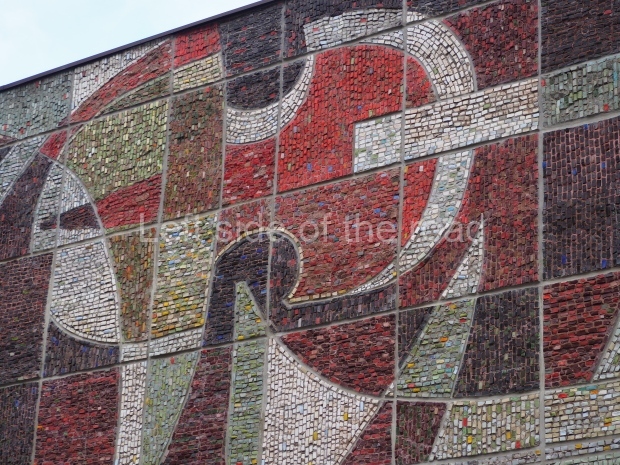
Workers’ Meeting
More on China …..
Art, Literature, Music and Culture in Socialist China
Culture and Education in New China, includes Report on Cultural and Educational Work by Kuo Mo-jo and six other reports, 110 pages. (Peking: FLP, n.d. [but either late 1950 or early 1951]).
China’s New Literature and Art, Chou Yang, FLP, Peking, 1954, 162 pages. (Later on, during the GPCR, Chou Yang himself became a target of the revolution.)
Folk arts of New China, FLP, Peking, 1954, 93 pages.
To Trumpet Bourgeois Literature and Art is to Restore Capitalism — A Repudiation of Chou Yang’s Reactionary Fallacy Adulating the ‘Renaissance’, the ‘Enlightenment’ and ‘Critical Realism’ of the Bourgeoisie, by the Shanghai Writing Group for Revolutionary Mass Criticism, (Peking: FLP, 1971), 53 pages.
Chinese for beginners, FLP, Peking, 1976, 201 pages.
A Glance at China’s Culture, by Chai Pien, 106 pages. (Peking: FLP, 1975).
Painting
Selection of Artistic Works by Shanghai Workers, Shanghai People’s Publishing House, 1974, 91 pages. A wonderful collection of paintings, with captions in Chinese.
Shanghai workers’ art selection, a collection of a couple hundred wonderful Chinese political paintings from the later stage of the Cultural Revolution. (Peking: 1975), 110 pages.
Peasant Paintings from Huhsien County, compiled by the Fine Arts Collection Section of the Cultural Group under the State Council of the People’s Republic of China, as exhibited in Peking in 1973. (Peking: People’s Fine Arts Publishing House, 1976), 85 pages.
Graphic Art by Workers in Shanghai, Yangchuan and Luta, FLP, Peking, 1976, 83 pages.
An article about these paintings appeared in China Reconstructs magazine, Jan. 1974, pp. 17-20
Wood Cuts and Paper Cuts
Chinese paper cuts, supplement to China Reconstructs, No. 12, 1955, 24 pages.
The East is Red: Paper Cuts of the Chinese Revolution, with text by Lincoln Bergman and paper cuts by members of a People’s Commune in Fatshan, 56 pages. (San Francisco: People’s Press, 1972)
Papercuts – Tigers, n.d. (probably from the 1970s), in color, 7 pages.
Papercuts – Karst Landscape, n.d. (probably from the 1970s), in color, 4 pages.
Papercuts – A Cock Crows at Midnight, n.d. (probably from the 1970s), in black, 8 pages.
Papercuts – Table Tennis, n.d. (probably from the 1970s), in red, 8 pages.
Papercuts – Collective Farm, n.d. (probably from the 1970s), in red, 8 pages.
Papercuts – Sword Training, n.d. (probably from the 1970s), in red, 10 pages.
Bookmarks – with fish and bird images, n.d. (probably from the 1970s), in colour, 9 pages.
Sculpture
Rent Collection Courtyard: Sculptures of Oppression and Revolt, probably the most famous set of works of art in China in the Maoist era. This is a great collection of photographs of these wonderful and emotionally powerful sculptures. (Peking: FLP, 1968), 88 pages.
Introduction to Rent Collection Courtyard, a small pamphlet that accompanied the ‘strip’ version of the sculptures. (Peking: FLP, 1968) 19 pages.
Wrath of the Serfs: A Group of Life-sized Clay Sculptures, powerful scenes of figures showing the pre-revolutionary Tibetan system of exploitation. (Peking: FLP, 1976), 88 pages. (Partial scanner distortion on sheet 17.)
A discussion of this exhibit appeared in Chinese Literature magazine, February 1976, pp. 109-117.
Graphic Histories and Literature (Picture-Stories)
The Old Messenger, by Chun Ching, drawings by Ting Pin-tseng. (Peking: FLP, 1956), 72 pages.
Immortal Hero Yang Ken-sze, story by Wang Hao about a real-life hero in the Chinese People’s Volunteers in the Korean War. Drawings by Ho Yu-chih. (Peking: FLP, 1965), 3rd ed., 140 pages.
Red Women’s Detachment, picture-story by Liang Hsin about the slave girl Chiung-hua on Hainan Island in 1930 who escapes and joins the Red Army. Drawings by Li Tzu-shun. (Peking: FLP, 1966), 148 pages.
Tunnel Warfare, picture-story adapted by Che Mei and Pi Lei about the clever tactics of the masses and people’s militia in Hopei Province during China’s War of Resistance Against Japan (1937-1945). (Peking: FLP, 1972), 164 pages.
Norman Bethune in China, a wonderful, inspiring work featuring fine ink drawings on every page. The adaptation is by Chung Chih-cheng, and the illustrations are by Hsu Jung-chu, Hsu Yung, Ku Lien-tang and Wang Yi-sheng. (Peking: FLP, 1975), 124 pages.
Storms on the Chinkiang Docks, a story of a struggle on the docks during the revolutionary war. Illustrations by Hu Po-tsung and Wang Meng-chi. (Peking: FLP, 1975), 88 pages.
Flying Eagle Cliff, adapted by the Kwangtung People’s Publishing House, drawings by Kuang Ming-yin, Tso Yi, Liu Wei-hsiung and Chung Hsien-chang. It is not clear if there is a historical basis to this story, or if it is just literature. Either way, it is a fine and moving story which is especially good at bringing out that the Communists can’t do what the masses must do themselves; to arrest the class enemies before the masses are aroused would be useless. (Peking: FLP, 1975), 164 pages.
Selections of Afro-Asian People’s Anti-Imperialist Caricatures, Afro-Asian Journalists’ Association, Peking, 1967, 196 pages.
Literature
The sun shines over the Sankgan River, Ting Ling, Stalin Prize 1951, FLP, Peking, 1954, 346 pages.
The Hurricane, Chou Li-po, Stalin Prize 1951, FLP, Peking, 1955, 409 pages.
A Brief History of Chinese Fiction, by Lu Hsun. (Peking: FLP, 1964), 2nd edition, 524 pages.
Lu Hsun – Great Revolutionary, Thinker and Writer, a loose-leaf collection of color paintings, (FLP: 1975), 36 pages. English:
Selected Works of Lu Hsun, Vol. 1, (Peking: FLP, 1956), 488 pages.
Selected Works of Lu Hsun, Vol. 2, (Peking: FLP, 1957), 378 pages.
Selected Works of Lu Hsun, Vol. 3, (Peking: FLP, 1964), 358 pages.
Selected Works of Lu Hsun, Vol. 4, (Peking: FLP, 1960), 326 pages.
Selected Stories of Lu Hsun, by Lu Hsun. (Peking: FLP, 1972), 282 pages.
Old Tales Retold, by Lu Hsun. A collection of 8 tales from 1922-1935. (Peking: FLP, 1972), 150 pages.
The True Story of Ah Q, by Lu Hsun. Probably his most famous work. (Peking: FLP, 1972), 5th edition, 82 pages.
Dawn Blossoms Plucked At Dusk, by Lu Hsun, a collection of essays written in 1926 and first published in 1928. (Peking: FLP, 1976), 138 pages.
Wall of Bronze, by Liu Ching, a novel of the War of Liberation. (Peking: FLP, 1954), 300 pages.
The Unquenchable Spark, FLP, Peking, 1963, 153 pages. The stories in this volume are selected and translated from the fourth volume of ‘The spark that started the prairie fire’, a collection of reminiscences of the Chinese Revolution, published in June 1961by the People’s Literature Publishing Houses, Peking.
The Builders, by Liu Ching, a novel about the struggles over mutual aid, co-operatives, and socialist collectivization in the Chinese countryside. (Peking: FLP, 1964), 588 pages.
Wild Bull Village, Chinese short stories, Ai Wu and others. FLP, Peking, 1965, 108 pages.
The Man Who Sold a Ghost: Chinese Tales of the 3rd-6th Centuries. (Peking: FLP, 1958), 190 pages.
The Battle of Sangkumryung, by Lu Chu-kuo. Novel about a major battle won by Chinese People’s Volunteers in Korea. (Peking: FLP, 1961), 176 pages.
The Seeds and Other Stories, 14 stories by mostly young writers written during the Cultural Revolution. (Peking: FLP, 1972), 204 pages.
City Cousin and Other Stories, 8 stories, mostly by amateurs, about life in China at this time. (Peking: FLP, 1972), 204 pages. [3,685 KB]
Bright Clouds, by Hao Jan, 8 short stories. (Peking: FLP, 1974), 162 pages.
Yenan Seeds and Other Stories, 6 short stories by various writers. (Peking: FLP, 1976), 156 pages.
The Making of a Peasant Doctor, by Yang Hsiao, a novel. (Peking: FLP, 1976), 228 pages.
The Golden Road, Hao Ran, a story of one village in the uncertain days after land reform, first published in Chinese in 1972, (Beijing: FLP, 1981), 408 pages.
Poetry
Mao Tse-tung Poems, by Mao Tse-tung. (Peking: FLP, 1976), 1st edition, 72 pages.
Wild Grass, all 23 prose poems of Lu Xun which were written in 1924-26. (Peking: FLP, 1974), 82 pages.
Mountains Crimsoned with Flowers, by Li Ying, 16 poems. (Peking: FLP, 1974), 44 pages.
Battle of the Hsisha Archipelago (Reportage in Verse), by Chang Yung-mei (Peking: FLP, 1975), 50 pages.
Music
Songs and Dances of the Chinese Youth, (Peking: FLP, 1959), 62 pages.
Historical Revolutionary Songs, (Peking: FLP, 1971), 28 pages.
Theatre and Film
On Stanislavsky’s ‘System’, by the Shanghai Revolutionary Mass Criticism Writing Group, (Peking: FLP, 1969), small pamphlet format, 47 pages.
A Vicious Motive, Despicable Tricks – A Criticism of M. Antonioni’s Anti-China Film China, by Renmin Ribao Commentator, Jan. 30, 1974. (Peking: FLP, 1974), 23 pages.
Opera
On the Revolution of Peking Opera, by Chiang Ching [Jiang Qing] and others, (Peking: FLP, 1968), 76 pages. Chiang Ching’s speech only (7 pages).
Red Detachment of Women. This is the most famous of all the model revolutionary Peking Operas created during the Mao era in China. It depicts the liberation of a peasant girl in Hainan Island and her role in the Chinese Communist Party. It is adapted from the original novel based on the true stories of the all-female Special Company of the 2nd Independent Division of the Chinese Red Army, first formed in May 1931.
Video: (in Chinese) Part 1 [54:51 minutes]; Part 2 [45:29 minutes];
The Red Lantern, a model Peking Opera on a contemporary revolutionary theme.
The Red Lantern: May 1970 Script, Hsinhua News Service, Aug. 6, 1970, 18 double pages in teletype font.
Shachiapang, a model Peking Opera on a contemporary revolutionary theme.
The Story of the Modern Peking Opera Shachiapang, illustrated with drawings, 52 pages. (Peking: FLP, 1972).
Shachiapang – Model Peking Opera on Contemporary Revolutionary Theme, screen play with photographs. (Colombo, Ceylon: Afro-Asian Writers’ Bureau, 1967), 86 pages.
Taking Tiger Mountain by Strategy. This is one of the 8 model works of revolutionary Peking Opera created during the Mao era. It is based on an actual event that took place in 1946 during the Chinese Civil War. A young communist reconnaissance team soldier, Yang Zirong, disguised himself as a bandit to infiltrate a local gang, eventually helping the main revolutionary force to destroy the band.
Video: (in Chinese) Taking Tiger Mountain by Strategy [1 hour, 58 minutes]
Libretto [Script] in English, October 1969, issued by Hsinhua News Agency (June 20, 1970), 22 double pages.
Miscellaneous Arts
Suzhou Embroidery, a fine hard-cover volume in Chinese with some beautiful examples of art from the Cultural Revolution era. (Shanghai: 1976), 78 pages.
Bookmarks in the shape of leaves with frog designs, non-political but artistically appealing bookmarks from China, probably from the 1970s, 7 pages.
Acrobatics and Sports
Chinese Acrobatics, photo book with introduction and captions in English, French and Swahili, (Peking: FLP, 1974), 126 pages.
Tourism
The West Lake Companion, about the famous tourist area in Hangzhou [Hangchow], 104 pages. (Peking: FLP, 1958).
Mount Omei, about Mount Omei (or Emei) in Sichuan Province. This is a collection of black and white photographs prepared by the Szechwan Provincial Art Gallery, with captions in Chinese, Russian and English, Szechwan People’s Publishing House, 1959, 30 pages.
More on China …..