No to Nuclear War mosaic – Chișinău – Moldova

No to nuclear war

No to nuclear war

More on Moldova – on the Post-Socialist Countries – Eastern Europe and Asia page

Soviet-era mosaics in Cahul – Gagauzia

Soviet Mosaics – Bălți – Moldova

VI Lenin and Palace of Culture Mosaic – Ribniţa – Pridnestrovie
No to Nuclear War mosaic – Chișinău – Moldova

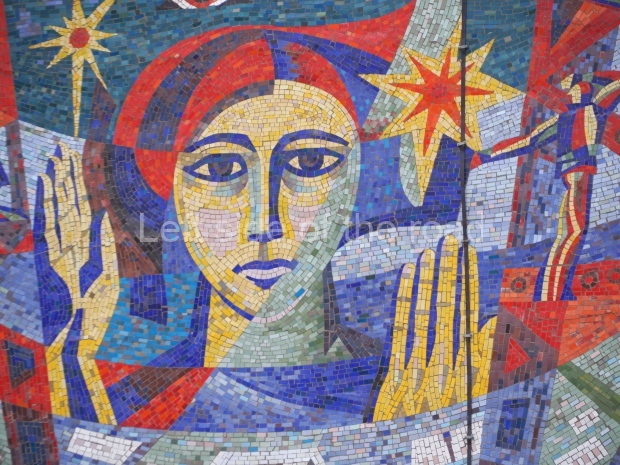
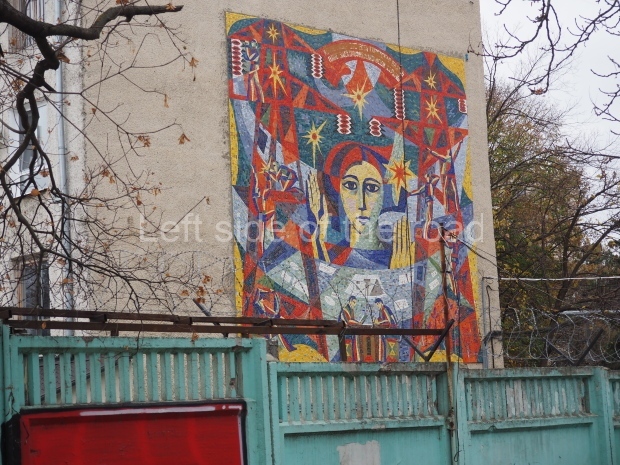
Unfortunately I have no information about this mosaic (artist or date) but it’s self explanatory as being an anti-war, specifically anti-nuclear war, declaration. However, it does seem to be tucked away, especially now that the trees in the gardens of the flats have grown so tall and effectively block any view other than when right next to the fence of the factory premises.

My assumption is that the factory and the apartment blocks were constructed at, more or less, the same time and the mosaic was saying something to the new tenants of the flats.

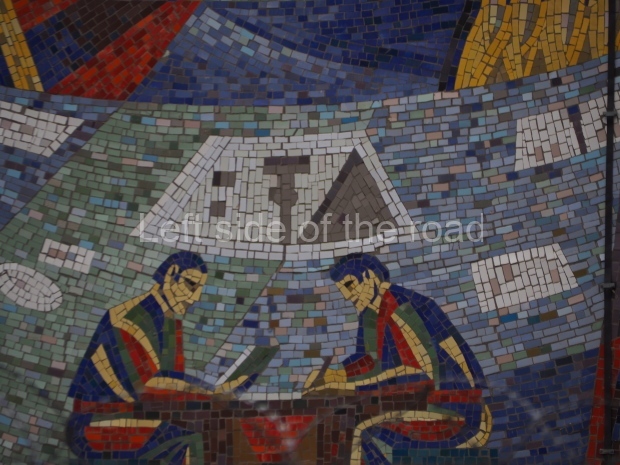
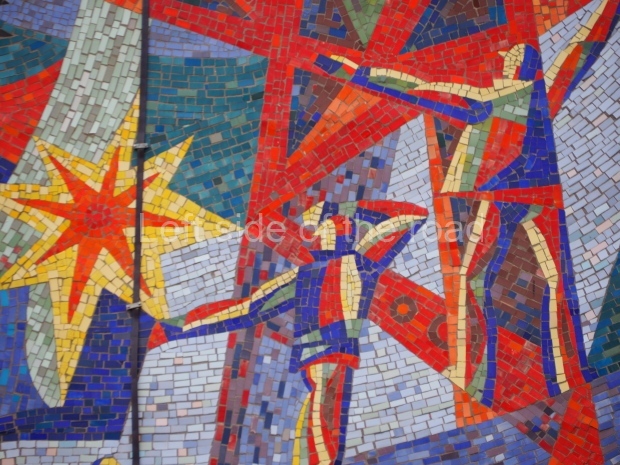
The image is simple and in that way more effective. Two, large disembodied hands just break in half a nuclear missile with one word above the image – НЕТ! = No! The exclamation mark making it a demand.

Although it appears in a good physical condition it has been subjected to mindless vandalism by the (relatively recent) installation of a new drain pipe. I can see no reason why the down spout had to be placed right in the middle of the mosaic – other than some capitalist shit making a statement. I’m still getting to understand the official status of Moldovan mosaics and know that some are considered part of the country’s artistic heritage – but this isn’t the case in all situations. Ownership of the property seems to be the main determining factor for any such registration. Private owners, i.e., those who stole public property under the guise of ‘privatisation’, seem to have a carte blanche when it comes to the preservation (or otherwise) of these Soviet-era public works of art. Whatever the legal situation the mosaic might have been vandalised but at least it hasn’t been destroyed.

As, at least at present (early 2026), those in political control of the country are bending over backwards to ingratiate themselves with the European Union bureaucrats they won’t agree with the sentiments expressed by this image. This might place the mosaic in some sort of threat as if the government wants to spend more money on armaments such an image is in opposition to such a political direction.

The ‘West’ – its politicians and its propagandist press organisations – have always tried to paint the Socialist countries as aggressive and a threat to ‘western values’. If that’s the case why do you find public art such as this anti-Nuclear War mosaic all over the post-Socialist countries yet not one officially sanctioned and paid for by the government can be found in the ‘peace loving’ countries of the west? Any ‘monuments’ against any future wars are always installed by anti- war organisations and not the State.

Artist;

Unknown

Created;

Unknown

Location;

Albisoara St 64

The mosaic is on the side wall at the northern end of the of the Viitorul furniture factory, hidden from the main road by trees but an informal footpath into the housing estate takes you past it.

GPS;

47.03576 N

28.84260 E

How to get there;

Trolleybus No. 38 goes along Albisoara St. The mosaic is on the side wall of a furniture factory (don’t know for certain if it is still functioning as such). It’s right next to a housing estate and when the gardens of the estate end and the factory buildings start that is where you will find the mosaic. The path that goes along this wall is at 90º to the main road. Will be hidden by the trees if outside of the winter.

More on Moldova – on the Post-Socialist Countries – Eastern Europe and Asia page

Soviet-era mosaics in Cahul – Gagauzia

Soviet Mosaics – Bălți – Moldova

VI Lenin and Palace of Culture Mosaic – Ribniţa – Pridnestrovie
Electrification mosaic – Chișinău – Moldova

Electrification

Electrification

More on Moldova – on the Post-Socialist Countries – Eastern Europe and Asia page

Soviet-era mosaics in Cahul – Gagauzia

Soviet Mosaics – Bălți – Moldova

VI Lenin and Palace of Culture Mosaic – Ribniţa – Pridnestrovie
Electrification mosaic – Chișinău – Moldova

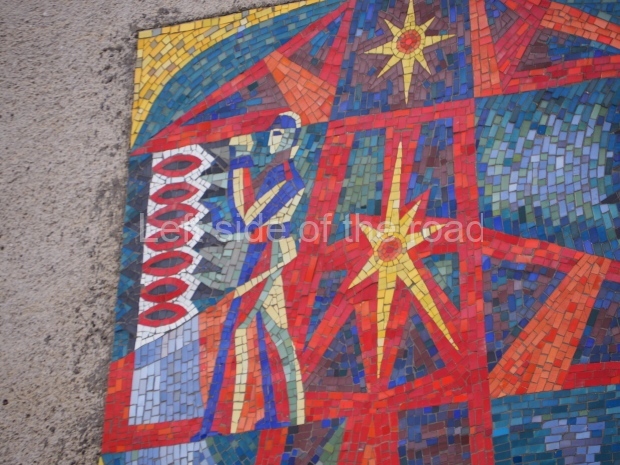
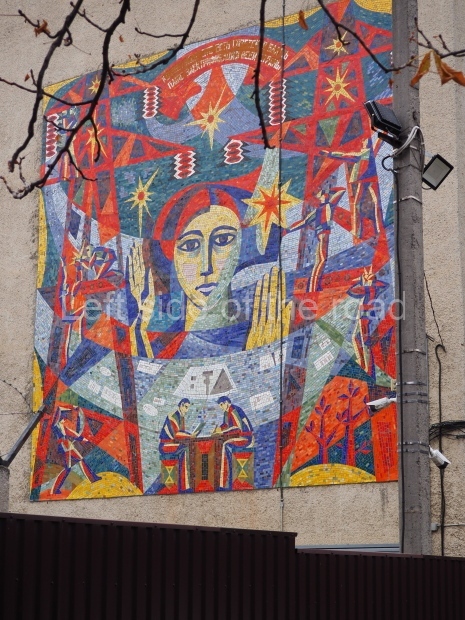
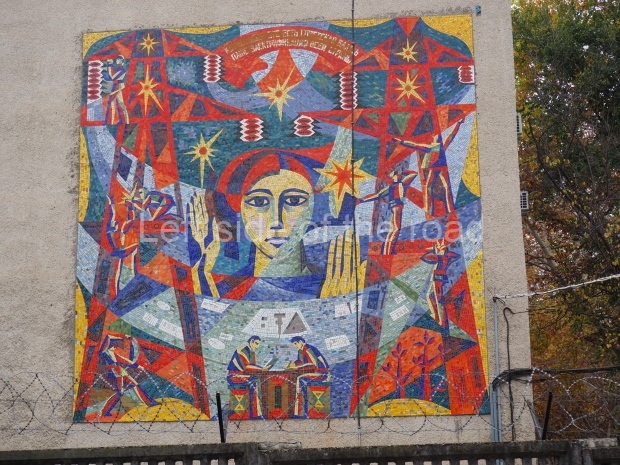
Known as ‘Electrification’ this mosaic covers the whole of the western end of the building. As far as I can tell the reason the mosaic was installed in this location was due to the fact this was originally a factory making electrical components. The building has since been re-purposed.

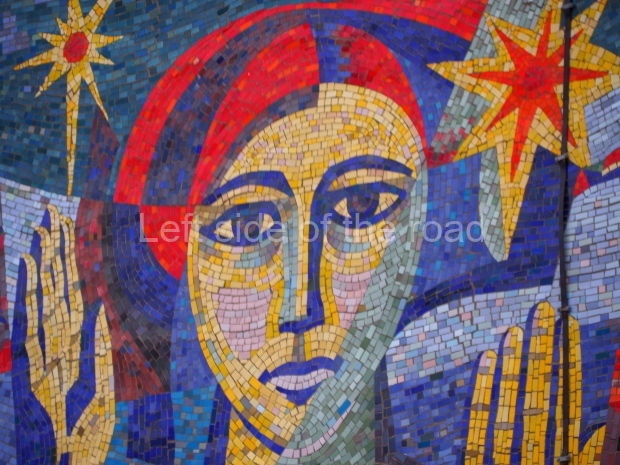
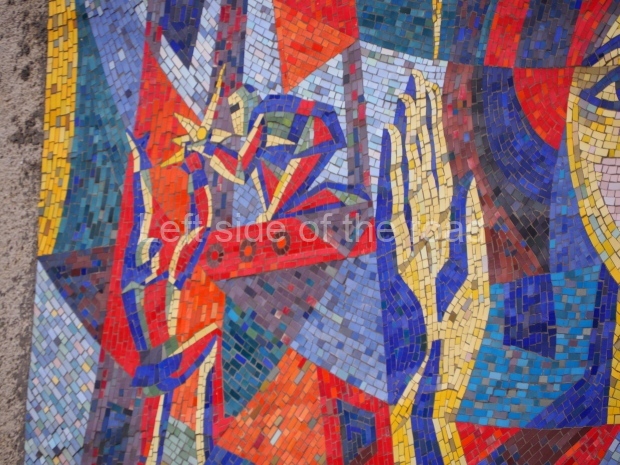
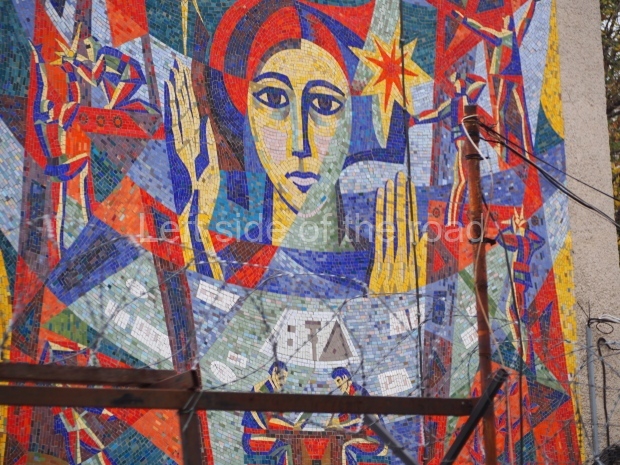
This is a very symmetrical mosaic with the principal focal point being the large image of a female face right in the centre. In Socialist Realist art the female face represented progress and the collective effort towards industrialisation. Central to this struggle to bring the backward country of Russia, inherited by the Russian Revolution, was the electrification of the country – as set out by VI Lenin in his speech to the Congress of Soviets in 1920 (see below). This was just an extension of the artist depiction of women. In the Soviet society they were active participants in the construction of Socialism (in both town and country) and their depiction in artist works integrated femininity with themes of modernity and technological advance. Here both her hands are raised to shoulder level and it appears that the power, the energy, the electricity is emanating from her finger tips.

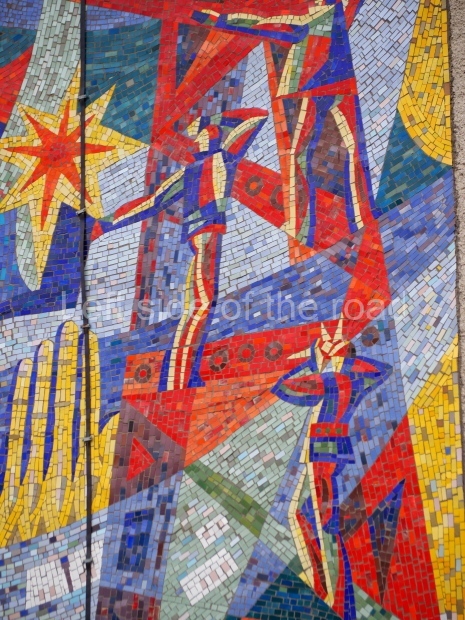
On both sides of the mosaic, and taking up the whole height and a third each of the width, are two large, red pylons. The pylon represented both the promise of electricity to all the country but also the enormity of the task of bringing electricity to all the people in a country that covered a sixth of the world’s land mass. This achievement was a visible difference from the old, Tsarist and feudal society in which the working masses were the last to see, if ever, the benefits of science and technology. When the pylon came to town life for all was about to change.

There are workers all over these two pylons and there are two tasks which can be clearly made out. One is the worker at the very top of the left hand pylon who is connecting cables to the glass insulators and lower down, on the same pylon, another worker is welding. Other workers on both sides are presenting a scene of activity, movement and a desire to complete the task of electrification as quickly as possible.

Underneath the pylon on the right there are a couple of trees and this indicates the task of providing electricity to the Soviet people was not just for those who lived in the cities – where the task was much ‘easier’ – but was something for which those who worked and lived in the countryside also had to see the benefits. It has to be remembered that immediately following the October Revolution the vast majority of the Russian people lived in the countryside and the sheer size of the country made the task that much greater.

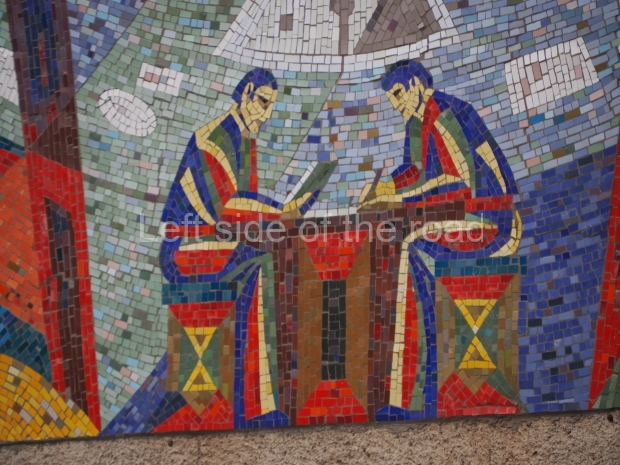
At the bottom of the mosaic, directly beneath the female face, two males sit at a desk. Presumably these are operators in the control room of a power plant, making sure all is correct for the distribution of the power through the pylons being constructed throughout the country. Above their heads, in a sweeping upwards arc, is what looks like the dials that you would normally see on a power plant control panel.

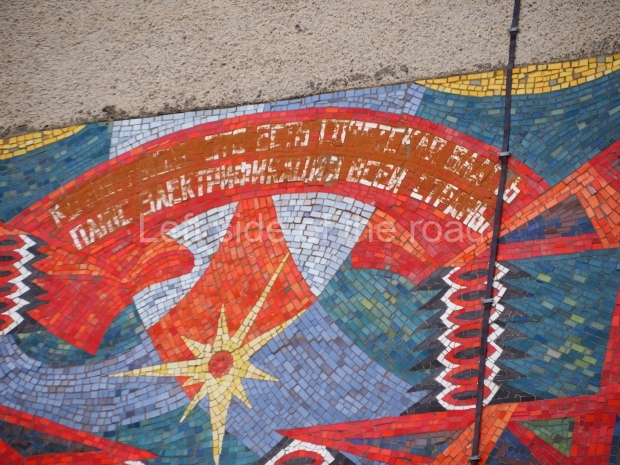
Perhaps the most interesting aspect of this mosaic, at least from the political perspective, is the quote from VI Lenin that are placed at the very top, in the centre.

In Russian;

Коммунизм — это есть советская власть плюс электрификация всей страны

which translates as;

Communism is Soviet power plus the electrification of the whole country

The quote can be found in context in VI Lenin, Collected Works, Volume 31, p516.

More than a 105 years since Comrade Lenin uttered these words at the Eighth All-Russian Congress of Soviets in December 1920 they are considered so incendiary, at least amongst the capitalist/European Union leaning authorities in Moldova, that there has been an attempt to mask that part of the image. They don’t have the courage to directly attack the mosaic so just resort to petty vandalism.

It’s not possible (or at least I couldn’t find an easy way) to get really close to the mosaic but it is still possible to get an overall view of the art work from various viewpoints at street level at the junction. However, from a distance the mosaic looks in a reasonable condition – apart from the crass vandalism of VI Lenin’s words.

Artist;

Aurel David

Created;

1969

Location;

On the side of a building at the corner of Vaslie Lupu Street 18 and Vassarion Belinski Street.

GPS;

47.02220 N

28.80424 E

How to get there;

Trolleybuses 3, 4, 33 35 go along Vaslie Lupu Street. Get off at the Vassarion Belinski Street stop.

From here you are only a short walk from the north edge of Valae Morilor Lake for the VI Lenin monument and on the way to the Colonnades mosaics of activities in the park.

More on Moldova – on the Post-Socialist Countries – Eastern Europe and Asia page

Soviet-era mosaics in Cahul – Gagauzia

Soviet Mosaics – Bălți – Moldova

VI Lenin and Palace of Culture Mosaic – Ribniţa – Pridnestrovie
Telecommunications mosaic – Chișinău – Moldova

Telecommunications

Telecommunications

More on Moldova – on the Post-Socialist Countries – Eastern Europe and Asia page

Soviet-era mosaics in Cahul – Gagauzia

Soviet Mosaics – Bălți – Moldova

VI Lenin and Palace of Culture Mosaic – Ribniţa – Pridnestrovie
Telecommunications mosaic – Chișinău – Moldova

This is a relatively small mosaic which is on the side wall of the building that is now the HQ of Moldtelecom but which, during Soviet times, was the home of the Ministry of Communications for the Moldovan Soviet Socialist Republic and the Central Post Office.

The theme of the image is unity and connectivity – not just local but international. In the background you have the globe superimposed upon which is a jet liner and a couple of dial telephones.

Behind the telephones is a hand and this suggests the idea of hands around the world, a term which would have been more in use when the mosaic was created than it is, perhaps now, in the 21st century. This unity/connectivity also has reference to the international aspect of Soviet Socialism. And that ‘movement’ of connectivity is displayed by the horizontal lines which indicate a spinning, dynamic world.

The top, left hand corner is dominated by an image of a communications satellite, which would have represented cutting edge technology at the time.

There’s no reference to postal services with, for example, an image of an envelope, which is slightly surprising as the building was also the Central Post Office when the mosaic was created. This would seem to indicate that the remit was to represent ‘modern’ technology – which in 1967 would have meant telecommunications, with the new satellites but primarily via cable.

One thing this mosaic – which doesn’t effect in the same way most of the other mosaics in the country – demonstrates is the ‘sell by date’ of technology. Many of the younger (and perhaps the not so younger) people who pass by this mosaic wouldn’t have a clue what the little boxy items with a circle with dots are in the image – unless they had happened to have noticed them during a visit to a museum.

Although on a busy road this mosaic is one that is easy to miss. During the working day the hustle and bustle of the market would distract as some of the more informal, ‘goods laid out on a tarmac on the ground’ type of market stalls are immediately in front and below of the image.

Artists;

Mikhail Burya and Nikolai Kotsofan

Created;

1967

Location;

On Strada Tighina, close to the junction with Stefan cel Mare si Sfant Boulevard, in the Central Market area.

GPS;

47.01760 N

28.84441 E

How to get there;

The mosaic is on the right hand side as you go down Strada Tighina towards the central bus station.

More on Moldova – on the Post-Socialist Countries – Eastern Europe and Asia page

Soviet-era mosaics in Cahul – Gagauzia

Soviet Mosaics – Bălți – Moldova

VI Lenin and Palace of Culture Mosaic – Ribniţa – Pridnestrovie