Telecommunications mosaic – Chișinău – Moldova

Telecommunications

Telecommunications

More on Moldova – on the Post-Socialist Countries – Eastern Europe and Asia page

Soviet-era mosaics in Cahul – Gagauzia

Soviet Mosaics – Bălți – Moldova

VI Lenin and Palace of Culture Mosaic – Ribniţa – Pridnestrovie

Telecommunications mosaic – Chișinău – Moldova

This is a relatively small mosaic which is on the side wall of the building that is now the HQ of Moldtelecom but which, during Soviet times, was the home of the Ministry of Communications for the Moldovan Soviet Socialist Republic and the Central Post Office.

The theme of the image is unity and connectivity – not just local but international. In the background you have the globe superimposed upon which is a jet liner and a couple of dial telephones.

Behind the telephones is a hand and this suggests the idea of hands around the world, a term which would have been more in use when the mosaic was created than it is, perhaps now, in the 21st century. This unity/connectivity also has reference to the international aspect of Soviet Socialism. And that ‘movement’ of connectivity is displayed by the horizontal lines which indicate a spinning, dynamic world.

The top, left hand corner is dominated by an image of a communications satellite, which would have represented cutting edge technology at the time.

There’s no reference to postal services with, for example, an image of an envelope, which is slightly surprising as the building was also the Central Post Office when the mosaic was created. This would seem to indicate that the remit was to represent ‘modern’ technology – which in 1967 would have meant telecommunications, with the new satellites but primarily via cable.

One thing this mosaic – which doesn’t effect in the same way most of the other mosaics in the country – demonstrates is the ‘sell by date’ of technology. Many of the younger (and perhaps the not so younger) people who pass by this mosaic wouldn’t have a clue what the little boxy items with a circle with dots are in the image – unless they had happened to have noticed them during a visit to a museum.

Although on a busy road this mosaic is one that is easy to miss. During the working day the hustle and bustle of the market would distract as some of the more informal, ‘goods laid out on a tarmac on the ground’ type of market stalls are immediately in front and below of the image.

Artists;

Mikhail Burya and Nikolai Kotsofan

Created;

1967

Location;

On Strada Tighina, close to the junction with Stefan cel Mare si Sfant Boulevard, in the Central Market area.

GPS;

47.01760 N

28.84441 E

How to get there;

The mosaic is on the right hand side as you go down Strada Tighina towards the central bus station.

More on Moldova – on the Post-Socialist Countries – Eastern Europe and Asia page

Soviet-era mosaics in Cahul – Gagauzia

Soviet Mosaics – Bălți – Moldova

VI Lenin and Palace of Culture Mosaic – Ribniţa – Pridnestrovie

Attributes of Art mosaic – Opera House – Chișinău – Moldova

Chișinău Opera

Chișinău Opera

More on Moldova – on the Post-Socialist Countries – Eastern Europe and Asia page

Soviet-era mosaics in Cahul – Gagauzia

Soviet Mosaics – Bălți – Moldova

VI Lenin and Palace of Culture Mosaic – Ribniţa – Pridnestrovie

Attributes of Art mosaic – Opera House – Chișinău – Moldova

‘The Mosaic ‘Attributes of Art’ can be admired again! Restoration work completed

20 December 2022

Successfully completed the restoration of the mosaic panel ‘Art’ by the famous artist Michael Burya. The opening of the panel took place on Friday, December 16, [2022] on the territory of the Maria Bieshu Opera and Ballet Theatre.

The event was attended by the Minister of Culture Sergey Prodan, the artist Valery Yabinski and his team and the architect Sergei Garkonitsa. The mosaic panel was dismantled in 2018 from the former building of the Palace of the Trade Unions, in the capital sector of Ryshkanovka ….. The cost of the project is 8 million lei and is fully covered by Kaufland Moldova [a supermarket chain]. ‘For Kaufland, this is a unique project not only at the level of the Republic of Moldova, but also at the level of the international group of which we are a part. It is a great honour for us that we had the opportunity to become a part of history, defending and exchanging national cultural heritage. Work on moving the mosaic panel was carried out in several stages in compliance with all the requirements, which was a real test for architects and artists’, said Dona Rapchuga, executive director of Kaufland Moldova.

The colour scheme of the big mosaics ‘Attributes of Art’ is combined with taste: red-black gold, with inclusions of yellow, grey and white colours, represented by comedic and tragic masks, musical instruments, and on the other hand resembles the Moldavian carpet. Valery Zhabinsky, head of the department of wall painting of the Academy of Music, Theatre and Fine Arts, led a team of artists who performed the process of restoration of mosaic.

‘They worked hard for nine months. That is how much time it took to restore 218 square meters of mosaics – from early morning until it got dark. We also had moments when we doubted that we would succeed, but together with the beautiful team of artists, we managed to finish this work of art’, said the artist Valery Zhabinsky.

Architect Sergei Garkonitsa, who has more than 20 years of experience in the restoration of monuments, noted that this project of disassembly and subsequent reconstruction of the mosaic is a complex work that requires not only talent, but also passion. ‘I would like to thank the investor who made such an unusual gift not only to the Chisinau municipality, but also to the whole country. This work can be admired by generations, and it will go down in history as the first project of this kind’, said Garkonitsa.

The mosaic panel ‘Attributes of Art’ is located on the territory of the Maria Bieshu Opera and Ballet Theatre. Residents and guests of the capital can already admire them. Kaufland Moldova is also going to transfer this work of art to the Ministry of Culture of the Republic of Moldova.’

The above from; Mosaic ‘Attributes of Art’ can be admired again! Restoration work completed – original in Russian and machine translated.

Attributes of Art - in its original location

Attributes of Art – in its original location

This is a bit of a success story. Not only was the art work protected there was a determined effort to preserve it when the original location was to be demolished. As the article above indicates the removal and repositioning of a mosaic is far from an easy task. Unfortunately, this happened three or four years ago. I don’t think the political climate is such, at least at the moment, for such effort and expense to be available to some of the other ‘under threat’ mosaics in other parts of Chișinău or even Moldova.

About the mosaic

It was originally installed at the side of the main entrance of the Trade Unions’ Palace of Culture in the Râșcani district of Chișinău. It measures 23 meters wide by 6.5 meters high, has a colour palette of red, black, gold, yellow, grey, and white and uses a traditional Moldovan carpet as its template.

The title takes its name from the symbols, musical and theatrical, that are included in the image. These include; a trumpet, a guitar, a violin, harp and two masks (representing comedy and tragedy)

Artist;

Mikhail Burya

Created;

1974 (at it’s original location, that building now demolished)

Location;

Mitropolit Dosoftei St 53, Chișinău,

GPS;

47.02874 N

28.83001 E

How to get there;

The Opera House is a short walk from the Triumphal Arch, going north-west along Boulevard Stefan cel Mare. The mosaic is at the side of the building, opposite the entrance to a secondary school.

More on Moldova – on the Post-Socialist Countries – Eastern Europe and Asia page

Soviet-era mosaics in Cahul – Gagauzia

Soviet Mosaics – Bălți – Moldova

VI Lenin and Palace of Culture Mosaic – Ribniţa – Pridnestrovie

Central bus station waiting room mosaic – Chișinău – Moldova

Central bus station waiting room

Central bus station waiting room

More on Moldova – on the Post-Socialist Countries – Eastern Europe and Asia page

Soviet-era mosaics in Cahul – Gagauzia

Soviet Mosaics – Bălți – Moldova

VI Lenin and Palace of Culture Mosaic – Ribniţa – Pridnestrovie

Central bus station waiting room mosaic – Chișinău – Moldova

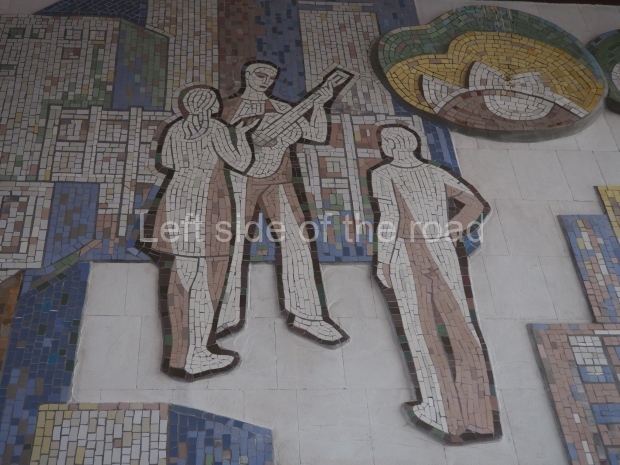
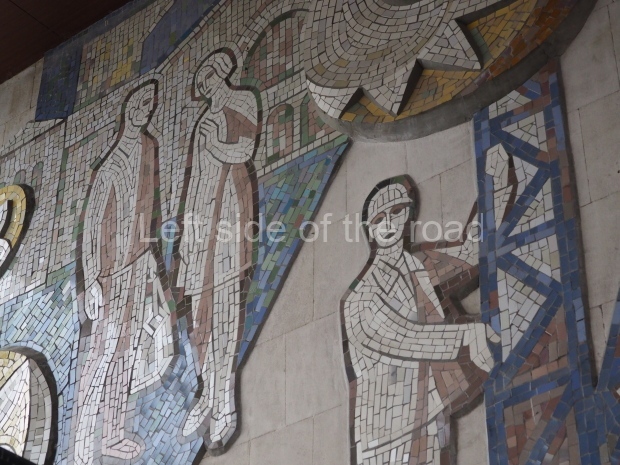
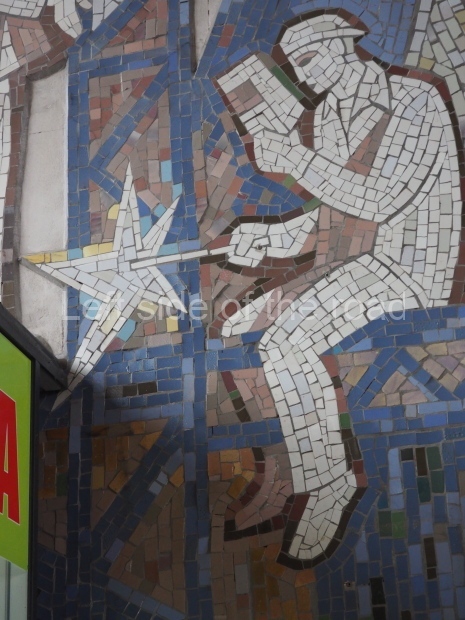
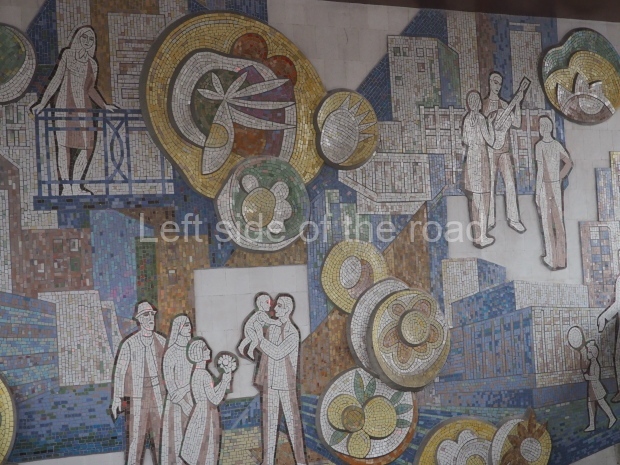
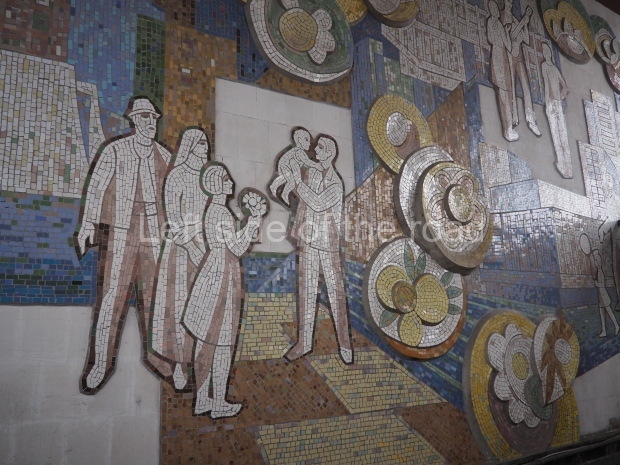
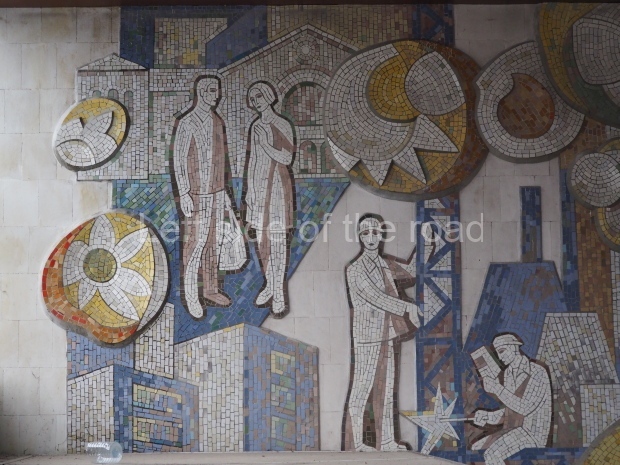
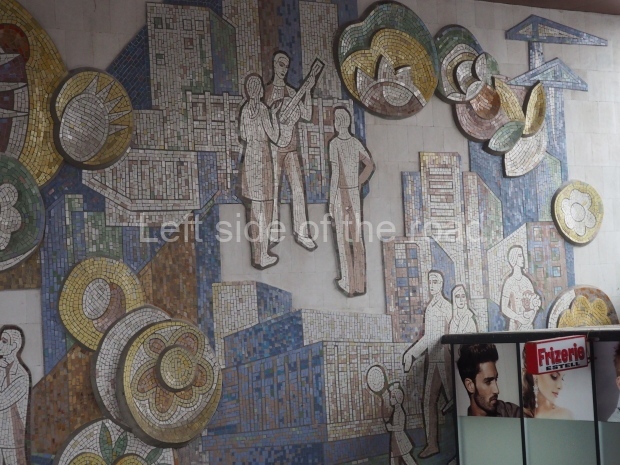
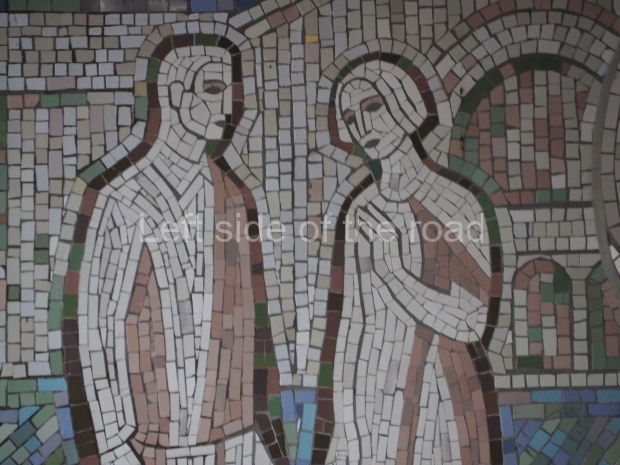
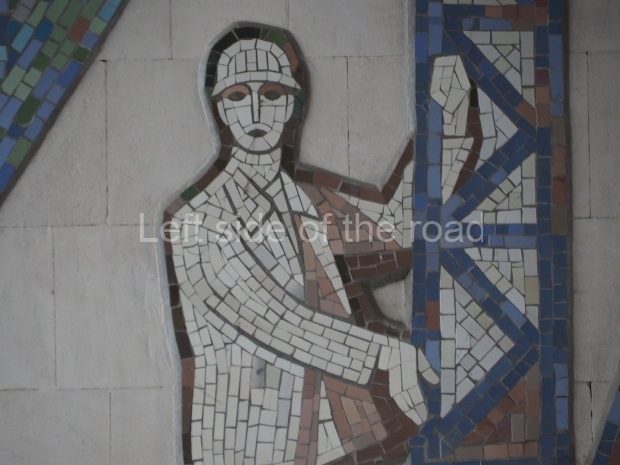
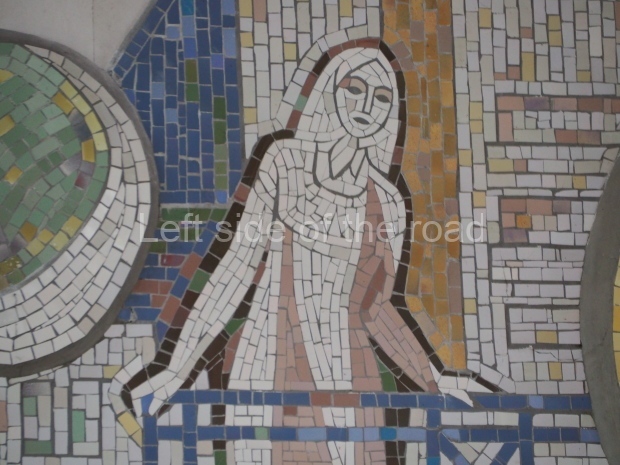
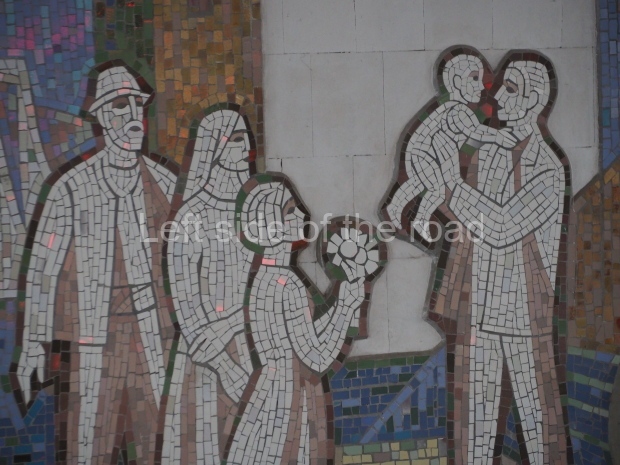
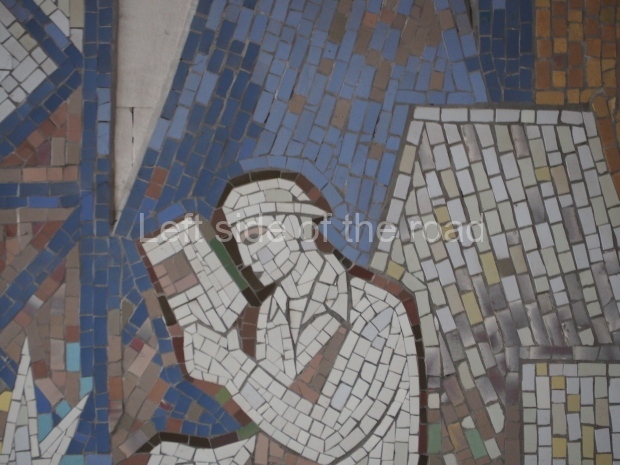
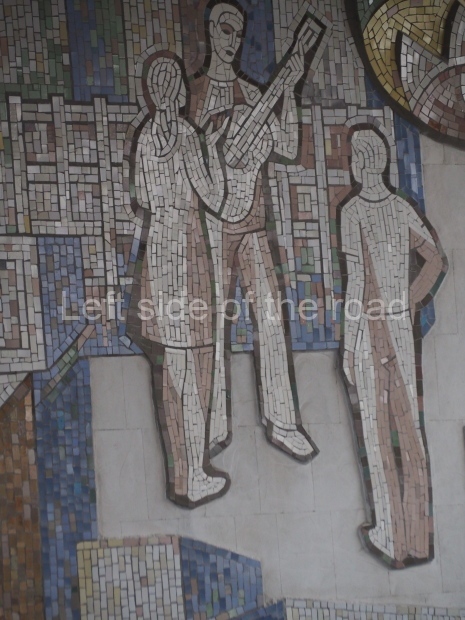
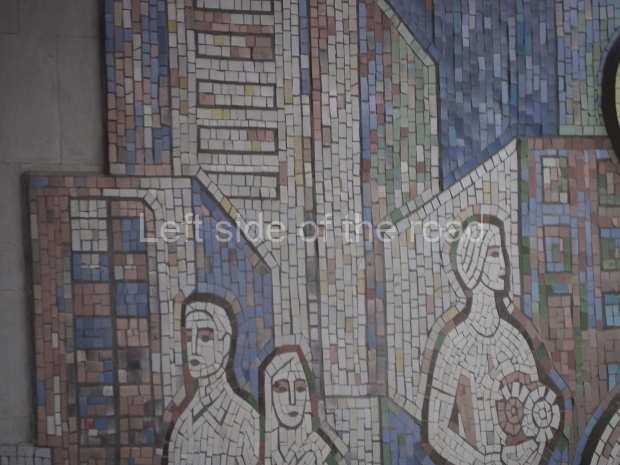
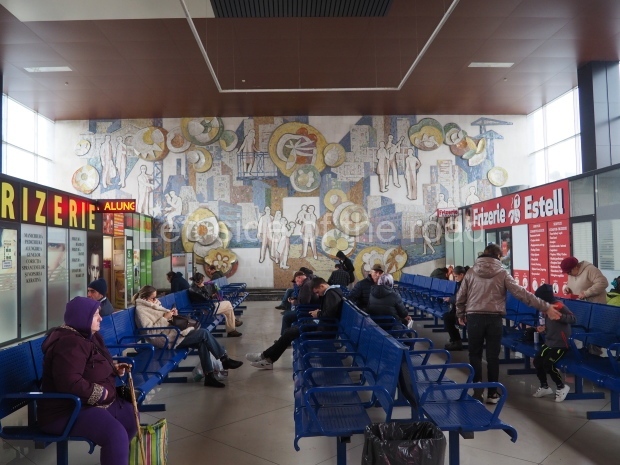
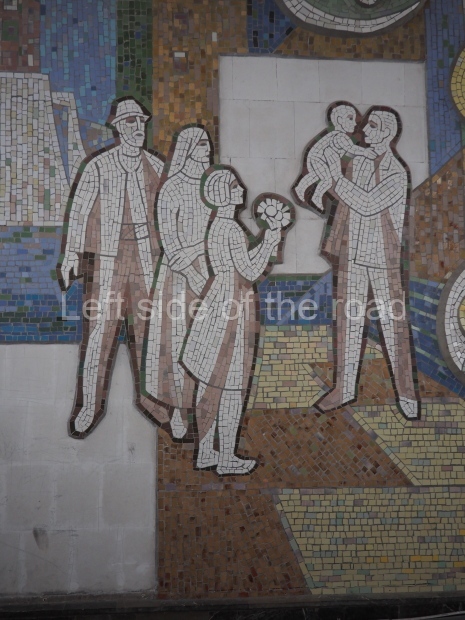
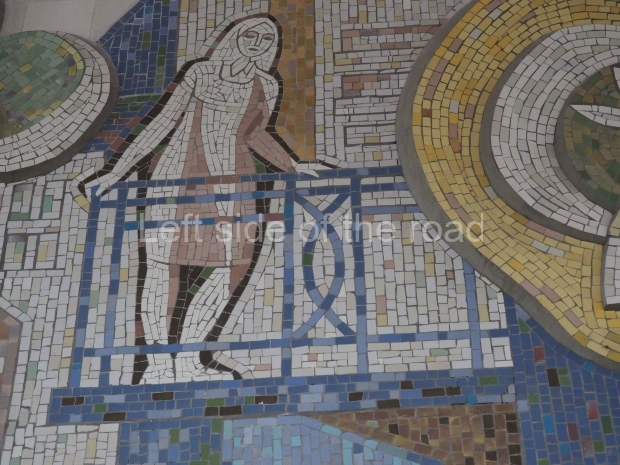
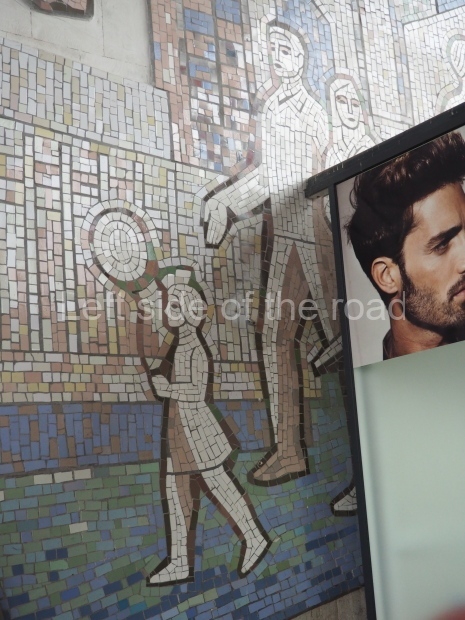
I’ve seen this mosaic referred to with two different names. The first is ‘The City is flourishing and being built’ and the second is ‘Hospitable Moldova’. It covers the whole wall at one end of the waiting room of Chișinău’s main bus station. There’s quite a bit going on here; a family is meeting visitors at the bus station; people working in construction; students going to school/college; musicians getting together; an electrician going up a pylon; a woman standing on a balcony outside her flat; a welder with his welding helmet; all with the background of a modern city in the process of being built.

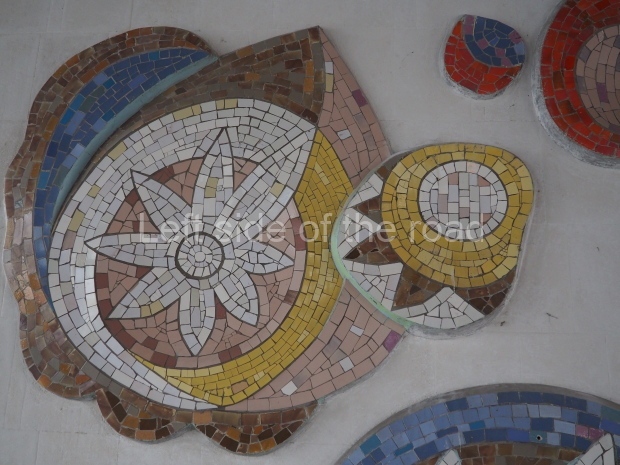
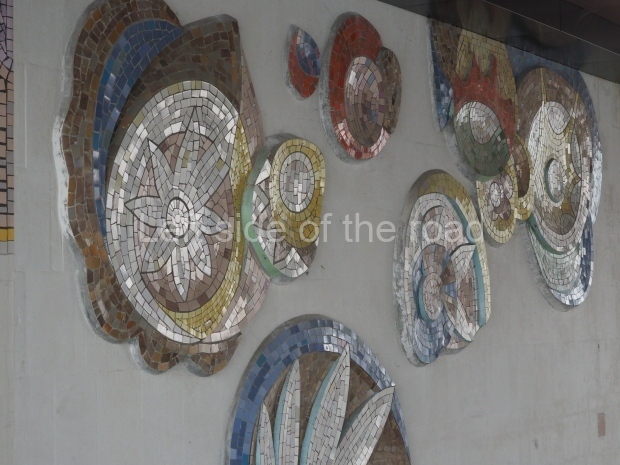
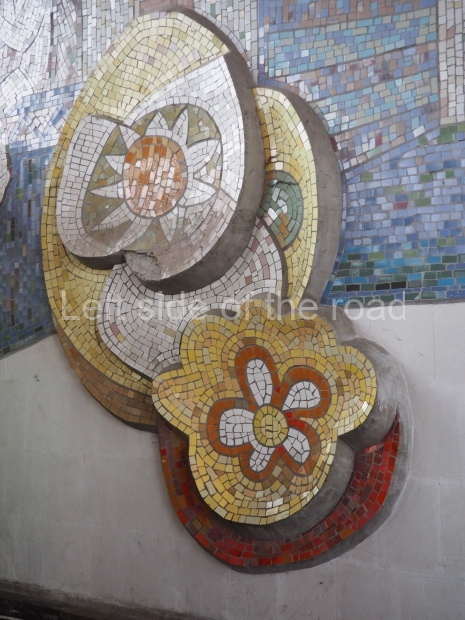
The background is what is normally recognised as a mosaic but the people are depicted in a relief format, giving the image a 3D effect. There are also large flower images with a much deeper relief which provide colour to the the image. This produces an effect similar to the mosaic on the outside wall of the bus station in Bălți.

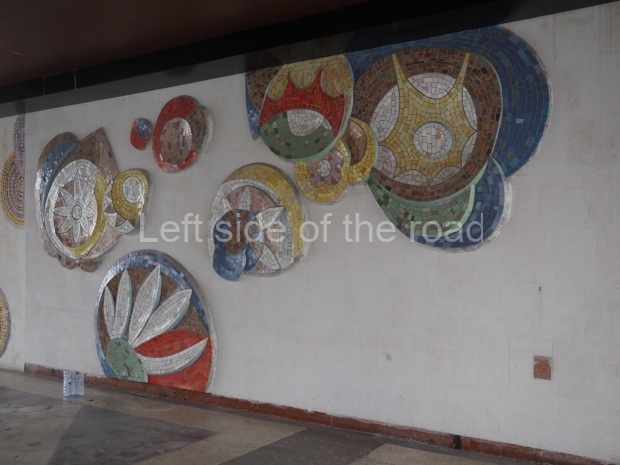
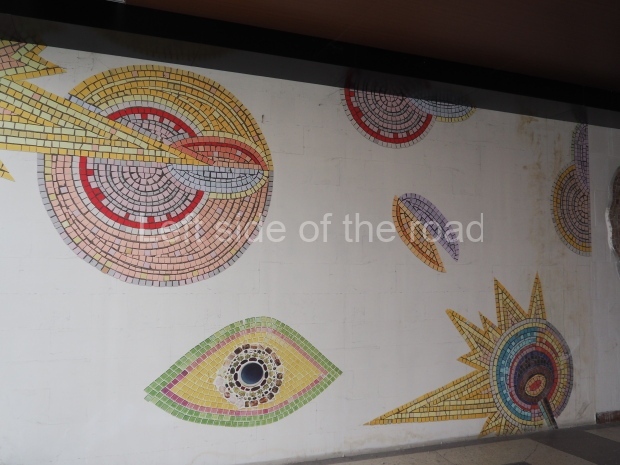
On the opposite wall (reached by stairs by one of the side entrances to the waiting room) there are more large and colourful relief mosaics, this time of large flowers and some geometric designs – but without any people.

When the mosaic was first installed it would have been possible to have seen it in full but commercialisation has meant that small shops have now been constructed in the waiting room space and they go right up to the wall on both sides so its no longer possible to see it as was originally intended.

All Soviet art works are now ‘vulnerable’, especially in a country like Moldova where there is a scramble from the ‘pro-Westerners’ in positions of power to ingratiate themselves with the European Union and hence to be able to feed at the same trough as the other bureaucrats. Although there are efforts to preserve these works of art throughout the country it appears that this particular mosaic might be under some threat. This is a prime location and there might be plans for a major commercial development of the market area and demotion might be on the cards.

Artist;

Mikhail Burya

Created;

1974

Location:

Central bus station, Mitropolit Varlaam St 58,

GPS;

47.01962 N

28.84502 E

How to get there;

The bus station building is an integral part of Chișinău’s Central Market

More on Moldova – on the Post-Socialist Countries – Eastern Europe and Asia page

Soviet-era mosaics in Cahul – Gagauzia

Soviet Mosaics – Bălți – Moldova

VI Lenin and Palace of Culture Mosaic – Ribniţa – Pridnestrovie