2021 starts with continuing Zionist attacks on the Palestinian population

More on Palestine

View of the world

Ukraine – what you’re not told

2021 starts with continuing Zionist attacks on the Palestinian population

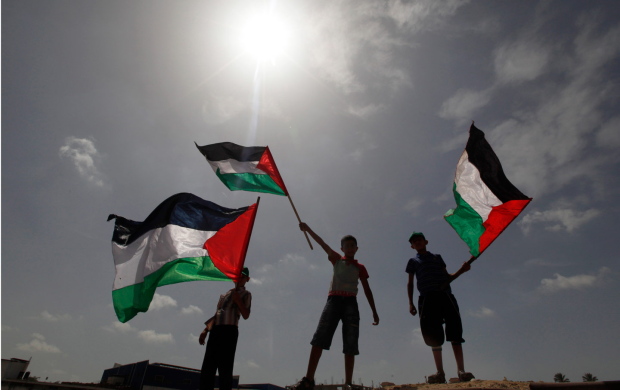
Israeli airstrikes damage children’s hospital and school in the Gaza Strip

Ramallah, January 23, 2021—Israeli warplanes launched five missiles at targets in Gaza City in late December, damaging a children’s hospital, school, center for disabled people, and several residential buildings.

Israeli airstrikes struck areas in the north, east, and west of Gaza City. The Israeli attacks damaged the Gaza Center for People with Disabilities, the Shuhada Gaza School, and the Mohammad Al-Dura Children’s Hospital, all located in the At-Tuffah neighborhood of Gaza City, according to information collected by DCIP. The Israeli military claimed the attacks targeted Hamas locations in response to rockets fired from the Gaza Strip towards Israel.

When the missiles struck the area, 16 Palestinian children were patients in the children’s hospital, including three in the intensive care unit. An ensuing power cut interrupted patient care at Mohammad Al-Dura Children’s Hospital.

“The explosions caused great bewilderment among the sick children in the hospital,” Dr. Majed Hamada, Head of Mohammad Al-Dura’s Children Hospital, told Defense for Children International – Palestine. “The explosion shattered ten windows,” he added, telling DCIP that none of the patients or staff sustained injuries.

“I was going to bring medication for the kids when I saw the sky turn red,” Eman Bilal, a nurse at the hospital, told DCIP. “After that, we heard the huge explosion that shook the building and shattered the windows. Everyone at the hospital panicked, parents were scared to the point they started carrying their sick children and running towards safer rooms.”

The Gaza Center for People with Disabilities in At-Tuffah, which provides educational and training services for 60 students with disabilities aged between 14 and 28, sustained damage that interrupted classes and other services for at least one day. Around 20 windows were shattered and three doors were damaged, according to the director of the center, Salah Al-Amasi.

The Shuhada Gaza School, also in the At-Tuffah neighborhood, sustained damage to 52 windows and five doors during the airstrikes, according to the principal, Ihab Quqah. The building is home to both the Shuhada Gaza Public School, which educates around 620 pupils aged between 6 and 11 years old in the morning, and UNRWA’s Al-Daraj School, which educates 1000 pupils aged between 6 and 14 years old later in the day.

“Israeli forces’ use of explosive weapons in densely populated civilian areas in the Gaza Strip is very likely to have indiscriminate effects,” said Ayed Abu Eqtaish, Accountability Programme Director at DCIP. “While no casualties resulted here, Israeli forces regularly treat Palestinian public infrastructure in the Gaza Strip as acceptable collateral damaging and attacking essential facilities such as hospitals and schools.”

International humanitarian law prohibits indiscriminate and disproportionate attacks and requires that all parties to an armed conflict distinguish between military targets, civilians, and civilian objects. Israel as the occupying power in the Occupied Palestinian Territory, including the Gaza Strip, is required to protect the Palestinian civilian population from violence.

Israeli warplanes struck a United Nations-run school in a United Nations Relief and Works Agency (UNRWA) compound in the Al-Shati refugee camp located in the northwest of Gaza City on August 13, 2020, according to documentation collected by DCIP. The munition did not detonate on impact. UNRWA officials confirmed reports that the UNRWA Beach Co-Educational School ‘D’ in the Al-Shati refugee camp was damaged by an Israeli missile that did not detonate. Students were not allowed on the premises, having only returned to school less than a week earlier following a five-month school closure in response to the COVID-19 pandemic.

DCIP and numerous other human rights organizations have extensively documented Israeli forces’ targeting of schools, hospitals, and other civilian infrastructure in the Gaza Strip, as well as the killing and maiming of children in and around such infrastructure.

DCIP’s investigation into all Palestinian child fatalities during the Israeli military’s assault on the Gaza Strip in summer 2014, known as Operation Protective Edge, found overwhelming and repeated evidence that Israeli forces committed grave violations against children amounting to war crimes. This included direct targeting of children by Israeli drone-fired missiles and attacks carried out against schools. In at least three incidents, Israeli forces carried out indiscriminate or disproportionate attacks against schools.

This article first appeared on Defense for Children International – Palestine

Israeli forces kill 17-year-old Palestinian boy, allege attempted stabbing

Ramallah, January 26, 2021—Israeli forces shot and killed a 17-year-old Palestinian boy Tuesday afternoon in the northern occupied West Bank after the teen allegedly attempted to stab an Israeli soldier nearby.

Attallah Mohammad Harb Rayan, 17, from Qawarat Bani Hassan, a town located southwest of the occupied West Bank city of Nablus, was shot dead by Israeli forces around noon at the Hares Junction near the illegal Israeli settlements, Revava and Barqan, according to documentation collected by DCIP. Israeli forces shot Attallah after he allegedly carried a knife and attempted to attack an Israeli soldier stationed at the junction, according to Israeli army radio. 

“Israeli forces frequently resort to lethal force in circumstances not justified by international law,” said Ayed Abu Eqtaish, Accountability Program Director at DCIP. “Children suspected of committing criminal acts should be apprehended in accordance with international law and afforded due process of law.”

Under international law, intentional lethal force is only justified in circumstances where a direct threat to life or of serious injury is present. However, investigations and evidence collected by DCIP regularly suggest that Israeli forces use lethal force against Palestinian children in circumstances that may amount to extrajudicial or wilful killings.

Attallah is the first Palestinian child killed by Israeli forces in 2021. In 2020, Israeli forces killed nine Palestinian children in the occupied West Bank, including East Jerusalem, and the Gaza Strip, six of whom were killed with live ammunition, according to documentation collected by DCIP. 

Israeli forces killed 17-year-old Mahmoud Omar Sadeq Kmail on December 22, after he allegedly shot at Israeli paramilitary border police forces deployed in occupied East Jerusalem’s Old City. On December 4, Israeli forces shot and killed 15-year-old Ali Ayman Saleh Abu Alia in Al-Mughayyir, a village northeast of Ramallah in the occupied West Bank. Ali did not present any threat to Israeli forces at the time he was killed, according to documentation collected by DCIP. The Israeli military has reportedly opened an investigation into Ali’s killing following international condemnation of the killing.

Israeli forces are rarely held accountable for grave violations against Palestinian children, including unlawful killings and excessive use of force. According to Yesh Din, an Israeli human rights organization, around 80 percent of complaints filed with Israeli authorities by Palestinians for alleged violations and harm by Israeli soldiers between 2017 and 2018 were closed with no criminal investigation opened. Of complaints where a criminal investigation was opened, only three incidents (3.2 percent) resulted in indictments. Overall, the chances that a complaint leads to an indictment of an Israeli soldier for violence, including killing, or other harm is 0.7 percent, according to Yesh Din.

This article first appeared on Defense for Children International – Palestine

More on Palestine

View of the world

Ukraine – what you’re not told

Monument to the 15th Partisan Assault Brigade – Elbasan

Monument to the 15th Partisan Assault Brigade - Elbasan

Monument to the 15th Partisan Assault Brigade – Elbasan

More on Albania ……

View of the world

Ukraine – what you’re not told

Monument to the 15th Partisan Assault Brigade – Elbasan

I must admit I have a little bit of a difficulty in working out exactly what the shape of this monument is supposed to represent. It’s like a huge belt or a ribbon. It starts at the back on the left-hand side and then comes back on itself in a big curve towards the front, where you have the main sculptural group, and then gently curves towards the back of the monument and finally straightening out slightly as it gets to the edge at the right-hand side – it’s a bit like a huge hook.

Not sure exactly the dimensions but it’s roughly 3 metres in width, which remains the same along its whole length, which I would estimate around about 15 metres in total.

There’s a sense of movement in this static, heavy concrete structure.

There’s a physically large clue on the left-hand side that it might be representing an ammunition belt because there are huge bullets on the extreme left. However, these cartridges seem to get absorbed by the lapidar and apart from the top of the casings disappear as they get close to the main sculptural group, only to re-emerge again at the edge of the flag.

The whole structure is about 2 metres above the ground – sometimes slightly less, sometimes a bit more – and the monument itself sits on two piles of rough rocks which are cemented together. This introduces the idea of the mountains, which is quite common in Albanian lapidars. On the left these rocks provide support directly underneath the sculptural group and then towards the right-hand side is another pile taking the weight.

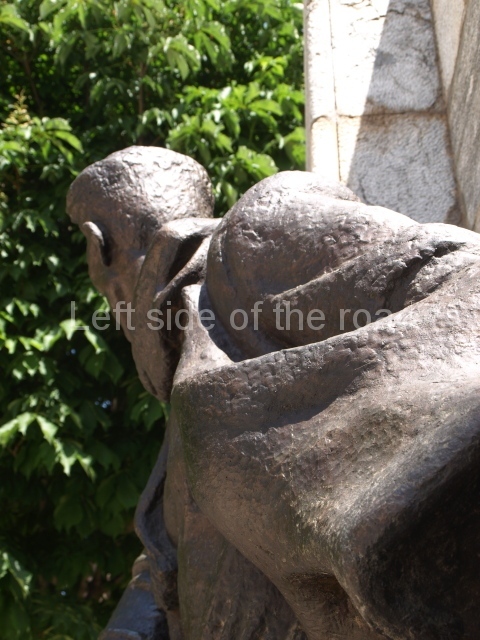
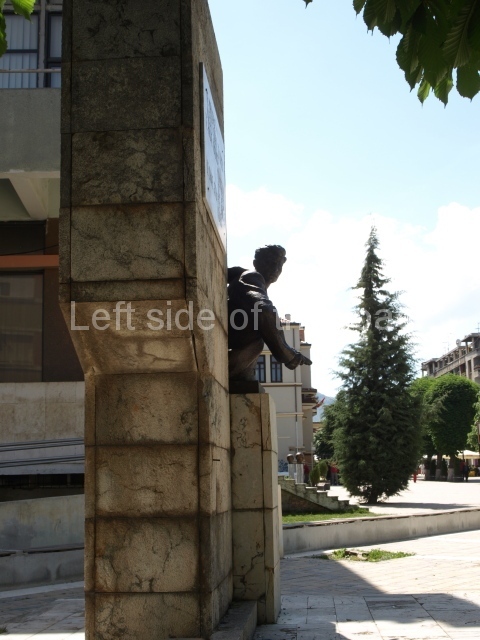
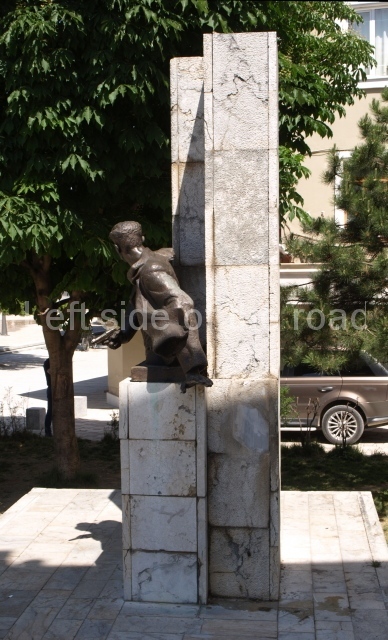
The principal artistic element and the image which immediately draws your attention is the stone bas relief of four Partisans, grouped together above the left-hand support pile.

The individual which dominates the image is the male figure of the standard bearer who is on the left of the group – and slightly higher. We also see much more of him, virtually the whole of his body above the waist. He stands face on but his head is turned to his left so we get a right profile. His right arm is raised and his hand grips the flagpole near its top point whilst his left hand grips the pole at waist level. He is a Partisan in full uniform, wearing a cap with a star at the front and tied around his neck is what would have been a red scarf. On his left hip is a buttoned-up, leather holster, only the butt of the pistol visible.

The flag, the flag of the Communist Partisans, flutters in the wind that’s coming from the left as we look at the image. The very top of the flag is the only part of the tableau that breaks the confines of the concrete shape. This would have been a red flag and on it would have been a black, two-headed eagle (an image used by Skenderbeu in the 15th century, through the period of Socialist construction between 1944 and 1990 and to date). However, during the National Liberation Anti-Fascist War and the period of Socialism there would be a small gold star in the space just above where the two heads separate.

The stars were the target for the reactionary, fascist, nationalist forces that gained control of Albania in the early 1990s and many of them on lapidars throughout the country have been the subject of masking or obliteration. Although most of the monument in Elbasan remains in good condition the star on the flag has been erased. If you look carefully at the space above the eagle heads, almost to the top of the lapidar, it’s possible to see that someone has applied ‘fresh’ plaster to level out the area and erase the star. The parallel marks as evidence of this ‘alteration’ are to be found nowhere else on the lapidar.

Monument to the 15th Partisan Assault Brigade - Elbasan - missing star

Missing star

Two of the other Partisans, one female the other male, are similarly looking towards their left. This is where the action is and they are on the way to the battle. They are also in profile but there’s still a lot of information, even though we don’t see much of them.

The female Partisan is partially hidden by the standard bearer but she is also in uniform. She wears a cap and the edge of the star is evident on the front, her long hair flying behind her as she moves quickly forward. It also looks as if she has a red scarf around her neck. In virtually all the lapidars relating to warfare when a woman is depicted she is always armed (as in the mosaic on the facade of the National Historical Museum in Tirana) although the men aren’t. This lapidar is no different and the sharp end of her rifle is seen poking out behind the head of the fighter on the right of the group.

In front of her is a young male Partisan from the countryside. In the lapidars the distinction is often made about those Partisans from the countryside by depicting them in the traditional clothing of the mountain people. He’s not in a formal uniform but is dressed in a woollen vest, his shoulders and arms bare. Around his forehead is a sweat band, the knot tied at the back of his head. But his political allegiance is shown by the (red) scarf around his neck. At waist level he holds a sub-machine gun, his right finger on the trigger and his left hand holding the gun at the magazine. His posture is the same as the woman, moving forward towards the battle, his left knee bent to give the impression of the effort to get there quickly.

The fourth member of the quarter is not moving forward. He is an older man from the countryside, he is wearing a waistcoat and on his head a traditional cap (a qeleshe) but one on which is a star. All the people in this image are Communists. Additionally, it’s almost a trope when it comes to depicting older men from the mountains, he’s boasting a bushy moustache. He’s aiming his rifle and pointing downwards with his right finger on the trigger and holding the barrel of his rifle in his left hand. The Partisans, knowing the terrain, would always aim to select the location that was to their greater advantage and this representation of firing downwards appears in other lapidars such as the amazing star at Pishkash. And the mountain top design of the plinth supporting the monument adds to this impression of mountain warfare, he seems to be shooting out of the bas relief into a mountain environment – like someone walking out of a screen of a film.

Everything indicates that this is an ambush of a Nazi column in the mountains.

Where the right hand side of the flag ends we can see the top casings of three gigantic bullets. These then merge into a large, five pointed star which appears to be leaning away from the lapidar at the top but which merges into the concrete at the bottom. It’s more than half the width of the concrete ribbon, so more than a metre from point to point. The very tops of the casings of the cartridges then reappear briefly on the other side of the star until they finally disappear.

The concrete base on which the bas relief sits has curved slightly towards the back of the lapidar creating a partial circular space in the rear but then the panel straightens up and extends for about half the of the total length to the right.

The top left-hand quarter of this now unadorned panel has been plastered so that it provides a smooth face on which are painted (now) in red letters the following;

Partizanet e Brigadës XV S. duke luftuar me popullin kundër pushtuesit nazist gjerman e tradhëtarive çliruan më 11 nëntor 1944 qytetin e Elbasanit

which translates as

To the Partisans of the XVth Assault Brigade who, with the people, struggled against the German Nazis and traitors to Liberate the city of Elbasan on 11th November 1944

(This re-writing of the inscription in red paint must have been completed around the beginning of 2015 as the image in the Albanian Lapidar Survey (Volume 2, page 205) catalogue shows a different version.)

Towards the extreme right-hand edge of the monument there is something attached to the concrete – looking like a rectangular box. I’m not too sure whether this is something which was there originally and supporting another element of the story (but can’t really imagine what). There are signs, holes and general markings, that indicate that whatever was there was more extensive.

(One of the problems of there being so many lapidars to document is that I don’t always ‘see what’s there’ at the time of my visit. It’s only when time and magnification on the computer screen that some aspects become ‘visible’. If I ever get the opportunity to return to Elbasan I’ll try to remember to ask the pertinent questions.)

Generally, this lapidar is in a very good physical condition. There doesn’t appear to be any damage (apart from the mystery markings on the extreme right-hand side) and although it’s unlikely that the bas reliefs would have been painted in gold paint originally at least the painting has been done with an element of care and professionalism, as has the signwriting of the inscription.

Unfortunately, there’s no information available of the artist who created this lapidar – nor of the date of its inauguration. The features of the quartet are very clear, distinctive and detailed – you would recognise the models (I’m sure, if you saw them. This would seem to indicate one of the more accomplished sculptors and it’s very pleasing to see that the detail has remained intact despite the troubled times the country, and consequently the Socialist monuments, went through – especially in the 1990s.

Its present condition and the fact that has had a relatively recent ‘renovation’ and attention would seem to indicate that it has local support and protection. Whether that be from the local community or the municipality is impossible to say.

Nonetheless, this is an important lapidar in the country as it has attributes which I haven’t seen repeated elsewhere.

Location

In the large square created at the junction of Rruga Kadri Hoxha and Rruga Çerçiz Topulli. This is a bit of a transport hub and looks like it might be the site of a recently installed roundabout. It’s just over half a kilometre east of Elbasan Castle in the centre of the town.

GPS

41.11280498

20.07384798

DMS

41° 6′ 46.0979” N

20° 4′ 25.8527” E

Altitude

137.4

More on Albania ……

View of the world

Ukraine – what you’re not told

Self-reliance – a Great Marxist-Leninist Principle in the Construction of Socialism and the Defence of the Country

The planting of cubes of maize - Stavri Cati

The planting of cubes of maize

More on Albania ……

View of the world

Ukraine – what you’re not told

Introduction

This article first appeared in New Albania, No 6 1977. It is being reproduced here in an effort to counter the false claim that Albania, during it’s period of Socialist construction, was a state that was purposely isolating itself from the rest of the world, as well as putting the concept into a contemporary context.

Yes, Albania could quite easily have bought more powerful friends in the block in Eastern Europe dominated by the, then, Soviet Union. But to do so it would have had to throw any principles the Party of Labour of Albania had out of the window and kowtow to forces that were working against the development of Socialism throughout the world.

Yes, it could easily have joined the capitalist/imperialist grouping of countries, dominated by the United States but including countries like the UK, Germany and Italy – the latter two countries against whom the Partisans had fought in the National Liberation War and the first of which was constantly seeking to undermine the society with armed ‘regime change’ (although the term wasn’t around at that time) by using fascist and pro-capitalist nationalist groups to infiltrate the country to commit sabotage and murder.

In the period from 1944 to 1990 Albania had an understanding of what independence meant. They had achieved independence from the Ottoman Empire in 1912 but it wasn’t until the defeat of the Nazis on 29th November 1944 that the country could say it was finally able to determine its future.

The fact that the future the country wanted to build was that based upon the dictatorship of the proletariat with the aim of establishing Communism meant they had to face enemies (including erstwhile Socialist states) that couldn’t countenance such opposition to the way they saw a different future.

So whilst self-reliance is crucial to the development of any Socialist state (in the past and in the future) as in Albania for the 46 years of its Socialist construction, it also has relevant lessons and important points for many people of the world in the third decade of the 21st century.

‘Globalisation’, hailed as the best way to increase the wealth levels of the poorest of the world has only led to the exact opposite. Economies that did have a certain amount of independence thirty or forty years ago now find that everything they do is determines by some faceless group who gamble on the price of the goods they produce and having to deal with the inevitable price cuts that comes with this form of the ‘free market’.

This has effected in more serious and fundamental ways the countries in the economic ‘south’ but even the most established capitalist countries have felt the effect.

The campaign to get Britain out of the European Union was part of that fight back. Obviously not from the racists, the xenophobes, the ignorant, the frightened, the narrow-minded, the ‘nationalists’ of Scotland, Wales and Ireland who want ‘freedom’ from England but voluntary bondage to the EU and the opportunist politicians (such as our home grown Buffoon).

There were many who saw the history of the economic decline (both industrial and agricultural) of Britain since the mid-1970s as being a direct consequence of the country’s membership of the gang of European capitalists. Decisions made in their clubhouse were for the benefit of the capitalist system in general and had nothing to do with the conditions of the workers and the general population of their respective countries.

It won’t be easy for the people of Britain to build a country where the decisions are taken at a local level (as it wasn’t easy – and proved to be ultimately fatal to the Socialist society in Albania) but in the process it’s possible the British people will realise we need neither the cold comfort of united European capitalism to organise our society nor capitalism itself.

That self-reliance is something worth fighting for.

Self-reliance – a Great Marxist-Leninist Principle in the Construction of Socialism and the Defence of the Country

Self-reliance is a great Marxist-Leninist principle. It has a profound political, ideological, economic and strategic character because it is linked with the fate of socialism and its defence. This principle is linked with the strengthening of the state of the dictatorship of the proletariat and keeping it pure, against every danger of retrogression to capitalism and revisionism, because the implementation of this principle is closely linked with the preservation and strengthening of political independence, with the creation of a strong and independent economy, with the development of a national socialist culture and the preparation of an invincible defence. In the field of foreign politics, this principle is connected with the construction of an independent policy, to prevent it from becoming an appendage of the foreign policy of some other party, state or country.

The implementation of this principle is also linked with the preservation of national sovereignty and territorial integrity, not to make concessions or not to create different joint economic or financial companies with the monopolies of the bourgeois or revisionist states and to reject any offer of ‘aid’ or ‘credit’ from them.

At the 7th Congress of the Party of Labour, Comrade Enver Hoxha said, that for us, the principle of self-reliance is a law of the construction of socialism and its defence, as well as an imperative necessity in this direction. This is related to the fact that both the revolution and the construction of socialism can never be exported or imported. The internal factor is the determining and decisive factor both in the struggle for the triumph of the revolution and for the seizure of power by the working class under the leadership of the Marxist-Leninist party, as well as in the struggle for the construction of socialism and the defence of the country. The external factor also has its own importance, but, never is it fundamental; it does not exert its influence directly, but through the internal factor.

This principle eliminates from the Marxist- Leninist thesis on the decisive role of the people, led by the Marxist-Leninist Party in the victory of the revolution, in the construction of socialism and the defence of the country. Speaking about this question at the 7th Congress of the Party of Labour of Albania, comrade Enver Hoxha said among other things, that ‘self-reliance, demands, first of all, that we strongly rely on the creative, mental and physical energies of the people, led by the Party’.

For Albania, this principle, is, at the same time, an imperative necessity because the Albanian people are building socialism in the conditions of a savage imperialist-revisionist encirclement and their all-round blockade, in the conditions of the pressure which the big economic-financial and energy crisis which has the entire capitalist-revisionist world in its grip is exerting on its economy, in conditions when US imperialism, Soviet social-imperialism, the whole of world reaction, modern revisionism and old and new opportunism are hatching up plots and plans to overthrow socialism and restore capitalism in Albania and to perpetuate it in their own countries.

Self-reliance means: first, to rely on your own manpower and the creative energies of your people, under the direct and indivisible leadership of the Marxist-Leninist party; second, to rely on the natural wealth and the material-technical base created in the country; third, to rely on the internal resources of material and financial accumulations.

Self-reliance is not at all a temporary policy, merely dictated by certain external circumstances; it has always been and remains a general course in the policy of the PLA for the construction of socialism and the defence of the country, a course which has always been consistently implemented in every step of life, in the political or economic fields, in art, culture, education, science, defence, everywhere, in all fields and sectors of social life.

In Albania the construction of socialism and the defence of the country are realized by firmly relying on our own forces. This is a living reality, a reality which is based on several objective and subjective factors.

Today, the Albanian economy has a powerful material-technical base. Industry, as the leading branch of the economy is capable of broadly utilising the natural resources, energy and raw materials. The extracting and processing industries have been developed and not only does Albania meet all the internal demands and those of export, but conditions have been created so that apart from the output of pig iron and steel, other minerals will also be gradually processed, so that they can be exported like this and not as crude mineral, or so they can be processed further locally. Today, the engineering industry produces 85 per cent of the spare parts and in 1980 will produce 90 per cent of them; it is capable of preserving the exploitation of the material-technical base created in Albania and, together with the chemical industry and other branches it is gradually assuming the qualitative advance to produce machinery, the instruments of labour, that is to create the level of the independence of the economy with the principle of self-reliance requires.

The socialist agriculture, as the basic branch of the people’s economy is developing at rapid rates as a modern and multi-branched economy and it increased the production of bread grain by giving priority to this sector, thus meeting all demands for bread grain locally. Together with the light and food — processing industry, it has managed to fulfil 85 per cent of the country’s demands for mass consumption goods and in 1980 it will fulfil 95 per cent of them.

As a result of the entire development of material production, internal accumulation has increased a great deal, on the basis of which such possibilities have been created that during the 6th Five-year Plan (1976-1980) colossal investments have been made, chiefly from local resources, equal to those which have been made during the entire twenty year long period from 1951 to 1970 in Albania.

Self-reliance is a general and permanent course, a principle for every socialist country, big or small, a principle which is applicable both in the struggles for liberation and the proletarian revolution, as well as in the construction of socialism and the defence ol the Homeland. Not only does it not exclude cooperation and reciprocal aid between revolutionary forces and socialist countries, but it presupposes it. This is an internationalist duty of great importance not only to the interests of the country which receives this aid, but also for the country which gives it.

Remaining loyal to the teachings of Marxism-Leninism, the PLA has continually exposed all those ‘theories’ and enslaving practices of the two superpowers and the other imperialist powers, which, under the mask of ‘fraternal aid’, ‘development’ and ‘progress’ exert pressure on and enslave countries. They spread all kinds of false theories which weaken the conviction of the peoples in the possibilities of the construction of a sovereign life, and in general, in their existence as nations and free countries and they sow and spread the psychosis that allegedly without relying on one big power you can not develop as a free and independent nation. Their theories and practices are out and out reactionary and rapacious. This is clearly proved by the concrete neo-colonialist activity both of US imperialism and Soviet social-imperialism, as well as by the whole of world imperialist and revisionist reaction.

The bourgeois and revisionist propaganda has long since been speaking in the most unrestrained manner against socialist Albania, against the consistent implementation by the PLA and the Albanian people of the principle of self-reliance, accusing them, that allegedly, with the course they are following, Albania is isolated, that the advance along this course spells isolation, autarchic development etc. With this they are trying to cultivate the feeling of subjugation towards them and to legalize the policy of imperialist expansion and exploitation of other countries, to transform the countries and peoples into colonies, as they have, in reality, transformed all those who drag behind their chariot. As the Party of Labour of Albania and Comrade Enver Hoxha have always stressed, Albania has never accepted and will never accept the so called aid of the imperialists and revisionists, which, in reality, means nothing else but the subjugation of whoever accepts and receives it. ‘The imperialists and the revisionists’, said Comrade Enver Hoxha at the 7th Congress of the PLA, ‘call a country isolated which has closed its doors to invasion through enslaving credits, through the tourists and spies, through the decadent culture and degeneration. From this angle we are truly an isolated country and we will remain such with full consciousness.’

In reality, the entire economic-social development of socialist Albania and the correct and far-sighting policy of the PLA, with the high prestige which it has won for Albania throughout the world, reject all these calumnies. The correct Marxist-Leninist policy of the People’s Socialist Republic of Albania is respected and evaluated by the revolutionary and progressive forces, just as they evaluate all the achievements and progress of Albania during these thirty three years of free and sovereign life. Today, Albania has diplomatic relations with more than 80 different states of the world and with more than 40 of them it maintains relations of economic and cultural exchanges.

The Party of Labour of Albania and the Albanian people have always followed a correct road in the economic, cultural and social development of the country, relying on their own forces, and this is why the rates of development in Albania are higher and more stable than in any other country of Europe and amongst the highest in the world.

More on Albania ……

View of the world

Ukraine – what you’re not told