Pyongyang to Moscow by train – with comments and observations along the way – Part 1

National Reunification

National Reunification

More on the DPRK

Pyongyang-Rajin

Easy enough to organisebut not without surprises

The problem of the best way to put together a visit to the Democratic People’s Republic of Korea (DPRK) and to then be in the erstwhile Union of Soviet Socialist Republics (USSR) for the 100th Anniversary of the Great October Russian Revolution seemed to have been solved when the option of taking the train from Pyongyang – the capital of the DPRK – direct to Moscow – the capital of the former Socialist country – was presented to me.

At first the arrangement seemed fairly straightforward. Instead of heading back to China at the end of the 11 Day Party Foundation Tour (which I had initially considered) I would now say my farewells to the group as I headed for the railway station in the centre of Pyongyang as they headed off to the airport for a relatively short flight to Beijing. My journey was going to be far from ‘short’ – the first stage (from Pyongyang to the biggest city in the north-east of the country, Rajin) would take 33 hours but I wasn’t in any real hurry (there being the best part of three weeks before the anniversary of the Revolution on the 7th November).

Matters started to get confusing as soon as I started to confirm my travel arrangements. It didn’t help in understanding the situation when the people I was dealing with didn’t seem to fully understand the situation either – the travel company in Berlin as well as those who worked at the Korea International Travel Company (KITC) in Pyongyang. It may be useful to remind readers here that independent travel to the DPRK is not an option and some officially recognised intermediary is a necessity.

Although slightly frustrating, as it wasn’t until I was actually in the country that I got to know my exact itinerary, it did have its plus side. People didn’t know what the situation was as not many people had actually made this journey before and they were making statements based upon what could, theoretically, be done without having a lot of actual practice to back it up. Though not a trail-blazer I very soon realised (and learnt even more so as I progressed along the almost 10,000 kilometre journey) that I wasn’t following in many others’ footsteps.

The ‘problem’ arose as it seemed to be impossible to get an exact date from Pyongyang until a matter of a week or so before departure. The date for the departure from Tumangang (the last station of the DPRK side of the border with Russia) was fixed in stone. On the other hand departures from Pyongyang seemed to be quite flexible. I couldn’t understand this as the ‘reason’ that ‘they do things differently’ in another country doesn’t make sense when it goes against all logic, especially when it comes to train timetables. After all it was around rail transport that time took on a different meaning during the Industrial Revolution in Britain, from the early part of the 19th century onwards.

The other issue with being a foreign tourist was that although the train that I eventually took from Pyongyang would go through to the terminus at Tumangang I had to get off in the city of Rajin, spend a night there and then get taken to the border station by road the next day – in order to make a late afternoon border crossing.

As an aside here I’ll comment on how information is transmitted by the people of Africa, Asia and Latin America to foreign tourists when the people giving the ‘information’ don’t have any idea of what the actual situation might be. Anyone who has travelled extensively in any of those parts of the world would have invariably come across similar situations at various times. The consequence of this is that the information that is imparted has little more practical value than what could be found in a novel.

I must stress here that the ‘information’ that is given is not passed on with any malice. What happens is that they a) don’t want to say they don’t know and b) don’t want the foreigner to leave with nothing. The theory seems to be that something, however inaccurate, is better than nothing. This meant that I received, in an authoritative tone, all kinds of answers to my questions that bore no relationship to actual reality.

In the context of the proposed journey of nine or ten days on a train there is another factor that has to be taken into account. Although not directly stated by the people I dealt with in Pyongyang they definitely thought that someone who would choose to travel all the way from Pyongyang to Moscow on a train – when they could take a flight that would take fewer hours than the train takes in days – must be crazy. People who have little chance of travelling to and from such places are probably even more bemused.

Although many people, more often than not those who have never (and don’t intend to) set foot in the DPRK write and talk about not being able to travel without being accompanied by local guides having them with you does make life an awful lot easier. The main Pyongyang Railway station was only a matter of a couple of hundred metres from my hotel, the Koryo, but on the day of departure I was collected and driven there in the mini bus that had been ‘mine’ for the three days I had had a private tour.

Tipping in Socialist Countries

Before leaving the mini-bus for the last time there was a ritual that had to be gone through and that was the tipping of the driver. This is something that is being expected in China, as well as the DPRK, as foreign tourism becomes more popular. This is expected to be paid in either Chinese Yuan or Euros (US dollars aren’t welcomed) and is one of those aspects of tourism in what are supposed to be Socialist countries which has been problematic for a long time.

Working with foreigners where, for example, meals are taken in westernised ‘Korean’ restaurants, beyond the means of many local people, a small group of a few hundred people in Pyongyang live a different life-style from their compatriots. Getting from 5-10 Euros per day from each member of the group (which is the recommended amount from virtually all the travel companies I investigated before booking my trip) means that they can, in theory, receive an income far in excess of that of the other people in their country who do much more important, useful and worthwhile jobs than cater for a bunch of over-privileged foreigners, some of whom (though by no means all) are there to find fault with as much as possible in order to return home with their ‘horror’ stories.

Unfortunately, nothing has been learnt from the experience of the Beryozka stores in the Revisionist Soviet Union where goods could only be paid for in foreign currency. In 1973 I had the experience of witnessing the guide for the group of which I was a member pulling out a roll of various European and North American currencies, which she had obviously saved up over a period of time, to take advantage of the luxury foreign-made goods that were not available in normal shops and to the vast majority of the population. The existence of such places is an anathema to Socialism and only served to perpetuate inequality and breeds corruption. I’m not aware of an equivalent shopping situation in the DPRK (although there are supermarkets in Pyongyang that will accept Chinese Yuan and Euros) but foreign currencies in the hands of a select few can only but be a cause for concern.

On top of that potential of undermining any development towards Socialism there is also the question of what role tipping should have in a society claiming to be constructing Socialism. Tipping under capitalism is used to supplement poor wages and employers use them as an excuse to pay less than the rate for the job. Any country that claims to be building any version of Socialism – as the DPRK does with its Juche variety – should outlaw tipping, considering the practice one that comes from a class divided society and the giving of which insults the worker.

But when you are at the mercy of such an arrangement it becomes churlish to not participate.

Pyongyang Station

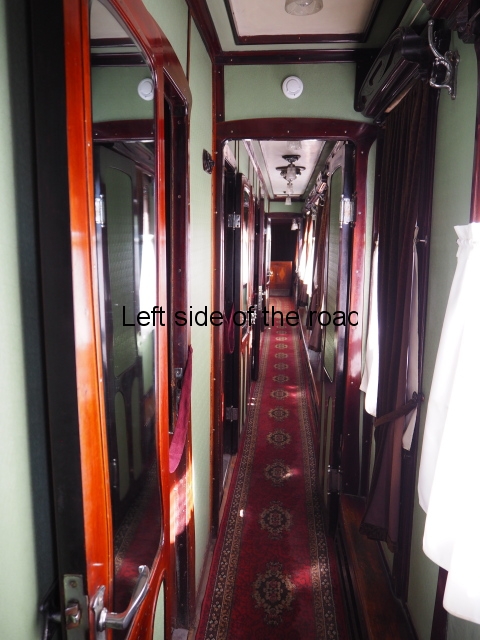
At the station there was a steady stream of people going in through the main entrance but myself and the two guides went through a door (at the left hand side of the station façade) that looked like an entrance to an office. This was the door that foreigners have to use and so we ‘jumped the queue’. I wasn’t aware that anyone really controlled that entrance but the way it was set up inside it appeared as if it was also the entrance for those who were travelling in the soft sleepers – what would be the equivalent of ‘first class’ on other rail systems. My guides had to sort out a platform ticket (so they could get out again when the train left) and no more than three or four minutes after arriving at the station we were standing on the platform.

On the platform things looked chaotic around the last carriage of the train – my soft sleeper. This was due to the fact that there were many more people seeing off friends and relations than were actually travelling – when the train did move off the carriage was far from full.

The taking of photos in the DPRK is not as restrictive as many would have you believe but a foreign tourist is always at the whim of their guides and although the two young women who had been my guides for the last three days of my trip to the country were friendly, approachable and efficient they also had an attitude of not allowing me to impose of their fellow countrymen and women.

Although I would liked to have taken a few more pictures of the station to record an impression of what it’s like in preparation for a long distance train journey in the country I do respect the idea that some people might not like having a camera pointed at them to satisfy the whims of someone from the other side of the world. In my photography in the countries I have had the chance to visit I tend to concentrate on things rather than people – not being a person who is too happy to be the subject of another’s photo myself. And anyway, the single picture I did take, of the destination board on the side of the carriage, was later deleted by the immigration police before I left the country to cross over to Russia from Tumangang but, again, more of that later.

The journey of 10,000 kilometres starts with the first turn of the wheel

The train departed at 07.50 on the dot and worked its way through the centre of Pyongyang, passing many of the places I had visited in my 11 day trip. The train never gathered anything like the speed of trains in Europe, not least because it was a single track for much of the way and of a narrower gauge than that used in the west. This made for a more interesting journey as life outside the train didn’t go by in flash and it was possible to see much of what was taking place in different parts of the countryside. Most tours to the DPRK will take in some places outside of Pyongyang but seeing the world from the window of a mini-bus is very different from the window of a train.

(I didn’t have the information with me at the time but anyone planning this journey might find it useful to copy the relevant information about the route and the stopping stations from this website. At a speed of (very roughly 25 km per hour) you can make a guess of the station or have something to show local people to get confirmation. So many times in life ‘if we only knew then what we know now’.)

Meeting the ‘locals’

Much is made in the ‘west’ about the fact that foreigners don’t have the opportunity to meet and talk with local people when travelling in the DPRK. If these are ordinary people who are just regurgitating the pap fed to them by the capitalist media they are very often the same sort of people who go on holiday to southern Europe (here I’m talking about people from the UK) and stay in resorts where the only contact they have with the ‘locals’ is in a bar or restaurant – or even worse stay at ‘all inclusive’ holiday resorts where they never leave the complex. In a way that makes sense. They don’t go into areas with which they are unfamiliar and where they can’t be understood (most English depending upon the ‘locals’ to speak English, in whatever part of the globe they might be visiting) because they will be like fish out of water. However, when it is not permitted all of a sudden it’s something they must do or their ‘freedom’ is being limited.

If they are arrogant journalists like the BBC’s Rupert Winfield-Hayes they want to go where they are asked not to go because being part of the BBC they think they have the right to do whatever they want, wherever they want to do it. He was arrested in Pyongyang in 2016 when in the country filming for an episode of the BBC news programme ‘Panorama’. I like to think that the DPRK security forces arrested him for a joke, just to put the fear of God up him. He was such an ineffectual prick he could have done little harm.

However, there is one way that a visiting tourist can get to ‘know’ the locals and that’s by travelling on trains. Again, the travel options, at present, are limited (the route from Dandong in China and this route to the Rason area) but there’s every opportunity to meet people from the country with no one there to oversee the conversation. On the journey into the country we (I was travelling with my brother on that part of the journey) got into a conversation with someone returning home after a trip in China. He had a bit of English and the conversation was the sort you normally have on such occasions, more passing the time of day than an interrogation about conditions of life within the country. Any more than that and you go outside what is considered the norm in any country. What would the British think if every time they met someone from Europe they were asked to justify their stance on the European referendum, whatever side they took?

When you are travelling in another country there’s no sense in creating conflict with someone you don’t know, when you will only be in their company for a very short time and will almost certainly never meet again. Not least because anywhere in the world you won’t get any controversial information from someone who doesn’t know you. It takes time for people to develop trust and a train journey, or a chance encounter in a street, does not allow that trust time to develop.

You pass the time of day, possibly share a drink (as we did on the way to Pyongyang) and part wishing each other all the best.

If that’s what you wish to do when travelling then a long, overnight train journey is as good a place as any to start.

More on the DPRK

Next

Stalin Museum – Gori

Stalin - outside entrance to Museum

Stalin – outside entrance to Museum

More on the Republic of Georgia

Stalin Museum – Gori

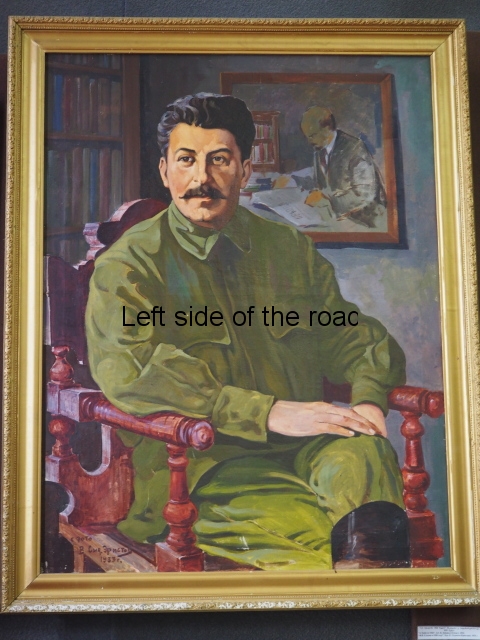
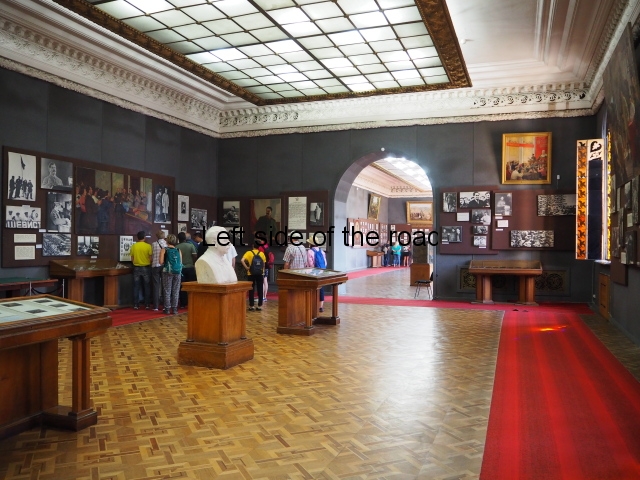
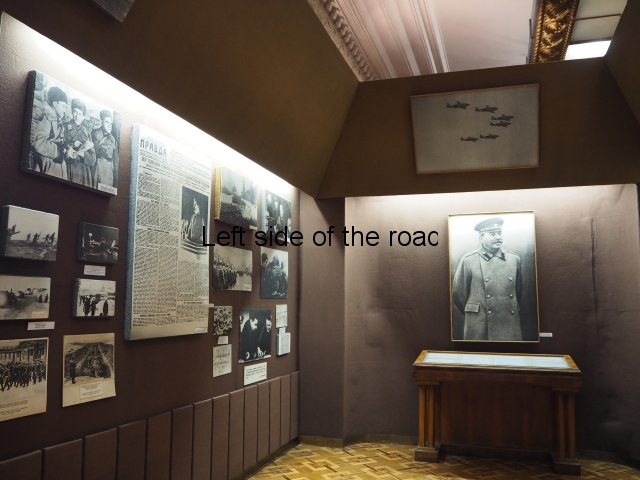
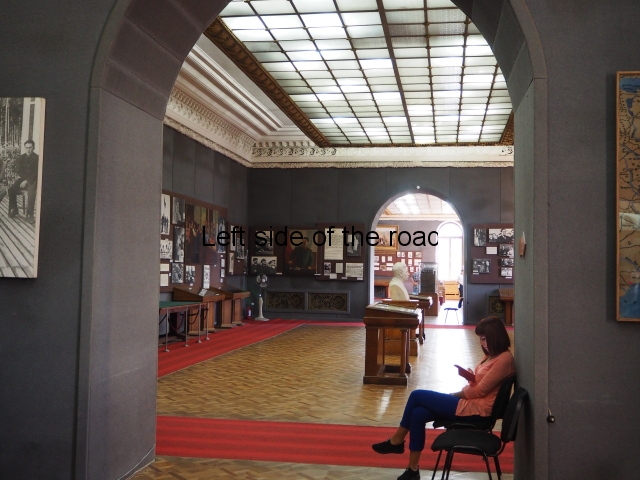
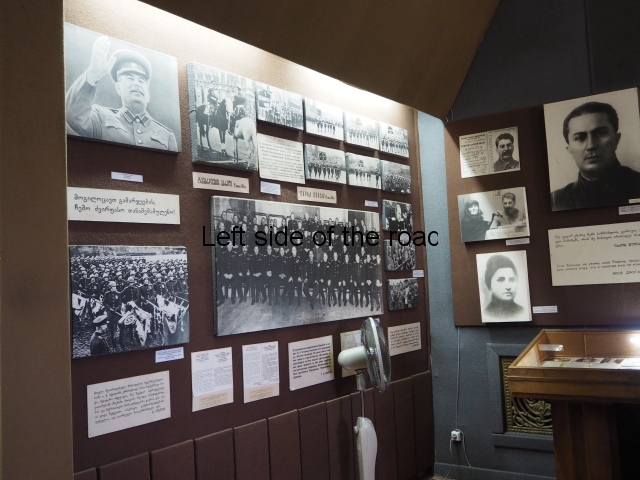
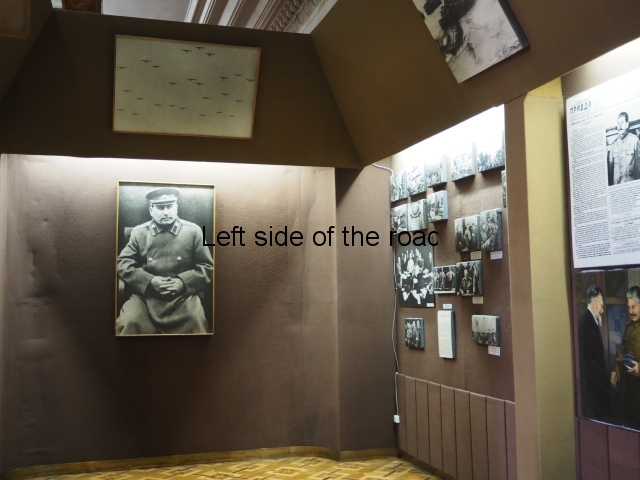
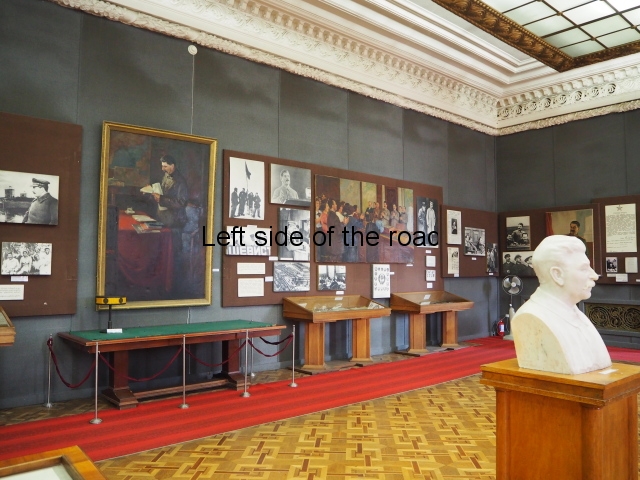
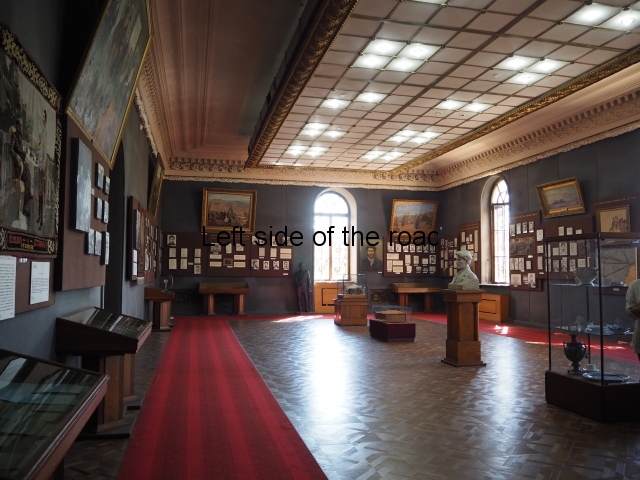
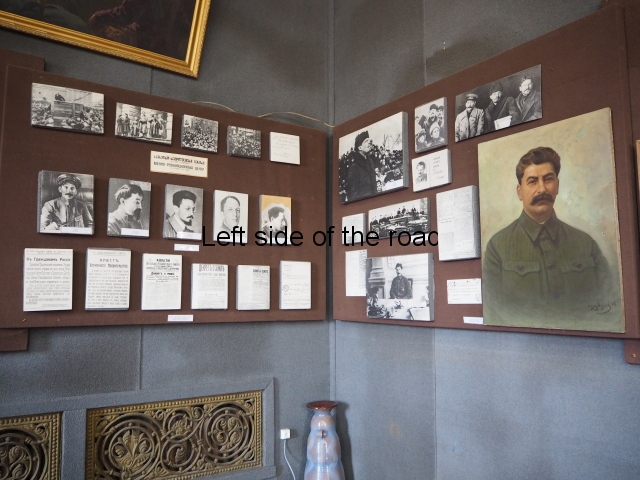
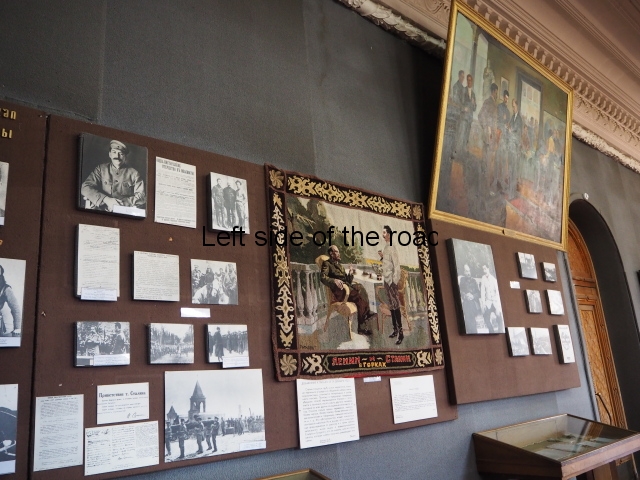
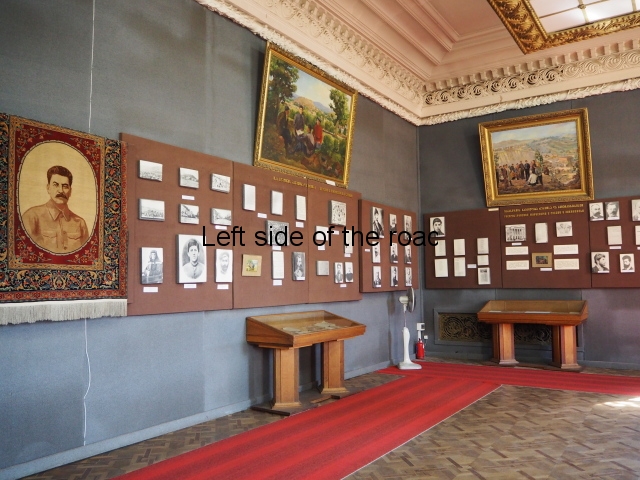
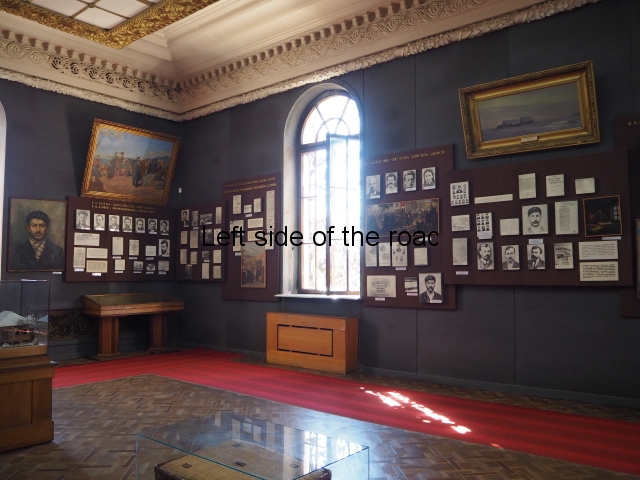
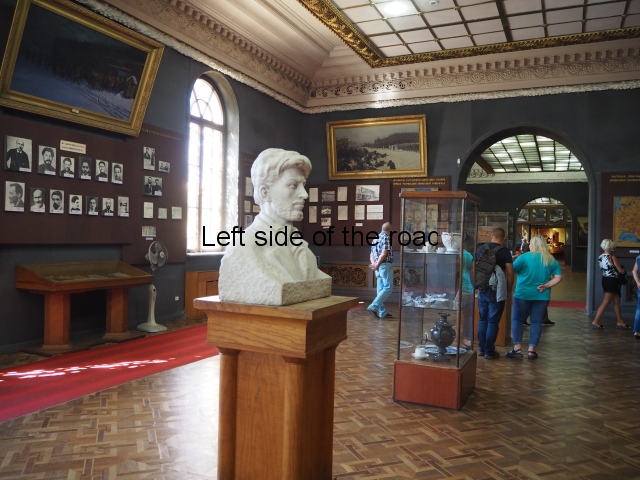
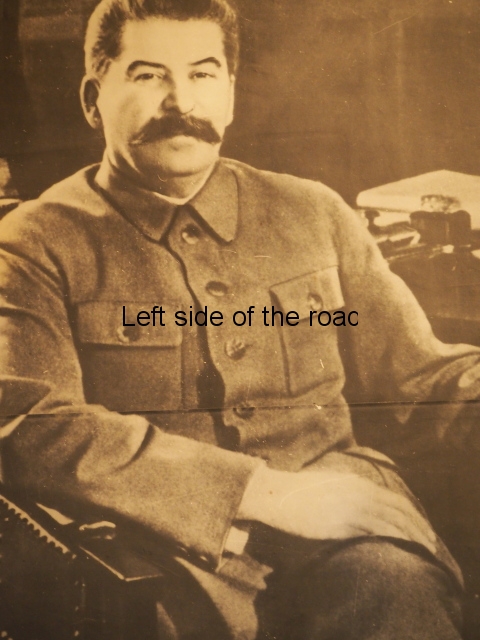
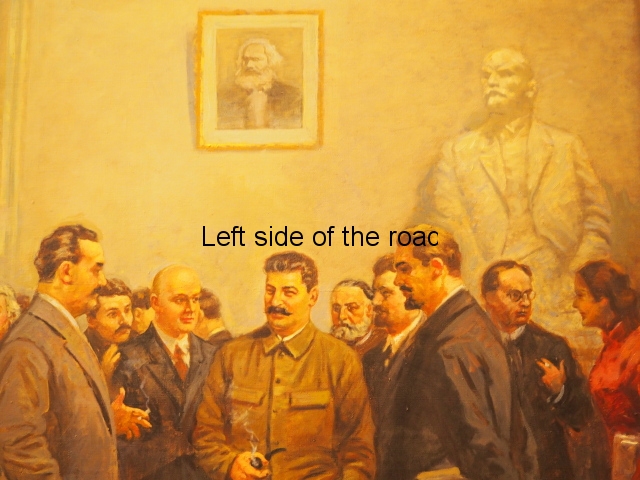
The Stalin Museum in his birthplace of Gori, in the centre of Georgia, is one of the few places in the erstwhile Union of Soviet Socialist Republics (USSR) where you will see any reference (let alone a positive reference) to the leader of the world’s first socialist state.

(Before the success of reaction in the Soviet Union, in the 1990s, there used to be a much larger museum dedicated to Vladimir Ilyich Lenin, just off Red Square, in Moscow. This was called The Central Lenin Museum. That museum space is now devoted to the successful war against the Napoleonic invasion of 1812 – by ignoring their Soviet past the Russian people have had to go back more than 200 years before they can hold their heads high.)

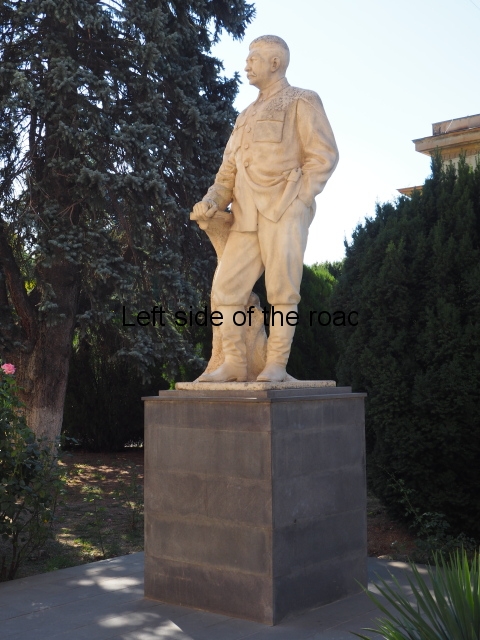
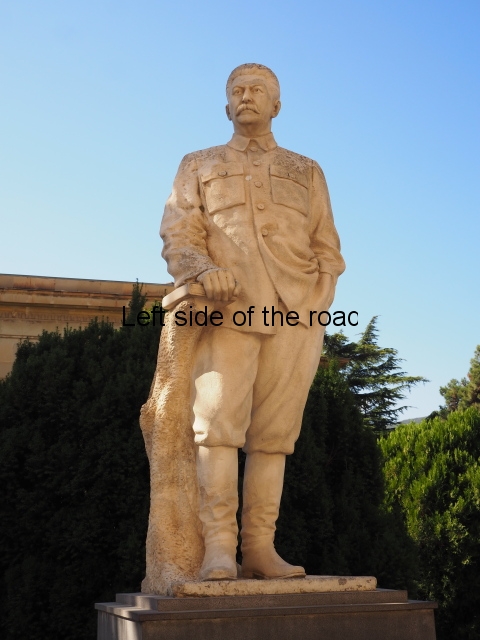
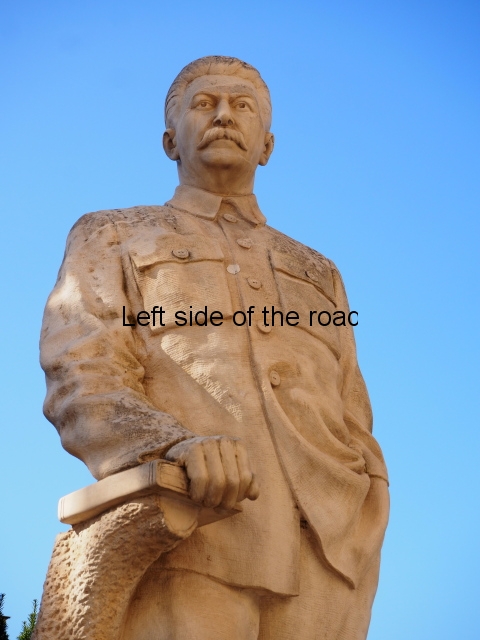
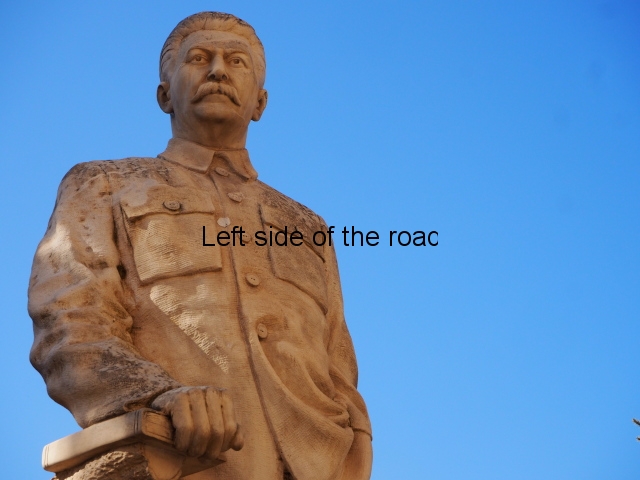
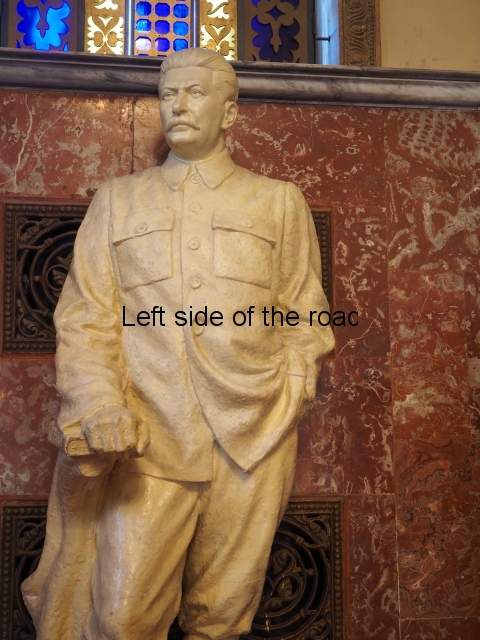
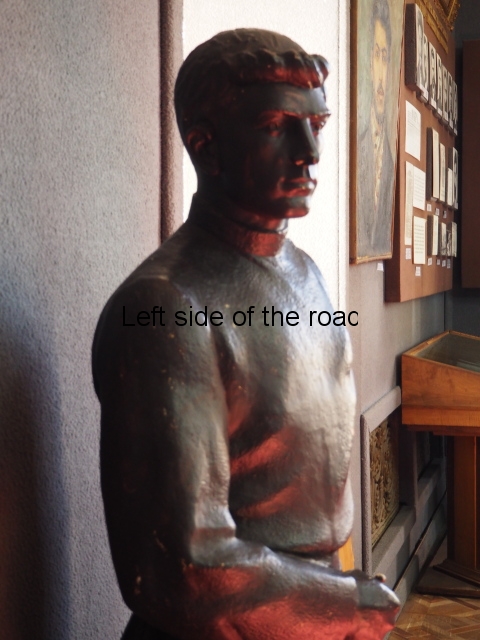
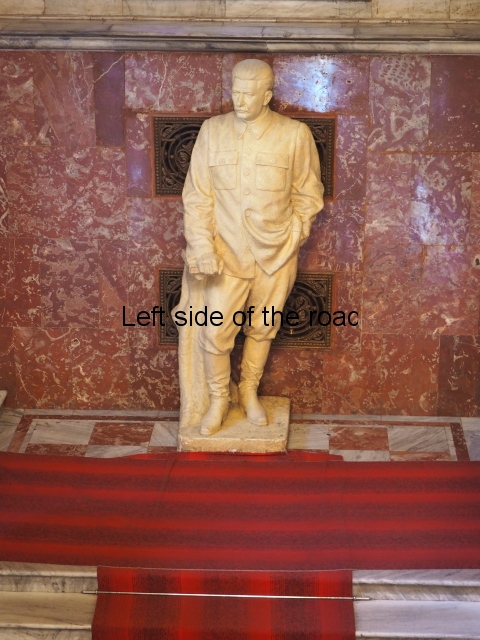
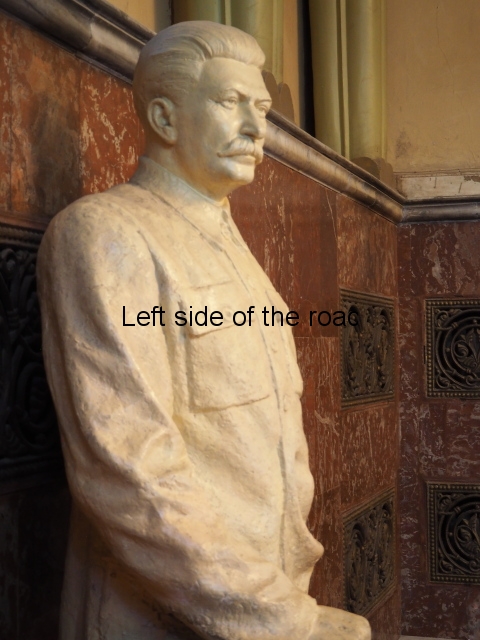
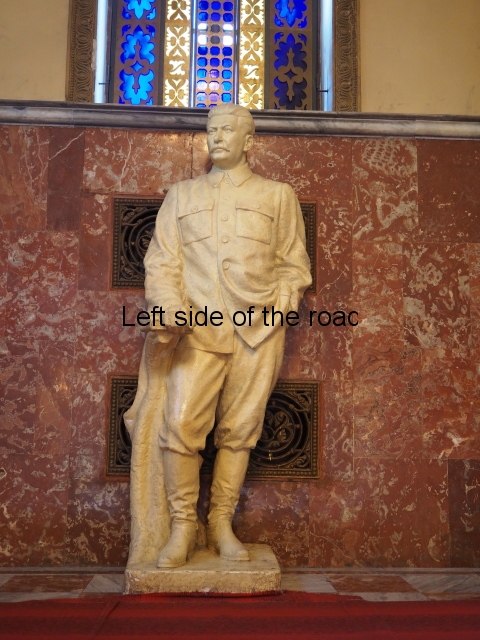
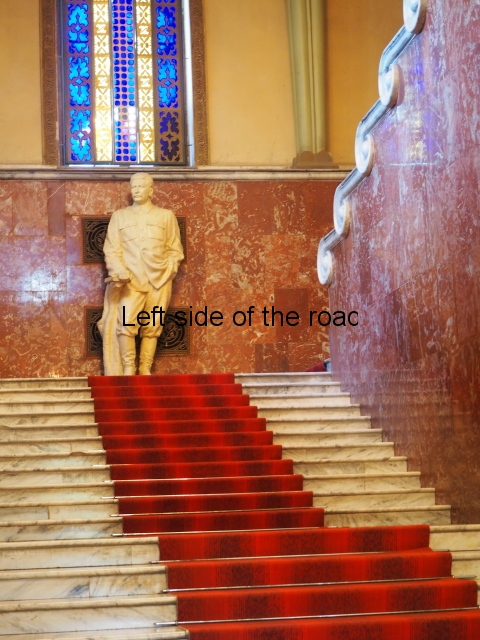
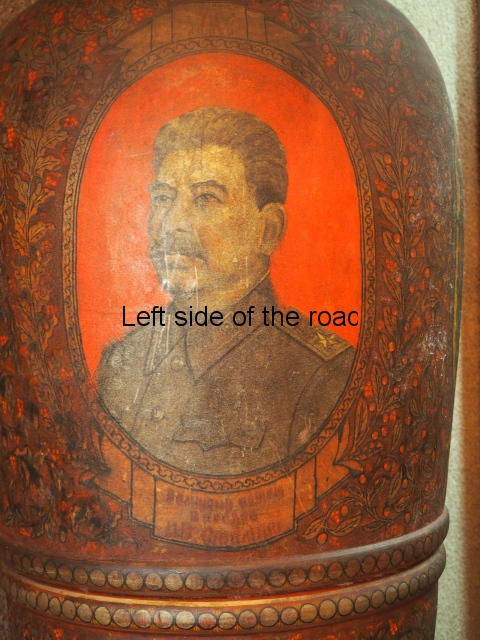
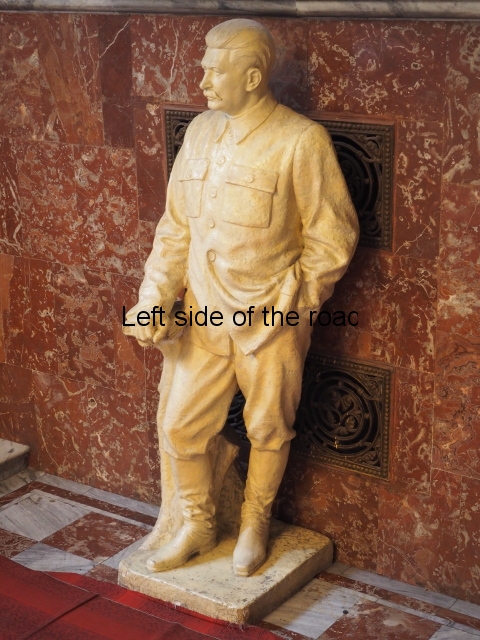
I don’t know when they were created but the life-size Stalin statues – one outside the museum and the copy which stands on the first landing of the stairs to the exhibition halls – are probably some of the worst likenesses of JV Stalin to be seen – apart from the terracotta wine container I obtained in Tbilisi. This, I can only assume, is deliberate. Georgian sculptors are no less able than those in different parts of the world to re-create an accurate image of an individual. To not do so is not a matter of artistic incompetence but a political statement attempting to erase the past. 

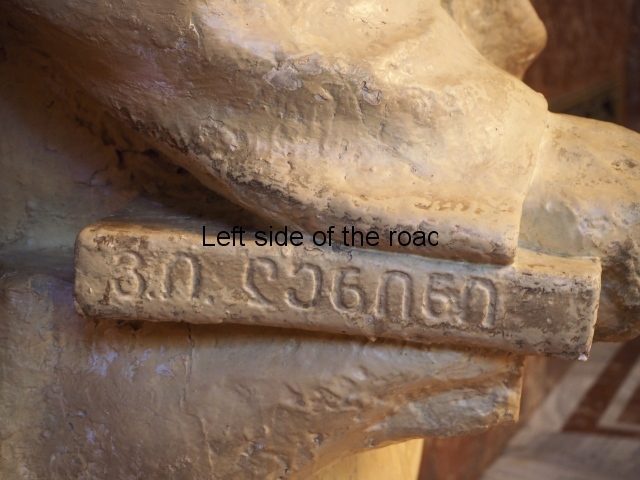
And one thing that demonstrates the dis-ingenuousness of these statues is the fact that Stalin’s right hand is resting on a book of his own writings, with his name in Georgian script on the spine. Never in his lifetime would Stalin self-reference in such a manner. If his hand would be on a book it would have been either on one of Marx, Engels or Lenin – never himself.

(However, though not widely known by visitors or really publicised anywhere in Gori itself, there are two ‘proper’ and ‘realistic’ statues of Uncle Joe still in existence within the city.)

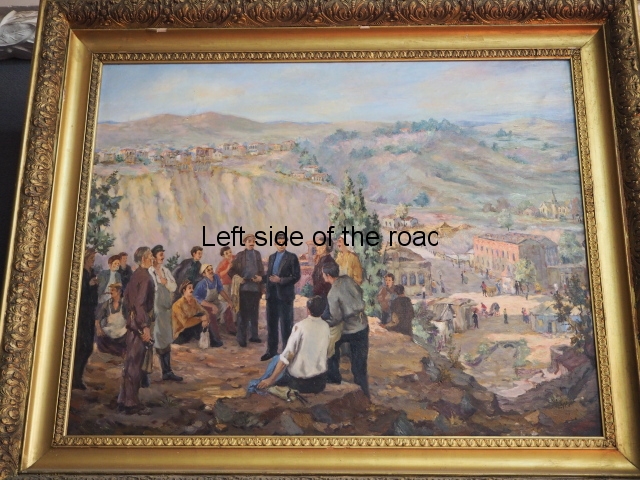
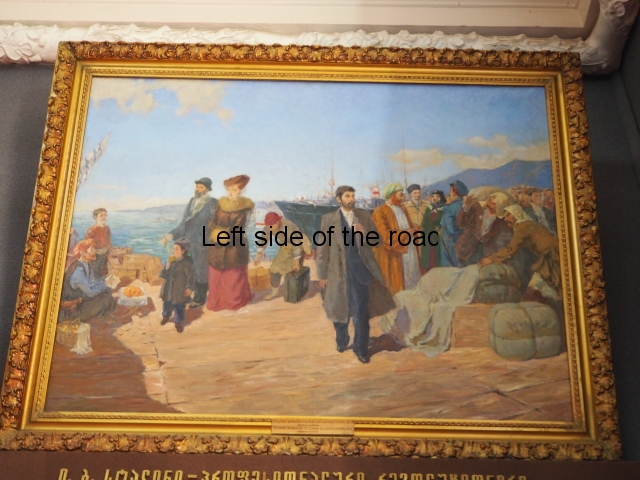
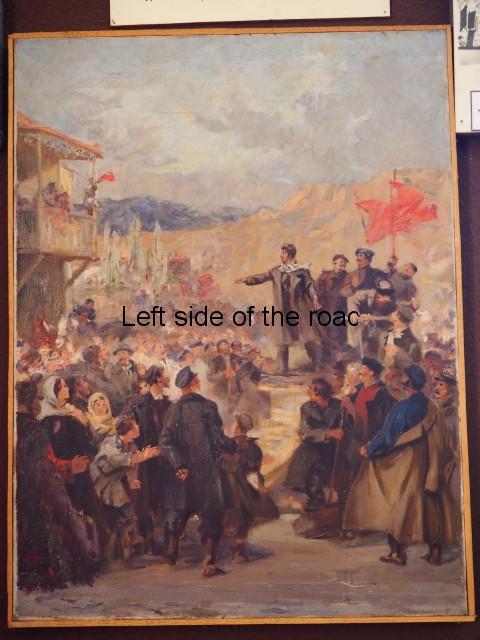
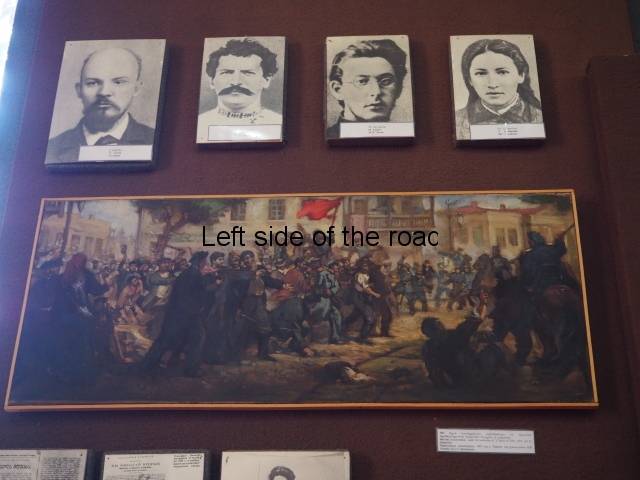
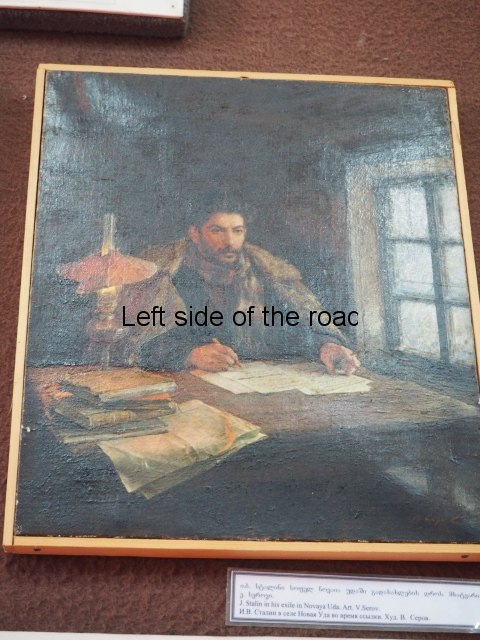
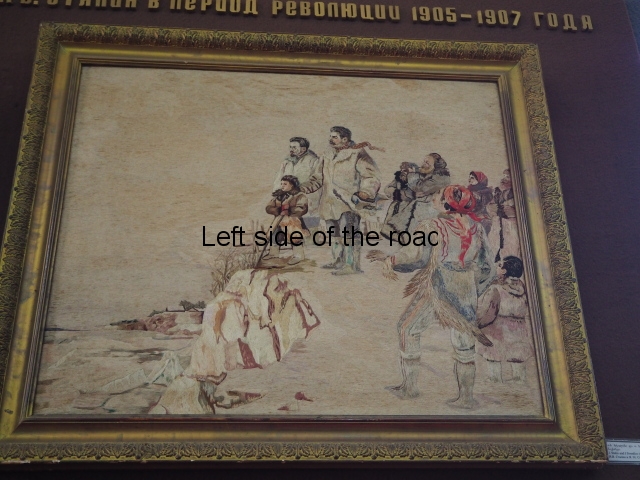
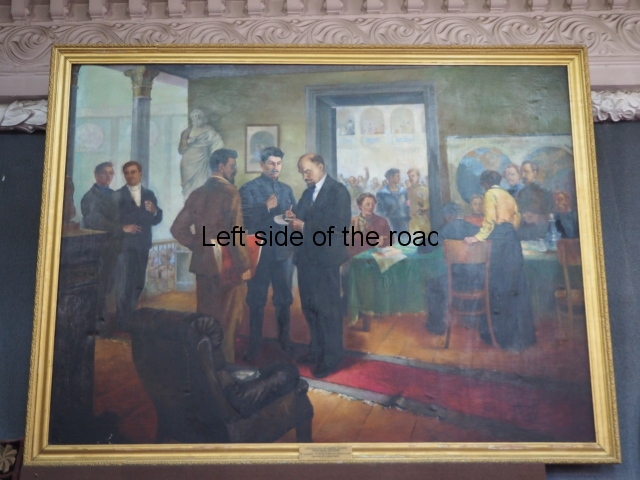
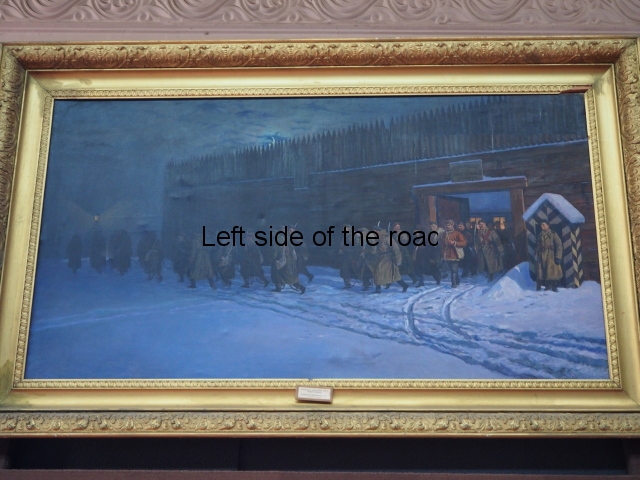
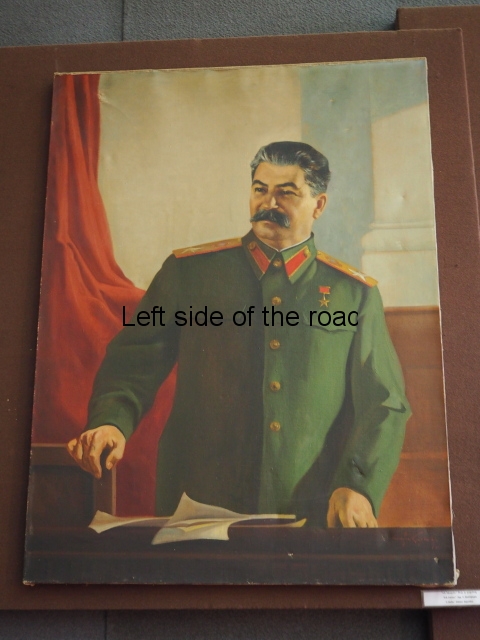
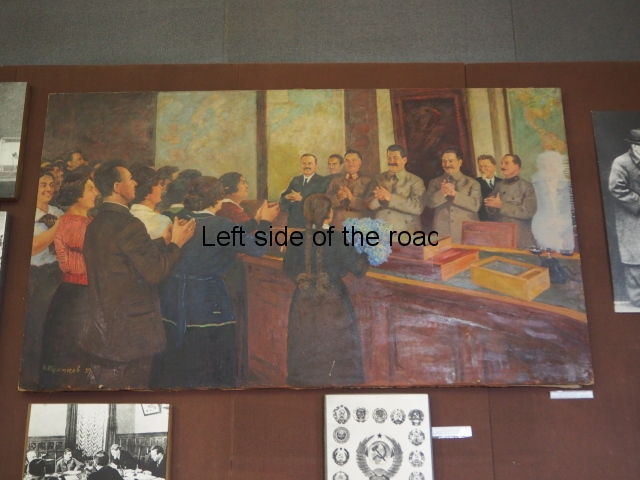
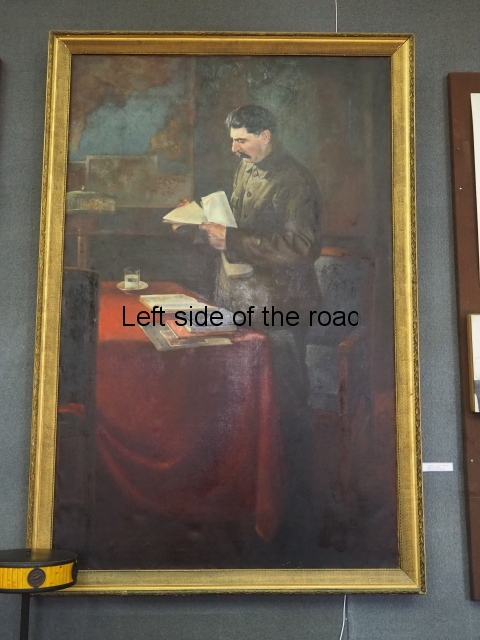
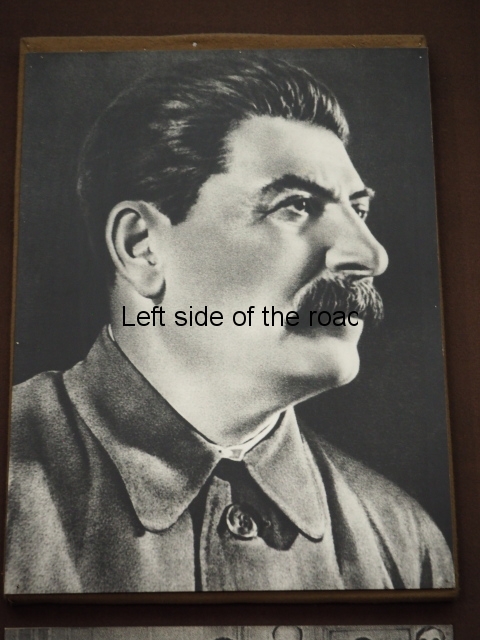
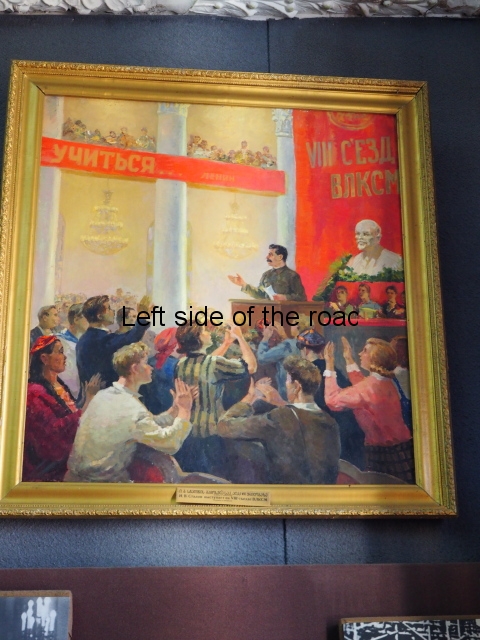
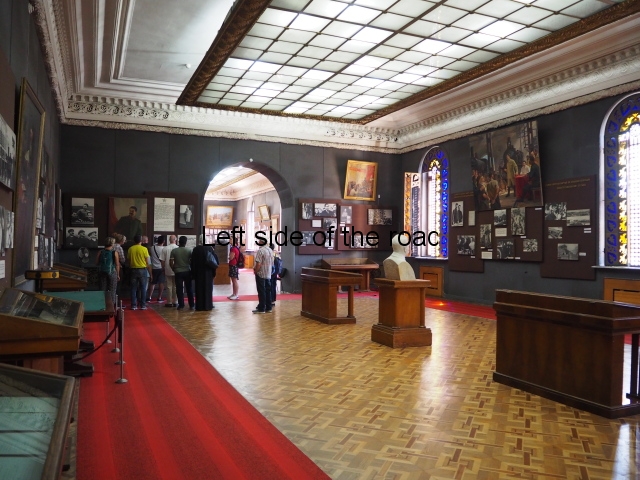
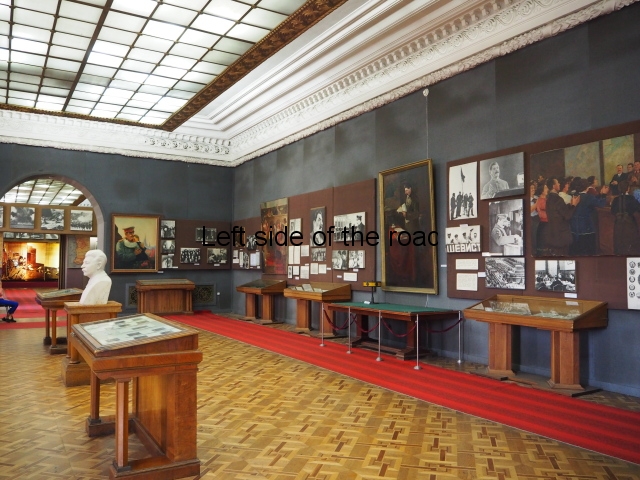
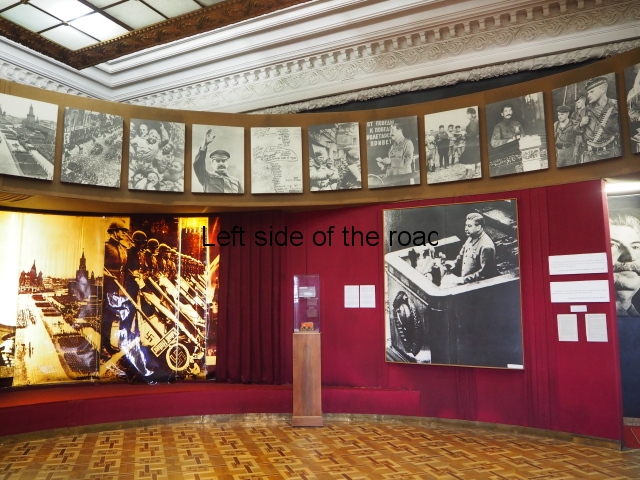
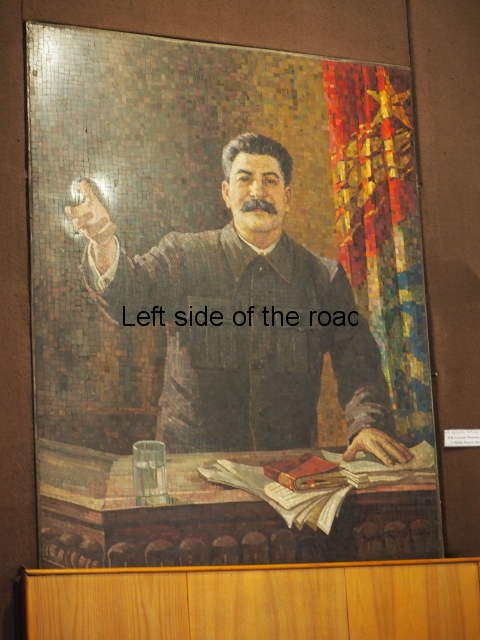
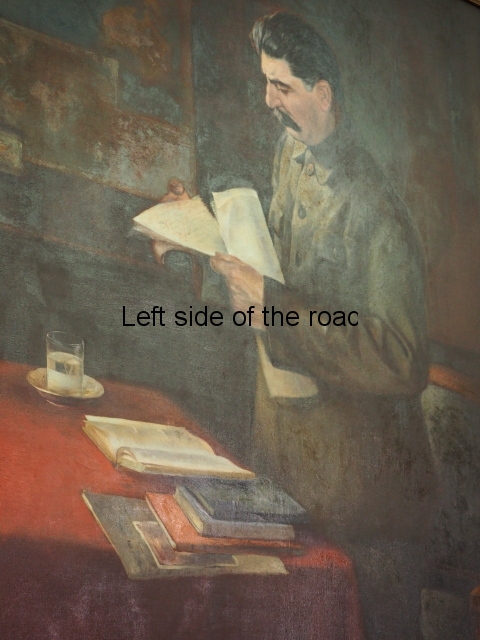
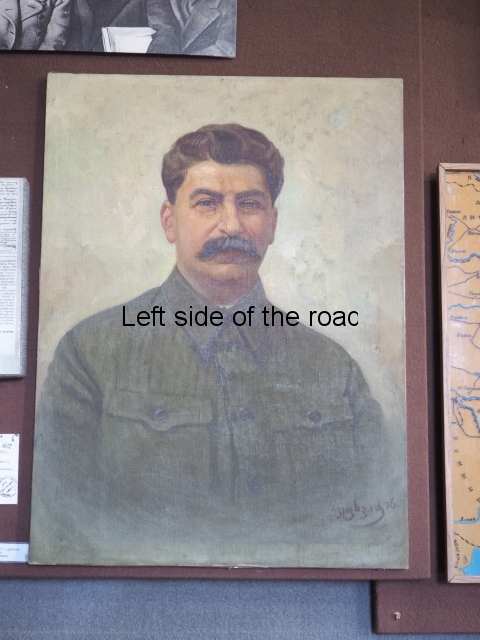
Comprising mainly of artistic representations of Stalin’s life (paintings and statues) and reproductions of photographs – many of which anyone with an interest in the period would have seen before – there are also a few personal artefacts. Uncle Joe wasn’t really into ‘consumerism’ and so there are few of the latter.

The aim of this post is to provide a video and photographic impression of the museum for those who have not yet had the opportunity to visit this unique location. To go to a video of the various parts of the museum click the link on the individual Rooms (numbered from 1 to 6, plus the Illegal printing press in Tiflis (Tbilisi), the reconstructed Kremlin Office and Stalin’s Birthplace). (Apologies for the low quality of the videos – no Oscar for me this year.) Then there’s a quite extensive photographic slide show/gallery at the end of the post.

Young Stalin

Young Stalin

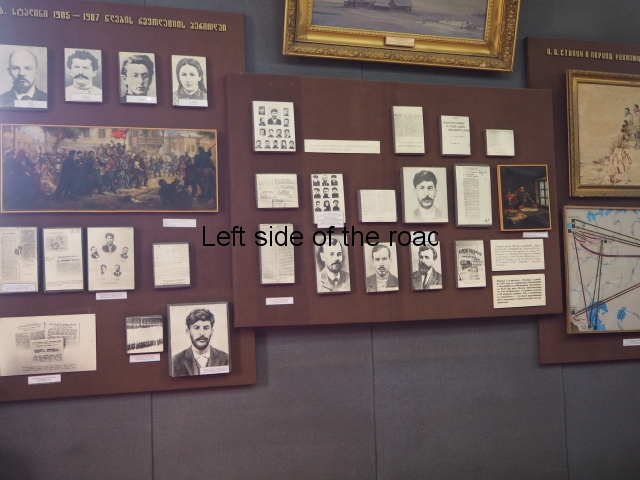
Room 1 – Early life, through Revolution and Civil War to the death of VI Lenin

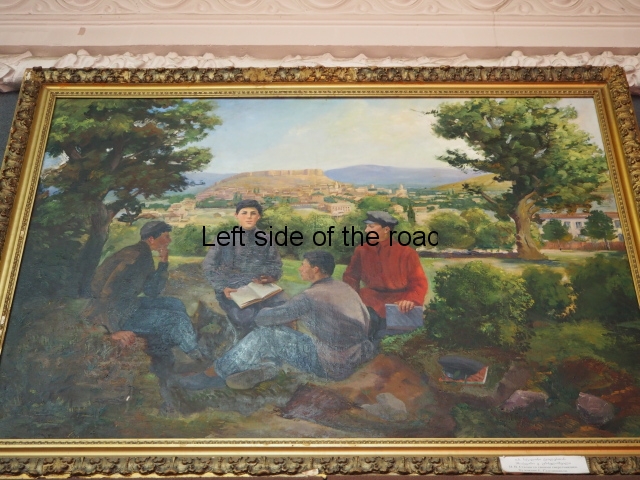
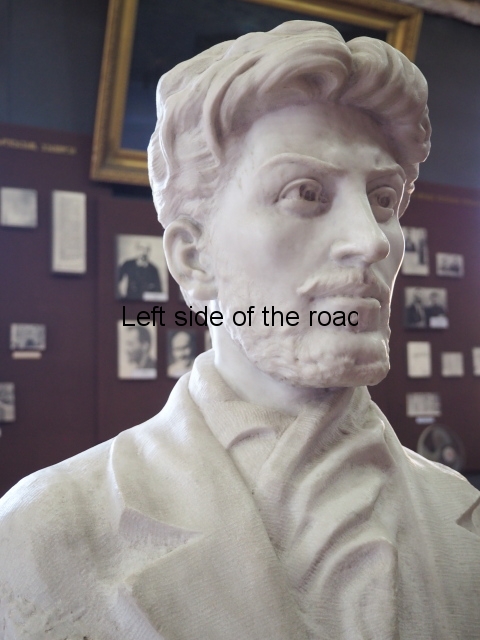
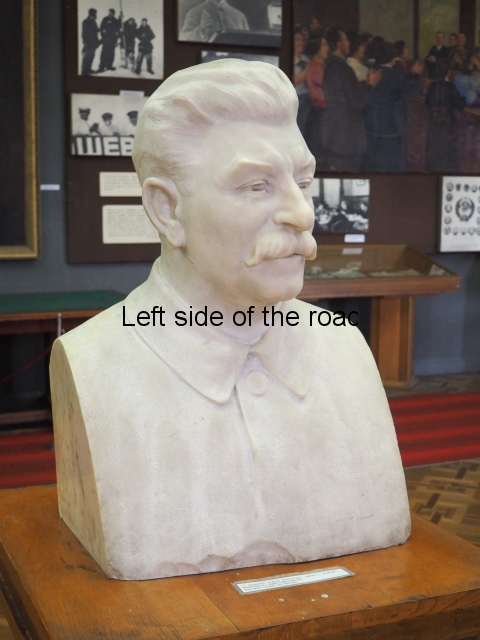
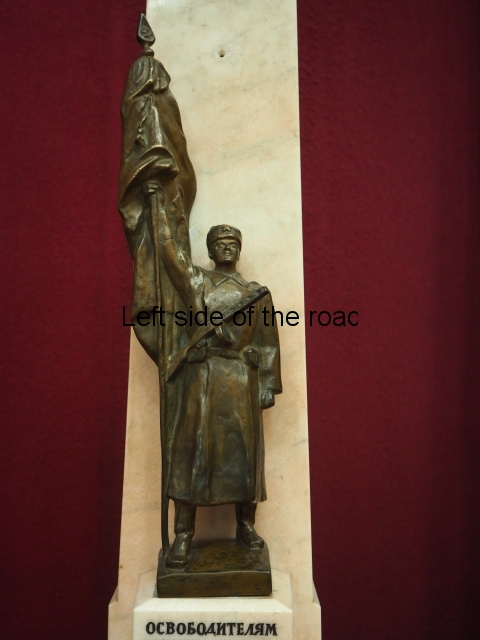
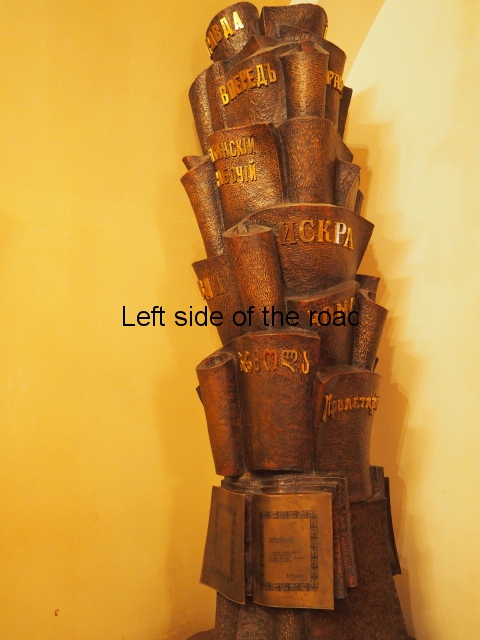
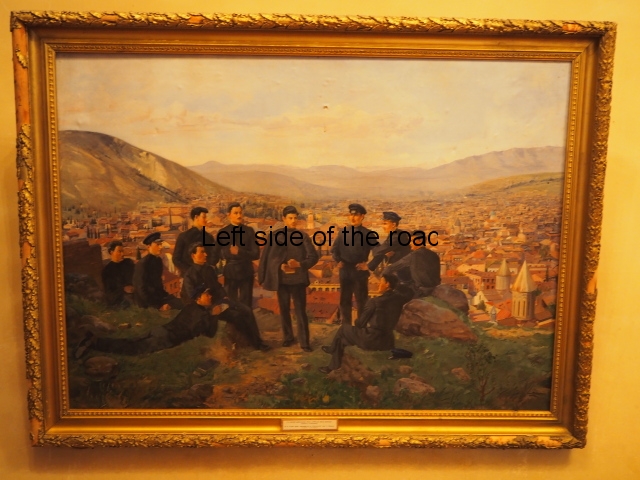
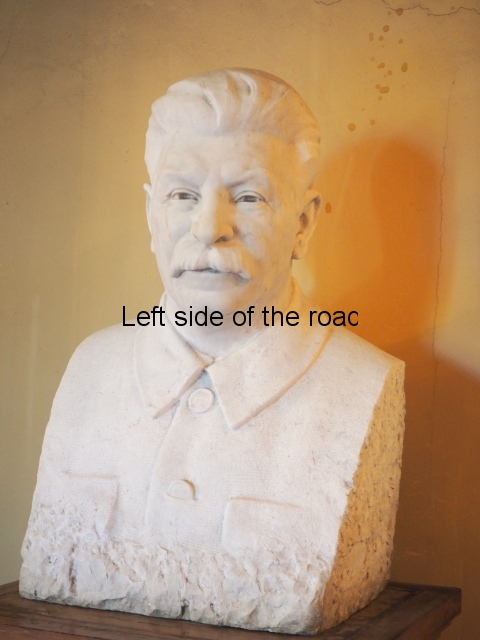
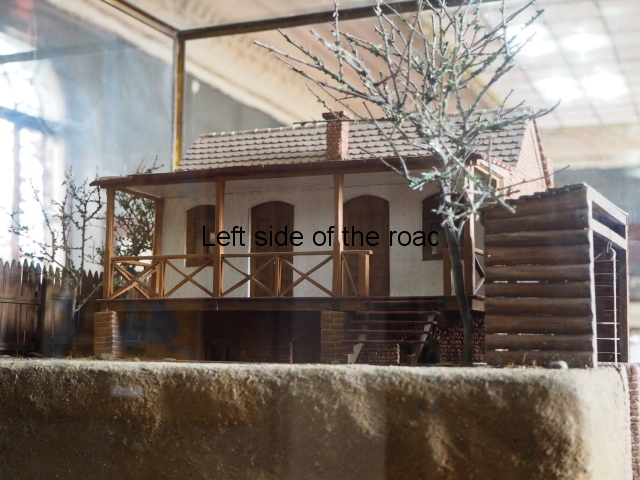
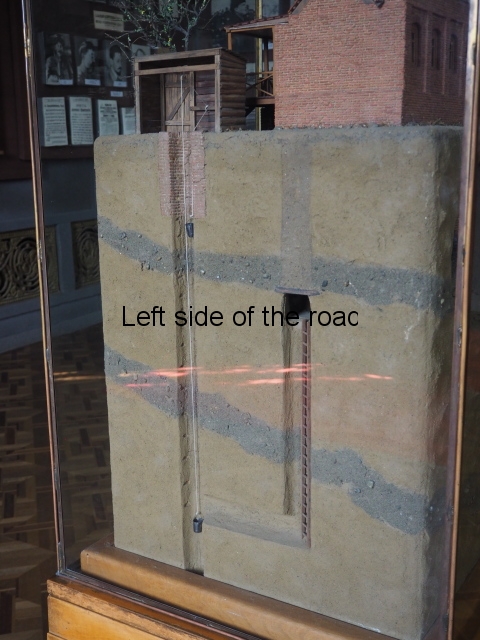
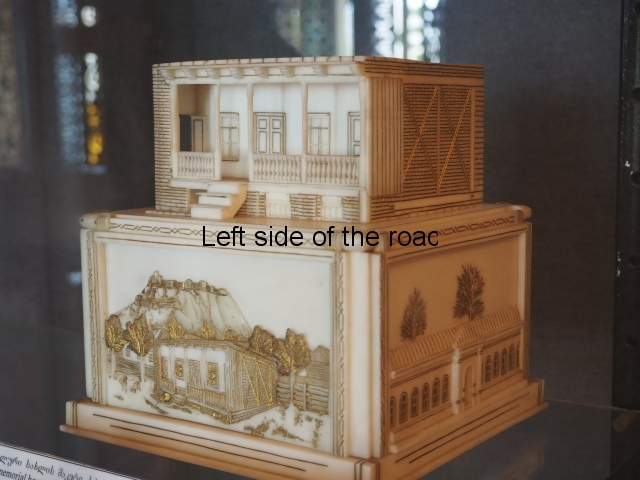
Highlights of this room include: a full size statue of the young Stalin; a maquette of his birthplace; a bust of the young Stalin and a maquette of the illegal printing press (see below).

The house of the illegal printing press, Tiflis

The house of the illegal printing press, Tiflis

The illegal printing press in Tiflis (Tbilisi) 1906

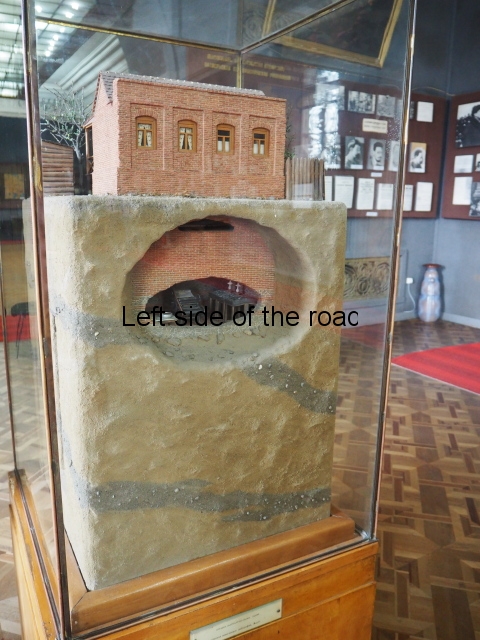
Just before the entrance to the second room, in the middle of the floor, can be found a maquette of the building which hosted the illegal printing press that Stalin was instrumental in establishing (and for which he wrote many articles and leaflets) that existed for a short time from November 1903 to April 1906 in Tiflis (present day Tbilisi). From looking at this model you can appreciate the amount of effort and planning that went into the hiding of this press from the Tsarist reactionary forces (and especially its ‘secret’ police, the Okhrana). It also makes you think about the determination of the Georgian/Russian revolutionaries to defeat the exploiting class. Such imagination, determination and dedication of present day ‘revolutionaries’ would be more than welcomed.

Stalin with the future

Stalin with the future

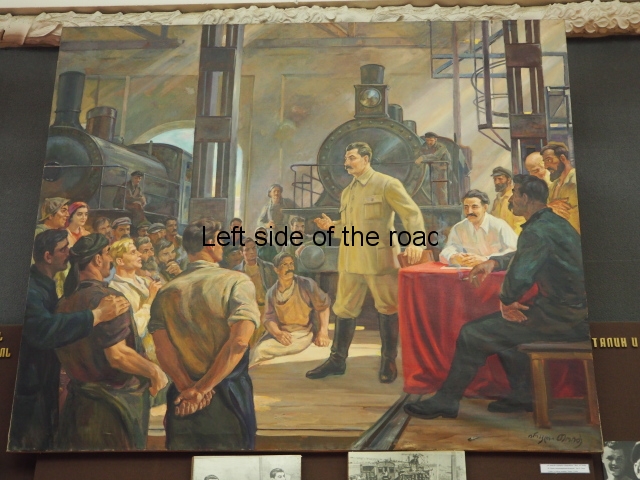
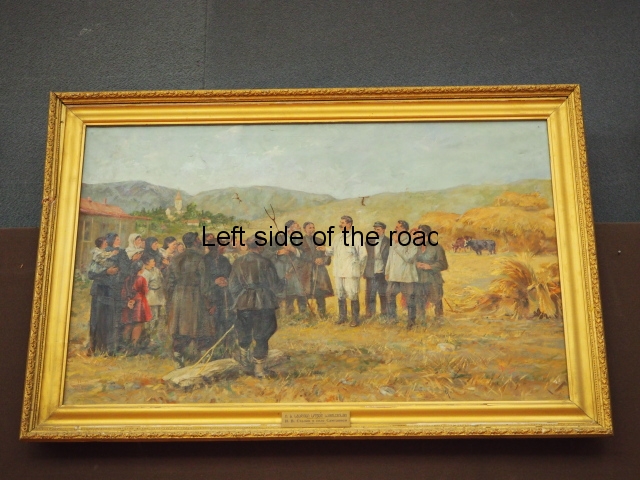
Room 2 – From Collectivisation and Industrialisation to the beginning of the Great Patriotic War

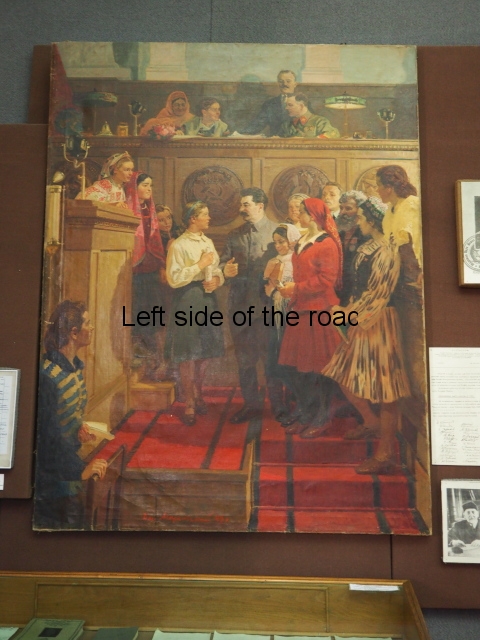
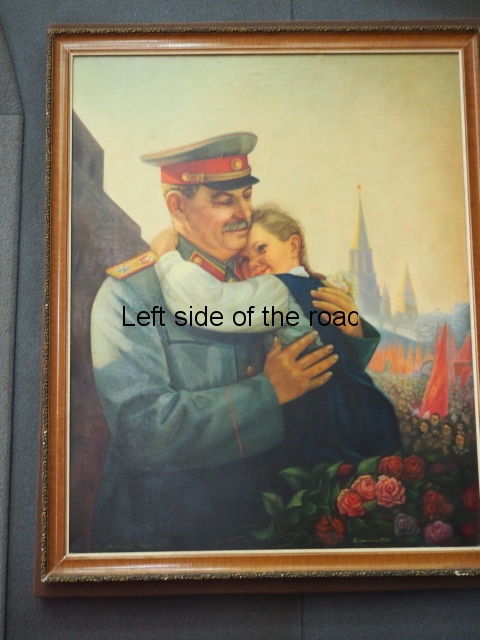
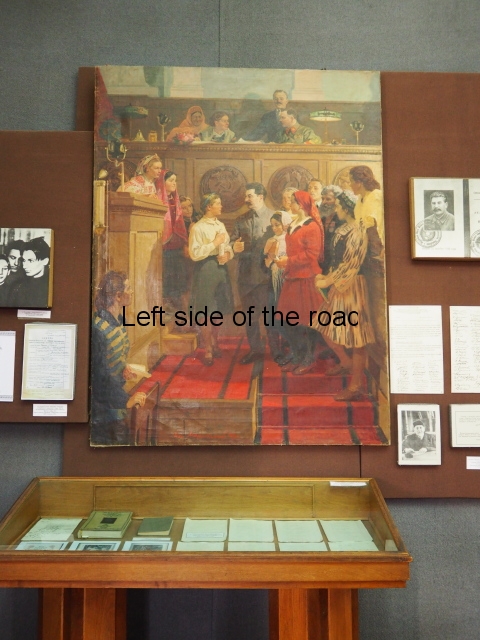
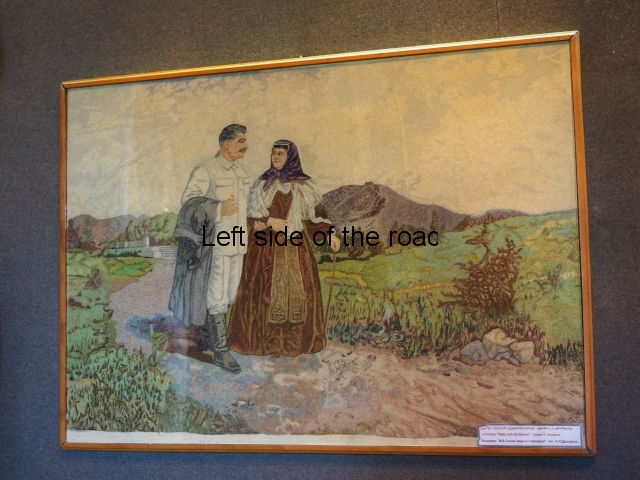
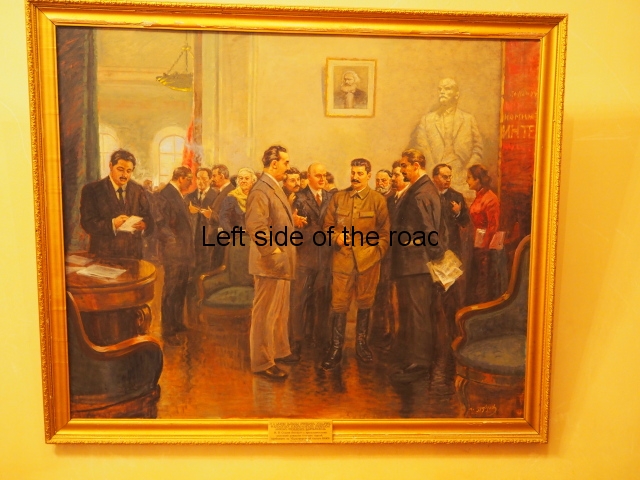
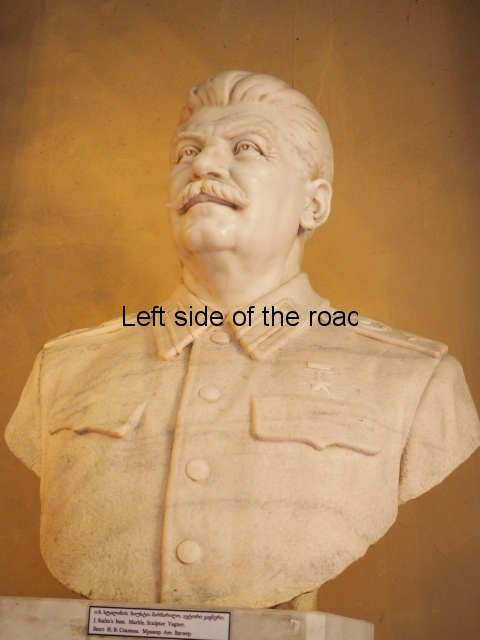
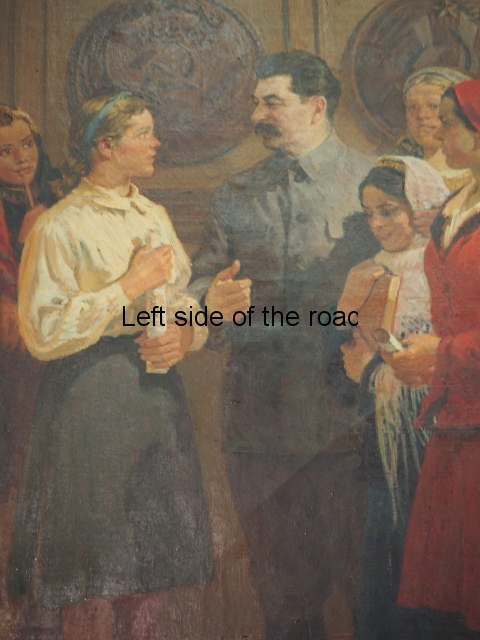
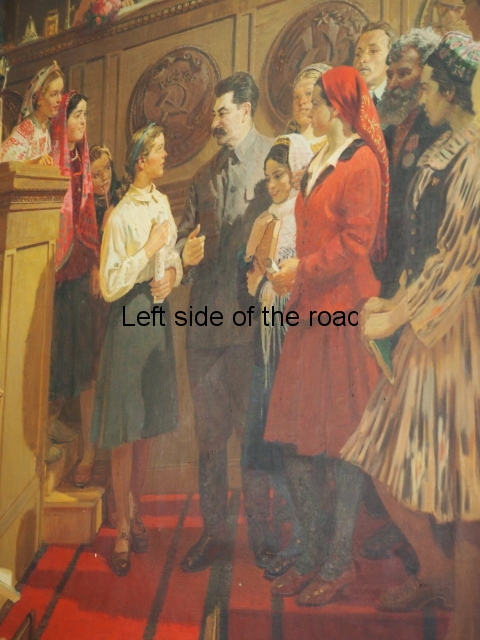
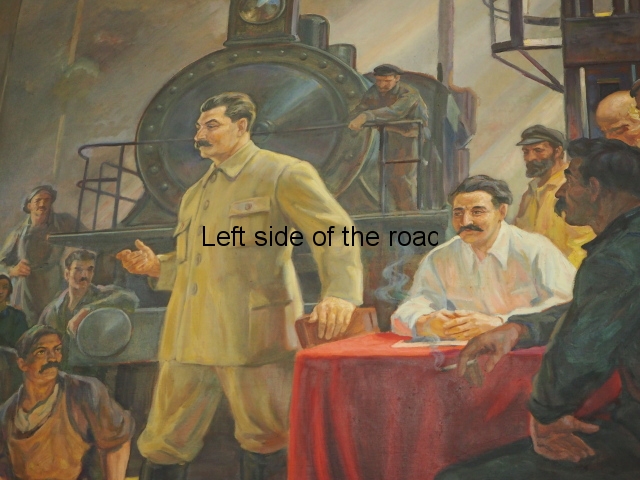
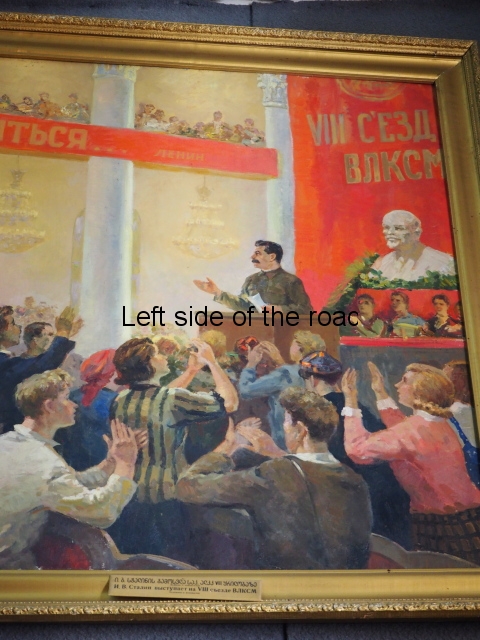
Highlights in this room include: Stalin at a meeting with workers in a locomotive works; Stalin with Collective Farm workers; Stalin greeting a young female collective farm worker; a series of postcards produced in the 1930s and a large bust of an older Stalin.

Stalin tank lamp

Stalin tank lamp

Room 3 – The Great Patriotic War

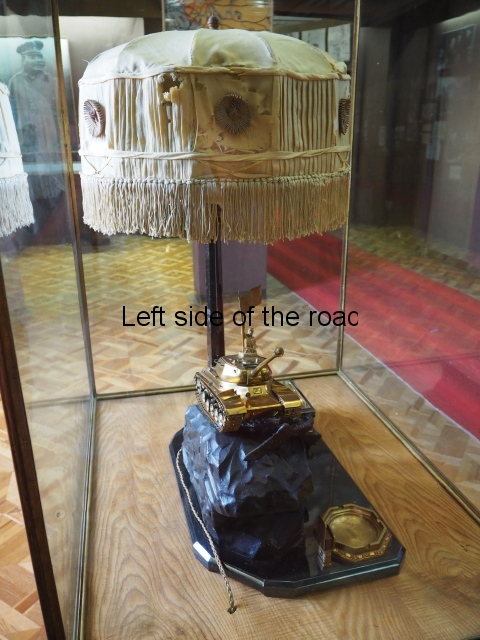
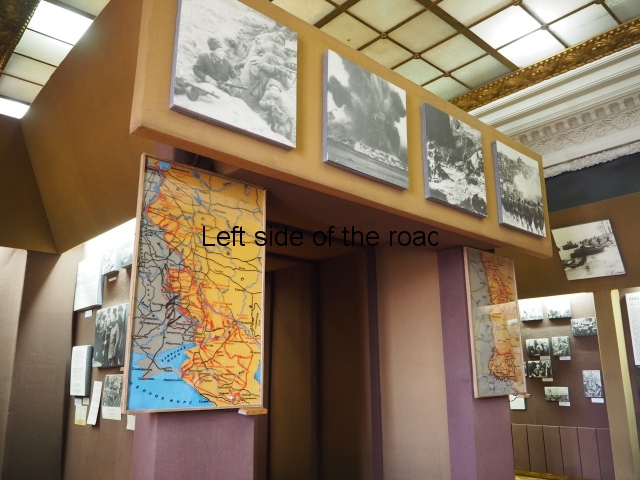
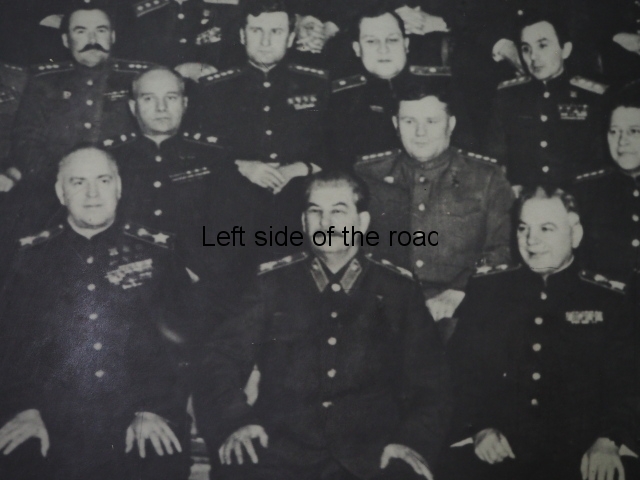
Highlights in this room include: a lamp incorporating a Stalin tank; a section on Stalin’s family (his wives and children); military maps describing some of the major campaigns of the Great Patriotic War and Stalin with his generals.

Soviet power annihilates Nazism

Soviet power annihilates Nazism

Room 4 – A review of his life and the 19th (final) Congress

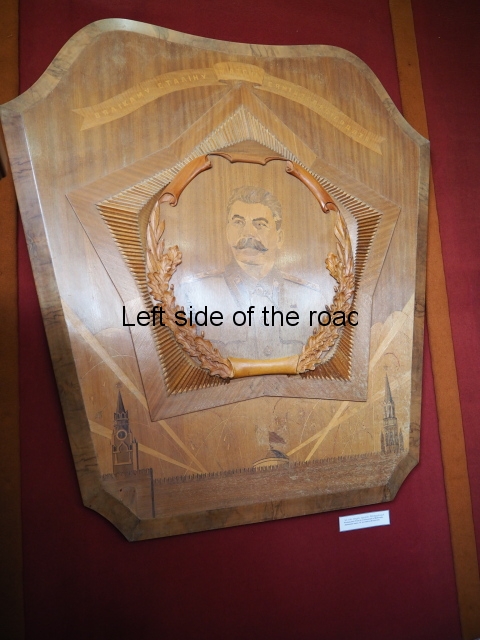
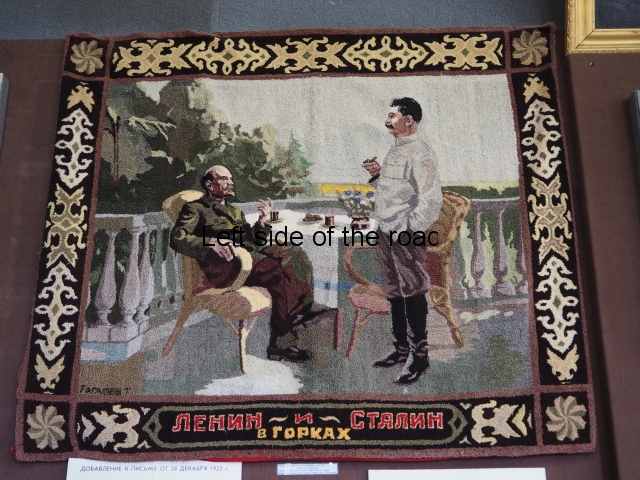
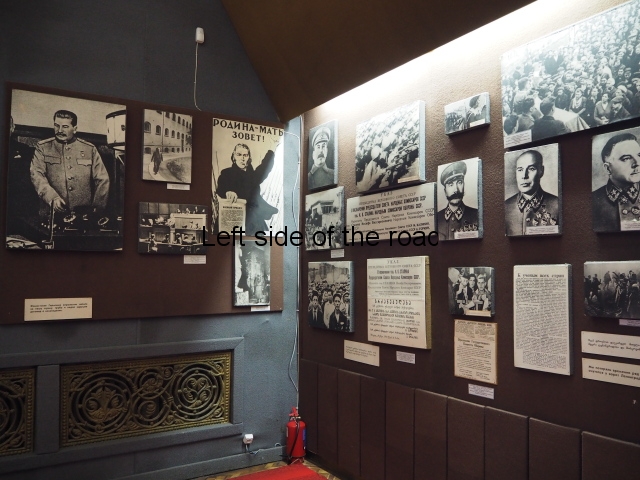
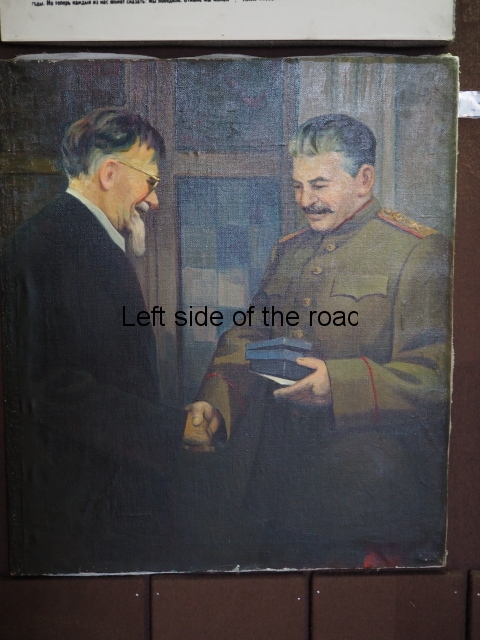
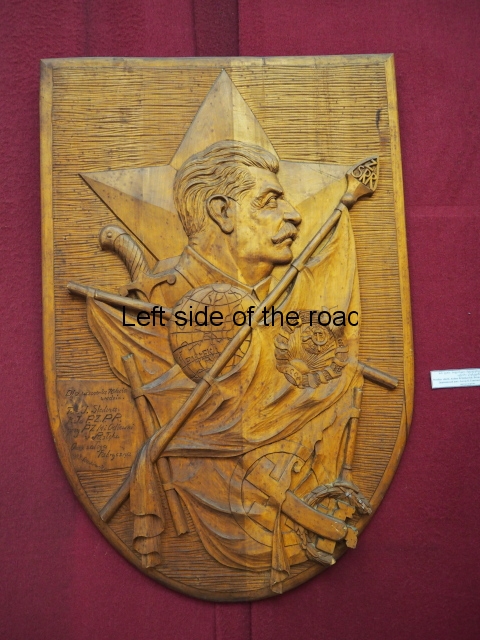
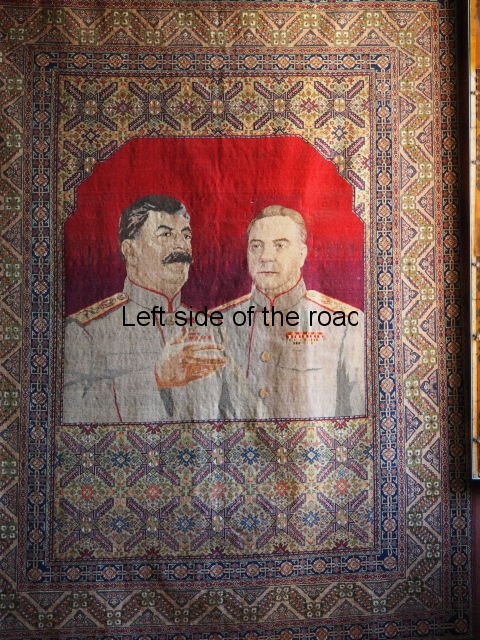
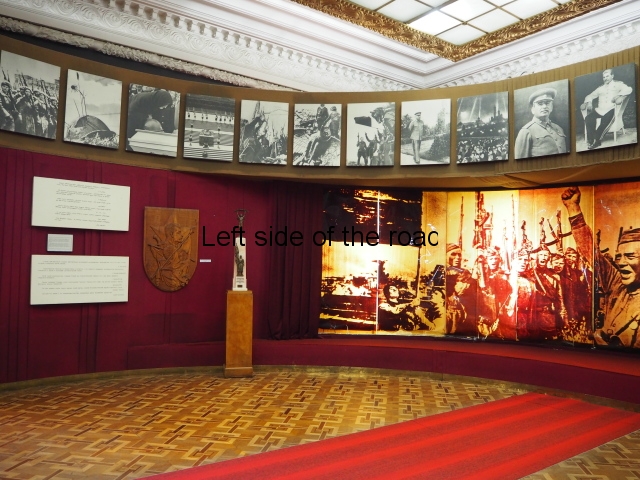
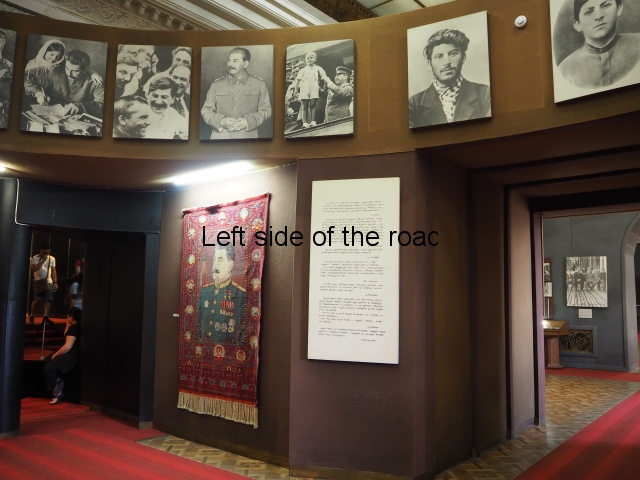
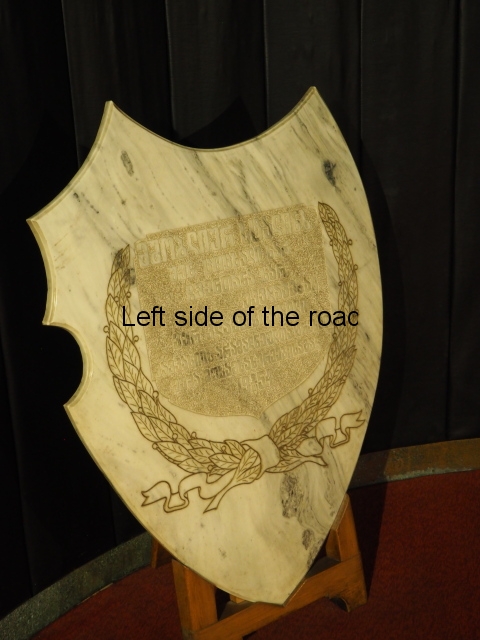
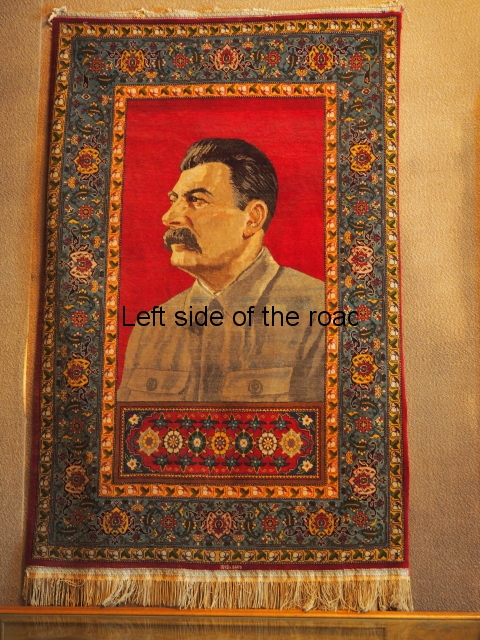
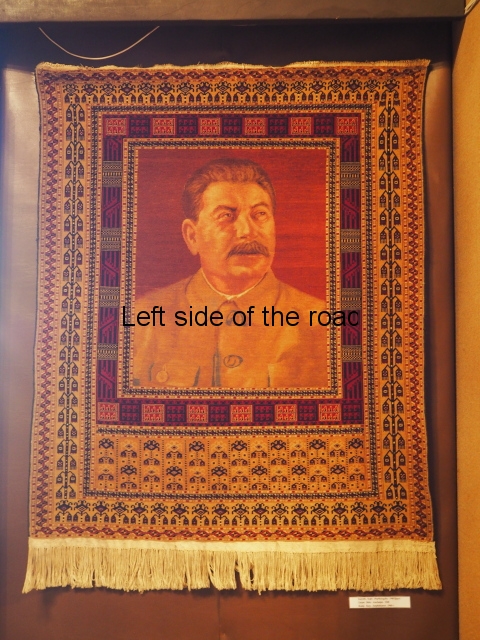
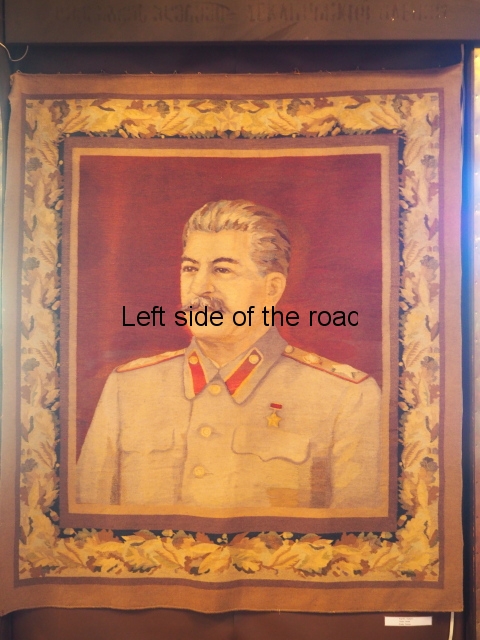
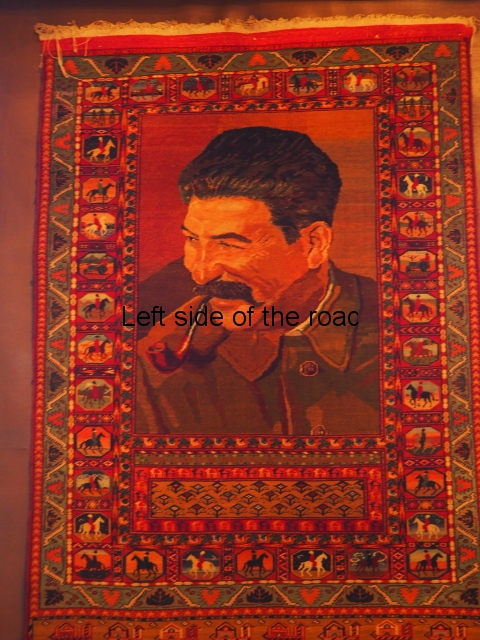
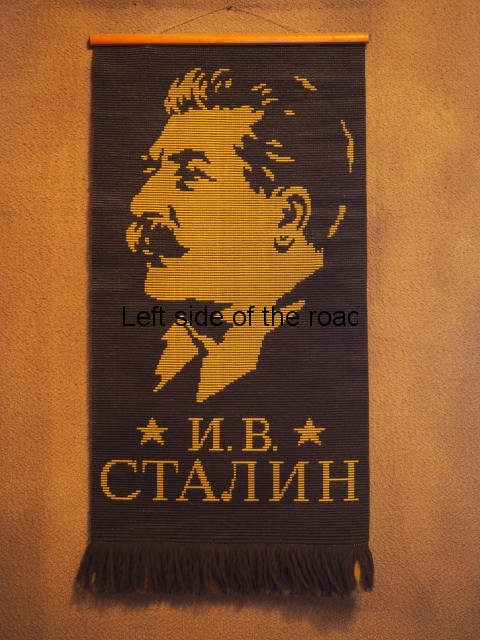
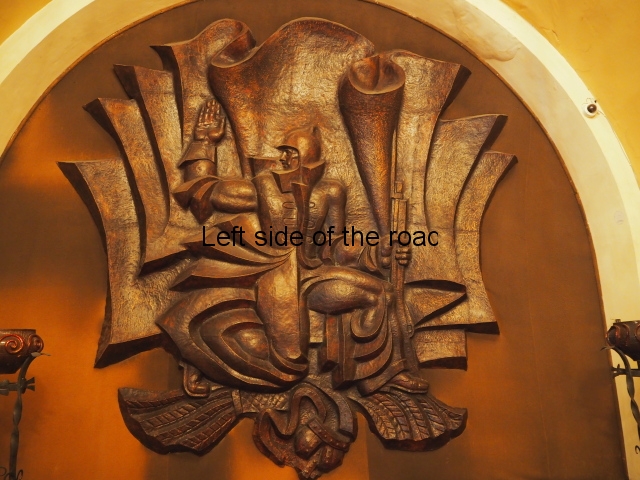
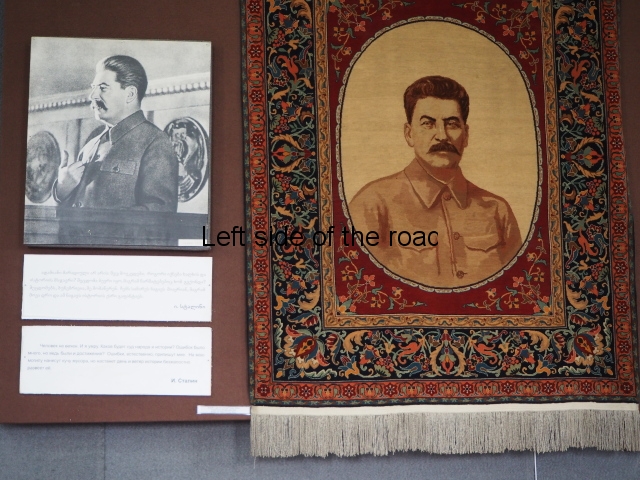
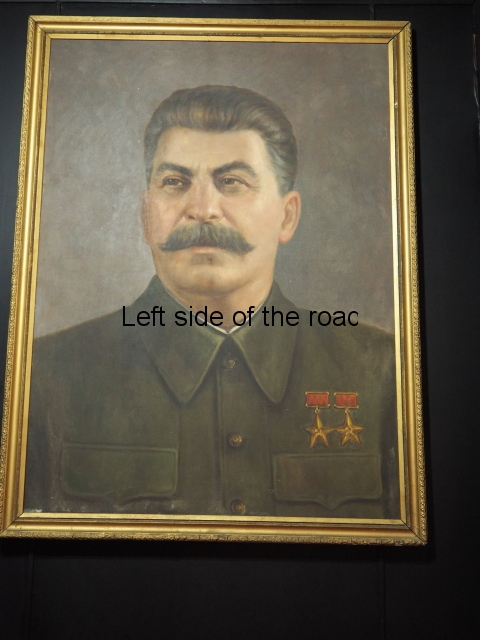
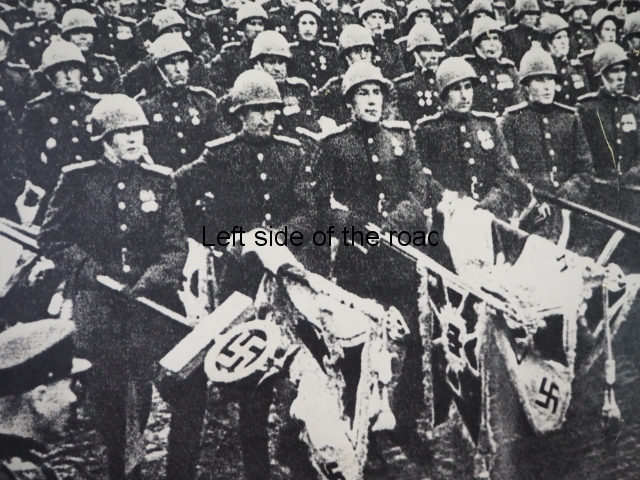
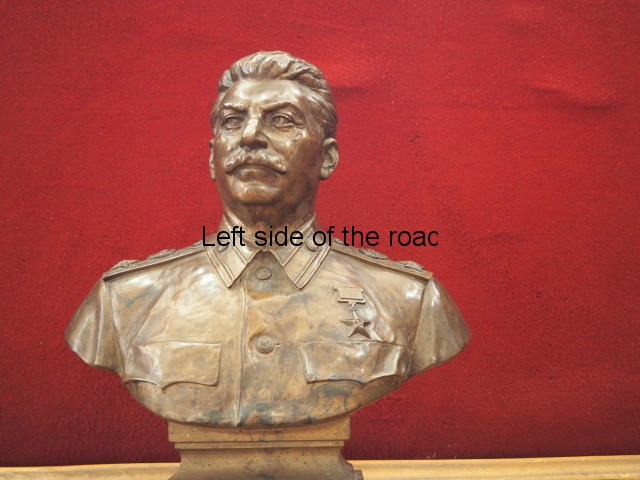
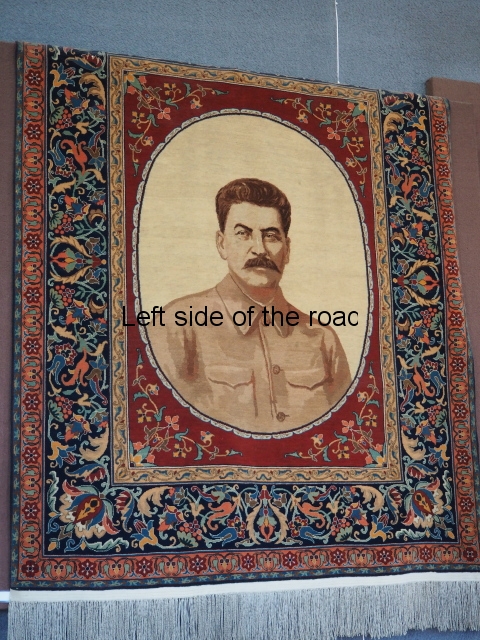
Highlights in this room include: a carved wooden shield with Stalin in profile amongst a number of symbols representing the Soviet Union and the image of a Russian sword smashing through a swastika at the bottom right; pictures taken a various stages of Stalin’s life; two large carpets with an image of Stalin (one of them also with Kliment Voroshilov); an image of Nazi banners being dragged through the dirt of Red Square in front of the Lenin Mausoleum and a picture of one of Stalin’s last public appearances at the 19th Congress of the CPSU.

Stalin lying in state - 1953

Stalin lying in state – 1953

Room 5 – Stalin’s Death

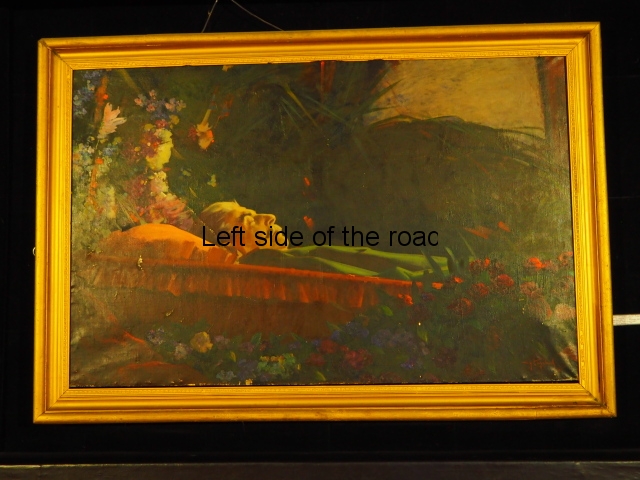
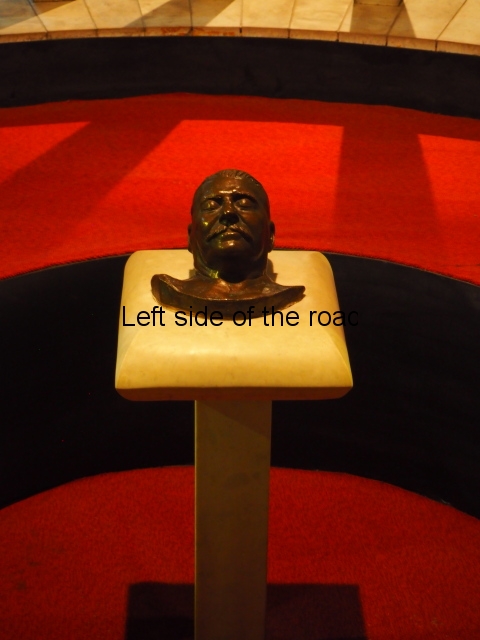
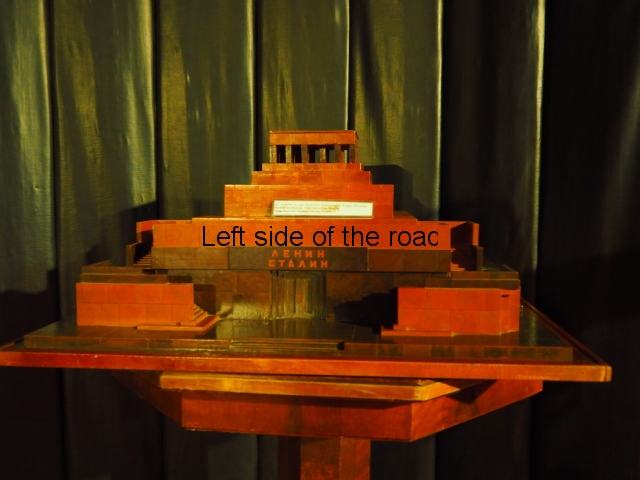
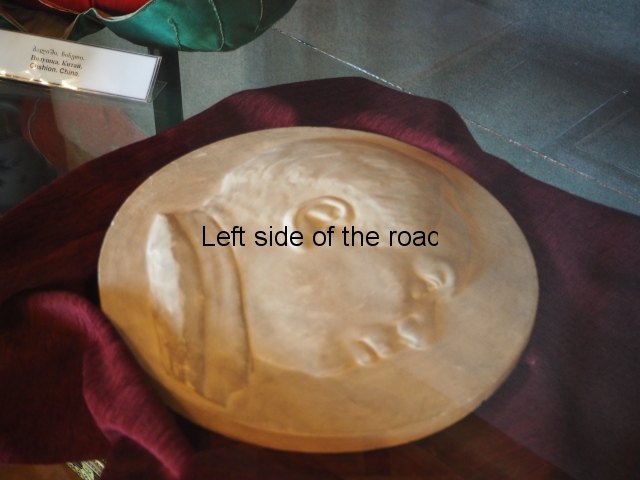
Highlights in this room are: Stalin’s death mask; a painting of Stalin lying in state and a maquette of the Mausoleum in Red Square bearing the names of both Lenin and Stalin.

Stalin and Mao

Stalin and Mao

Room 6 – Presents

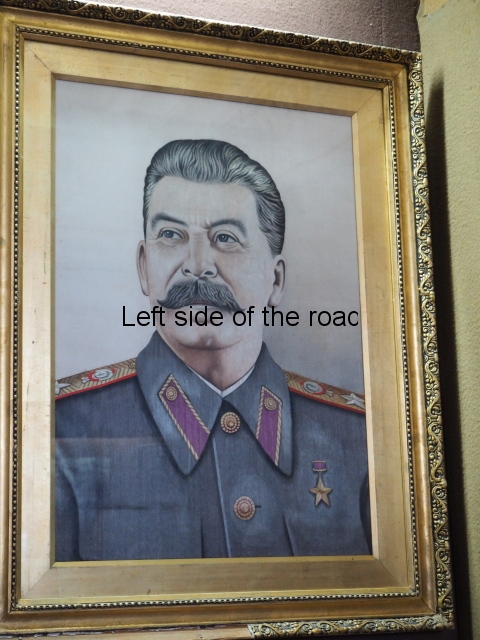
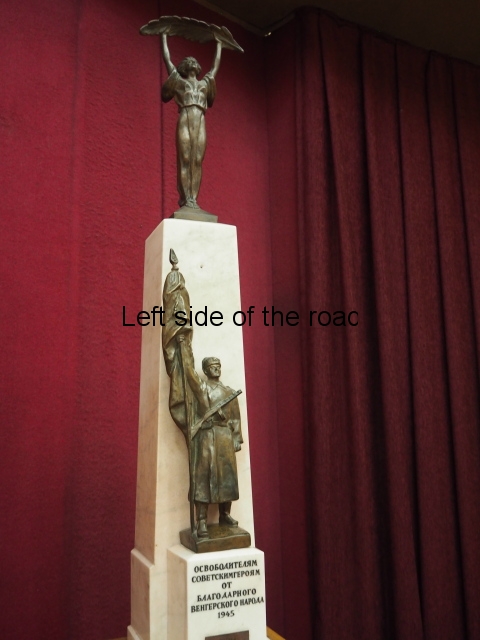
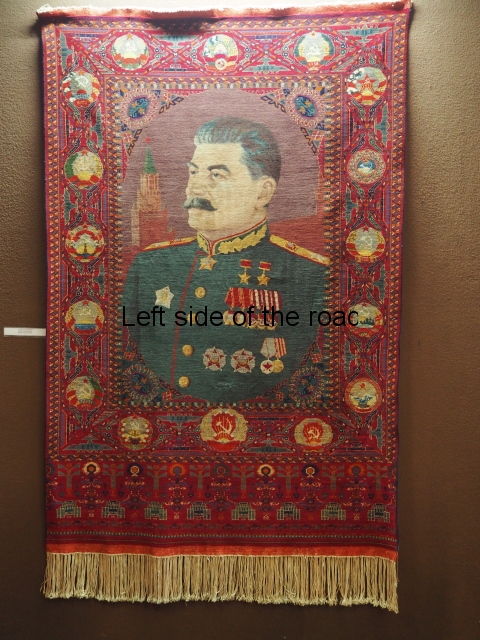
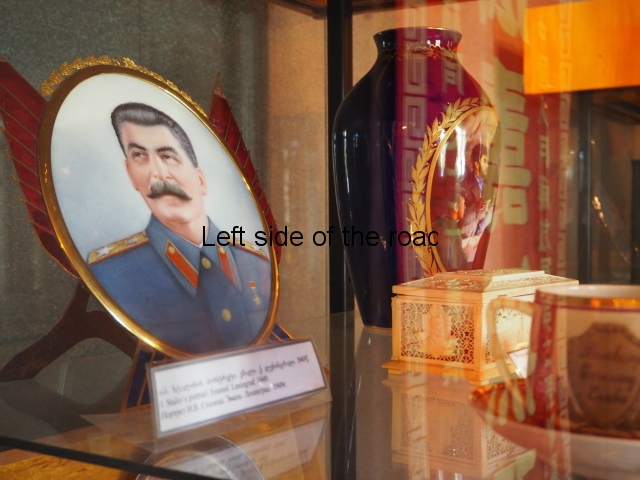
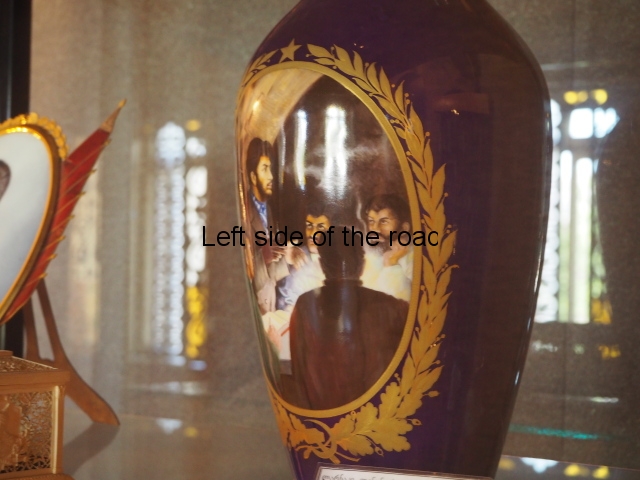
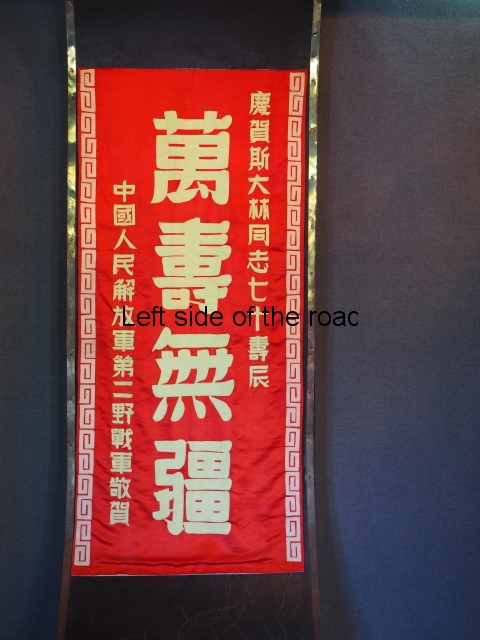
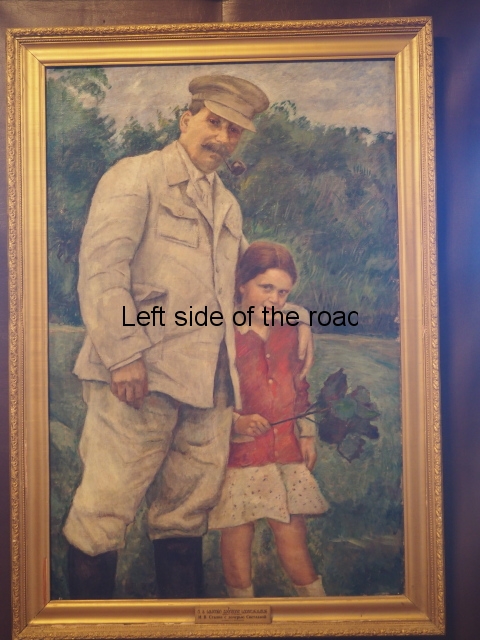
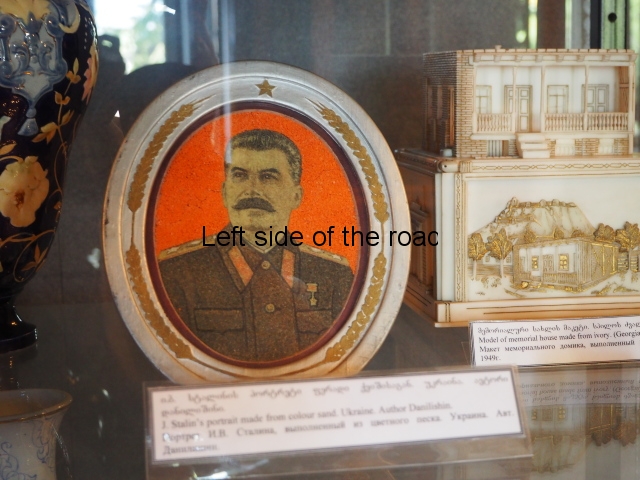
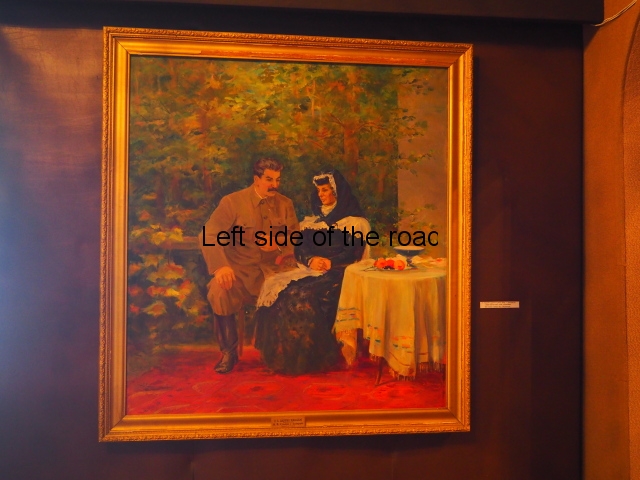
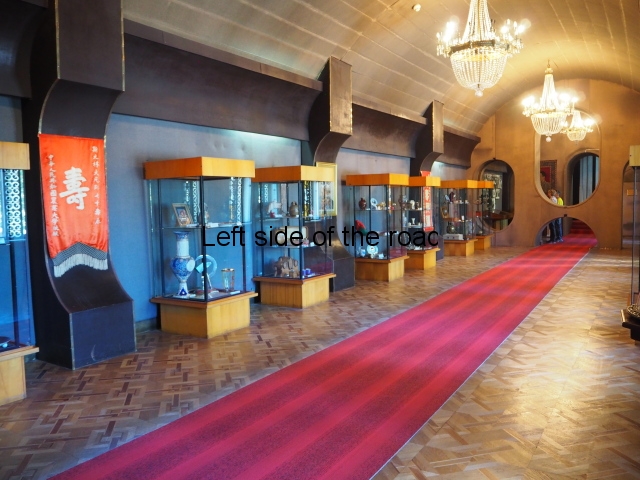
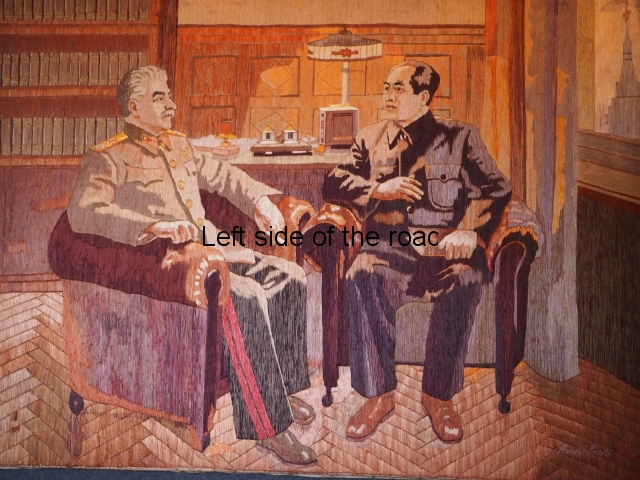
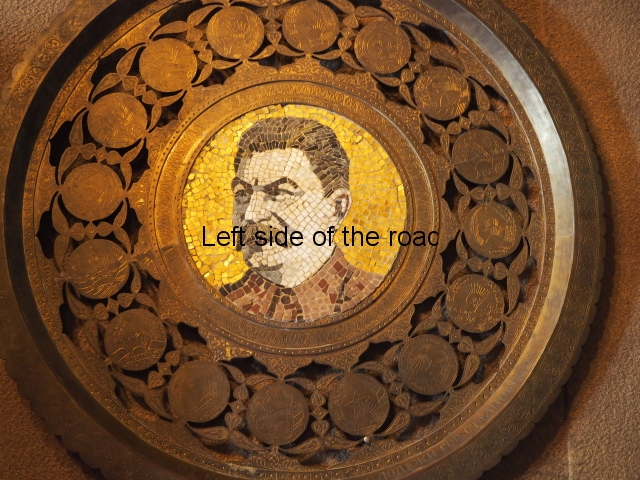
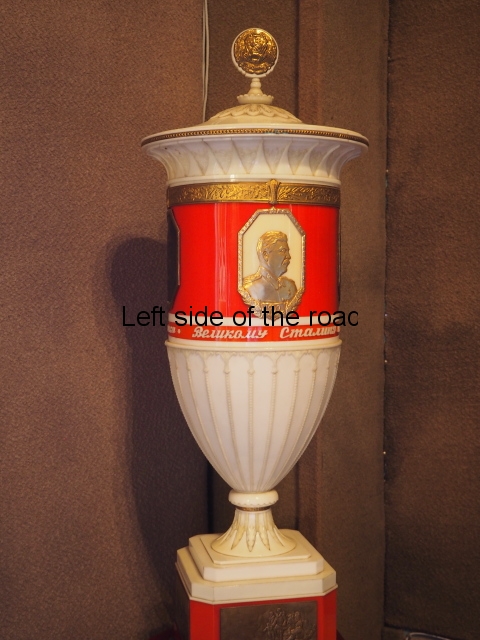
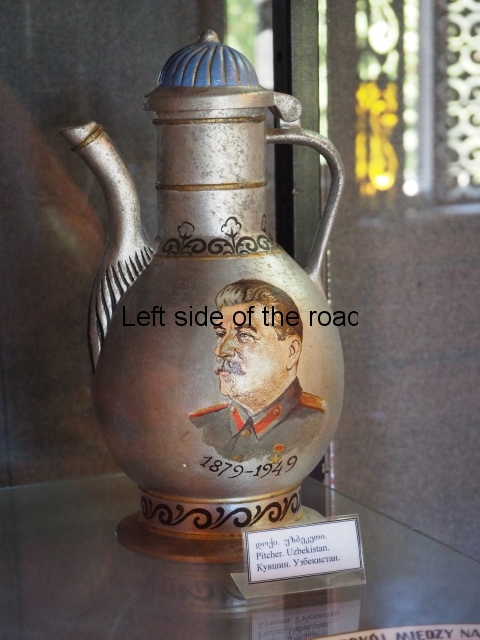
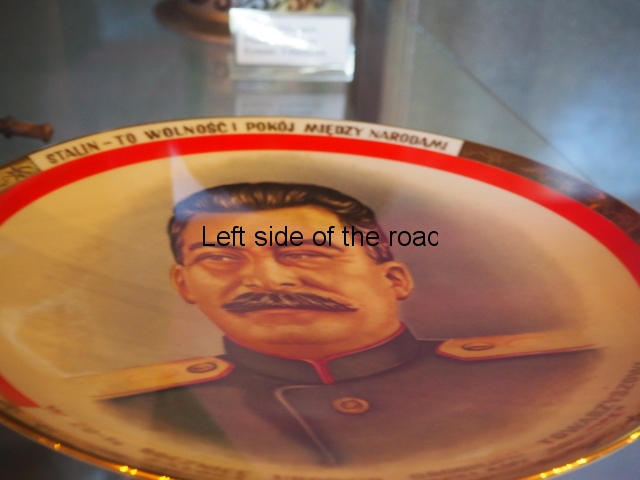
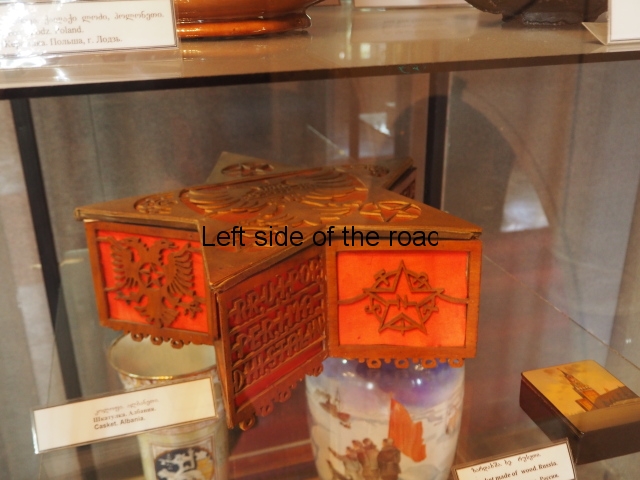
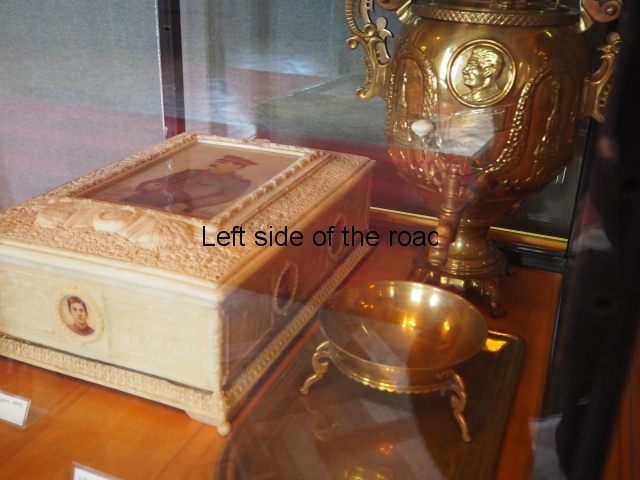
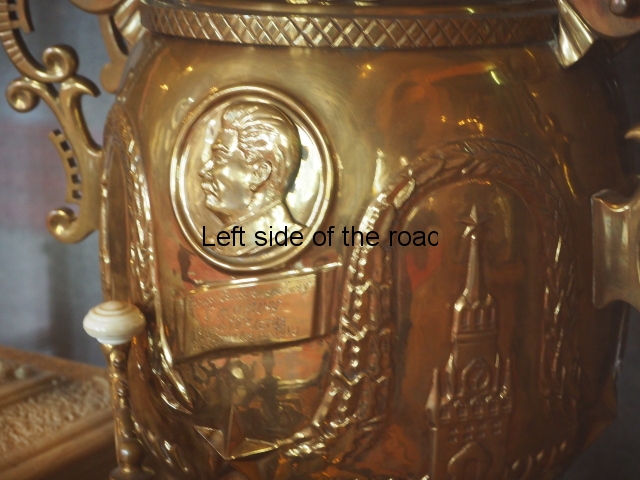
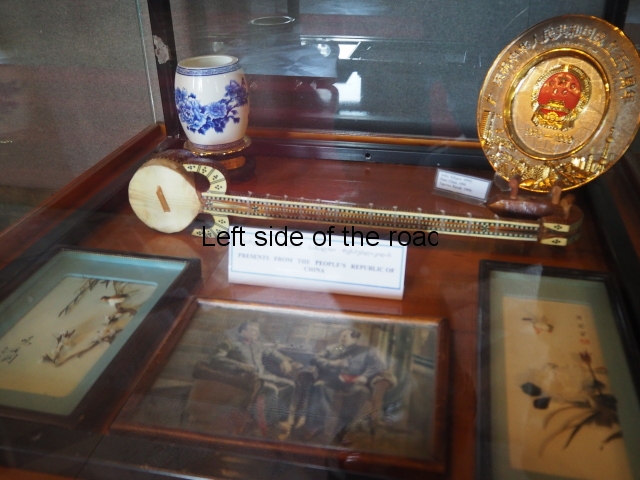
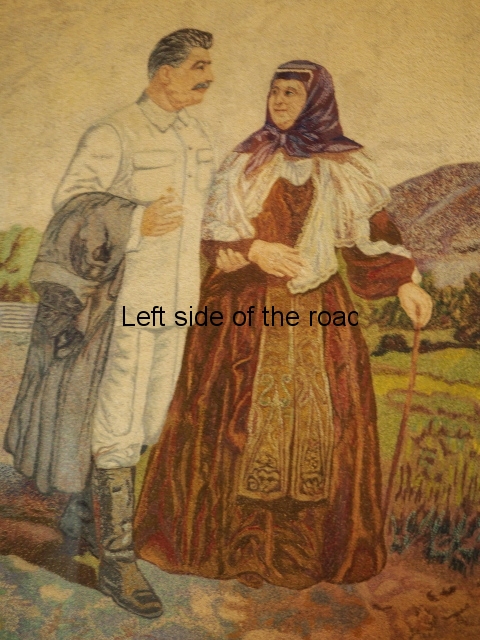
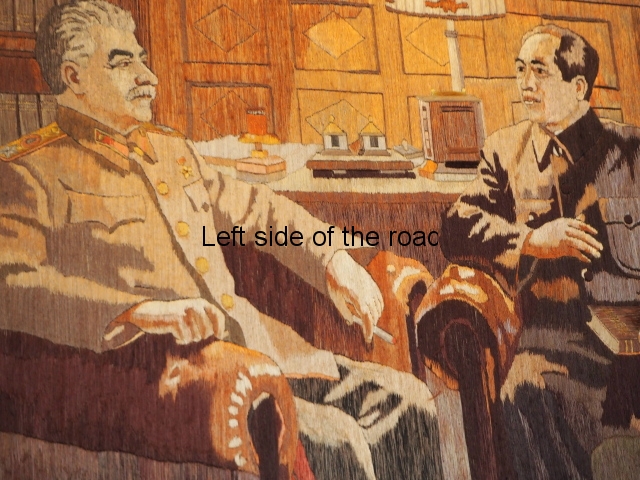
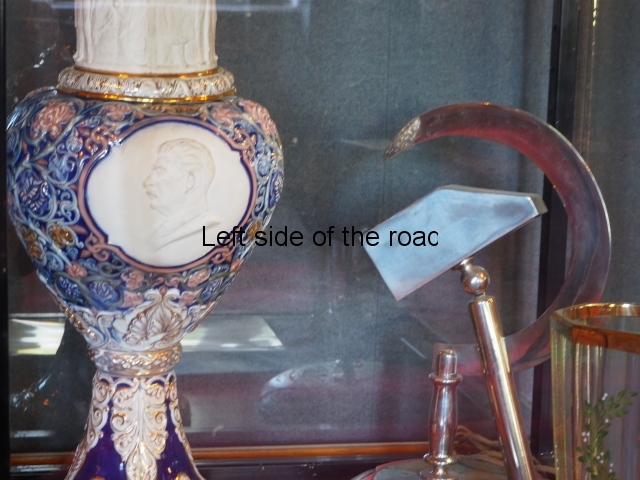
It’s in this room where there are more artefacts and this consists of presents and other objects bearing the image of Stalin, of other Communist leaders and items brought from former Socialist countries representing their culture. There are many objects (many depicted in the slide show) but it’s worth mentioning a picture of Stalin and his daughter, Svetlana, as a young girl; a textile print of a meeting between Stalin and Chairman Mao Tse-tung; a number of large carpets with Stalin as the central image; a couple of images of Stalin with his mother; a large, Chinese silk portrait of Stalin and a large, circular, metal plate with a mosaic of Stalin in the centre.

Stalin's office in the Kremlin

Stalin’s office in the Kremlin

Stalin’s Kremlin Office Reconstruction

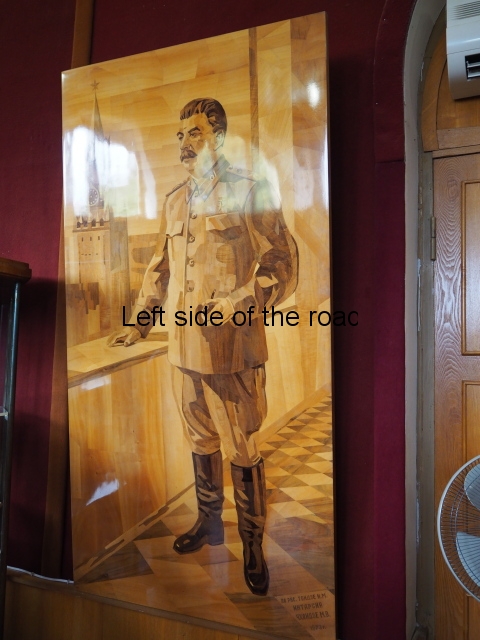
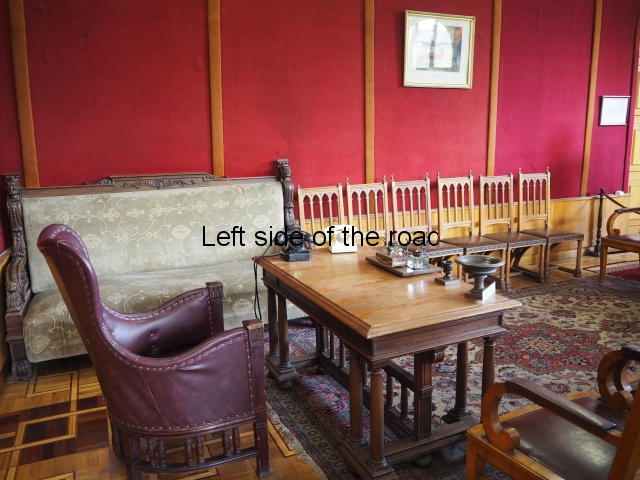
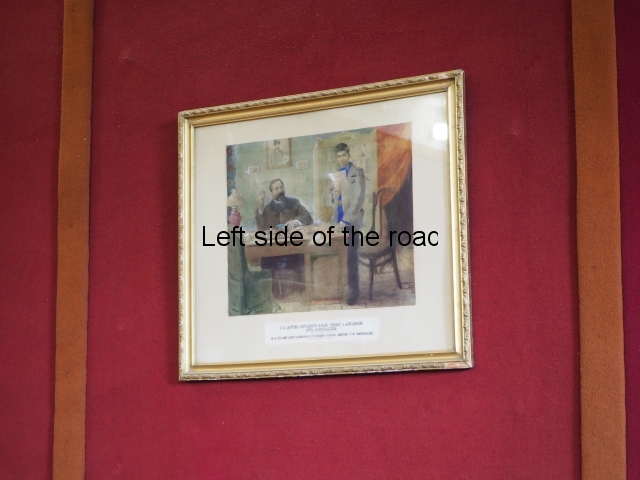
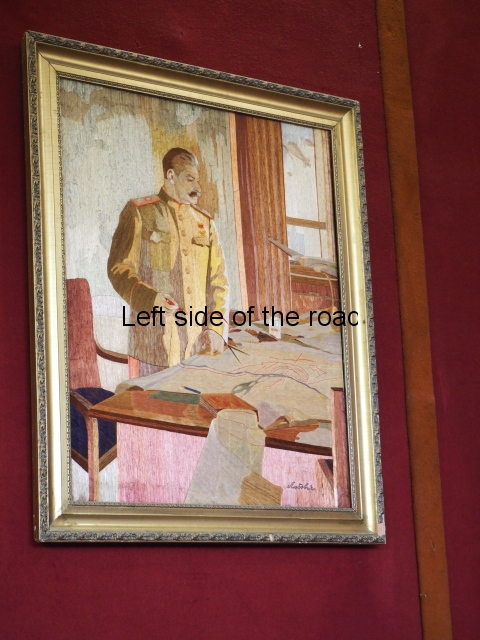
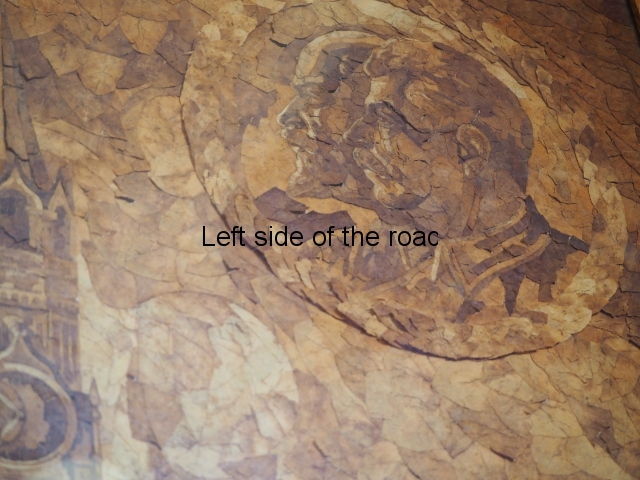
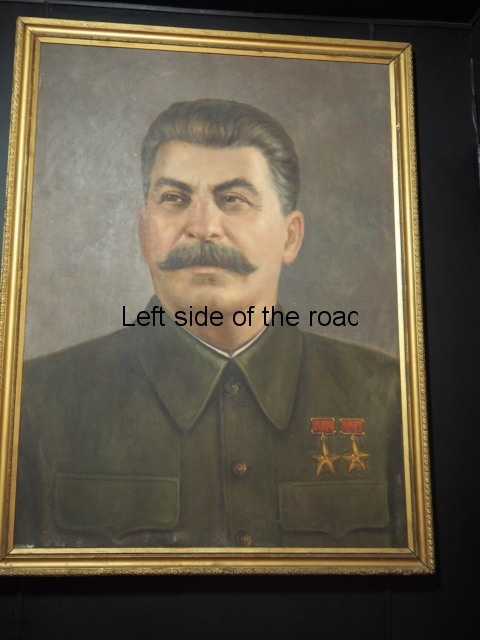
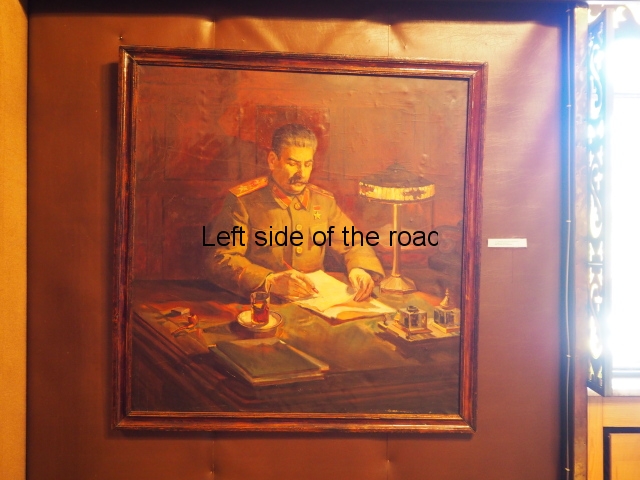
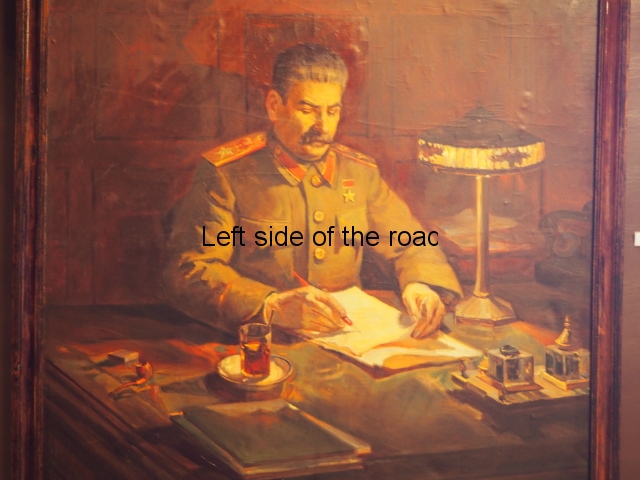
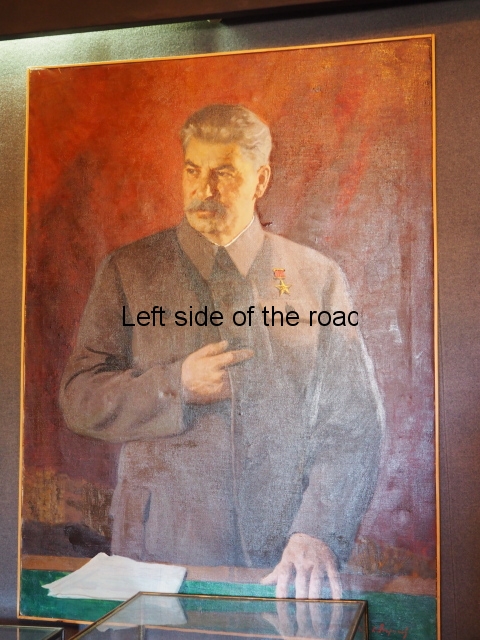
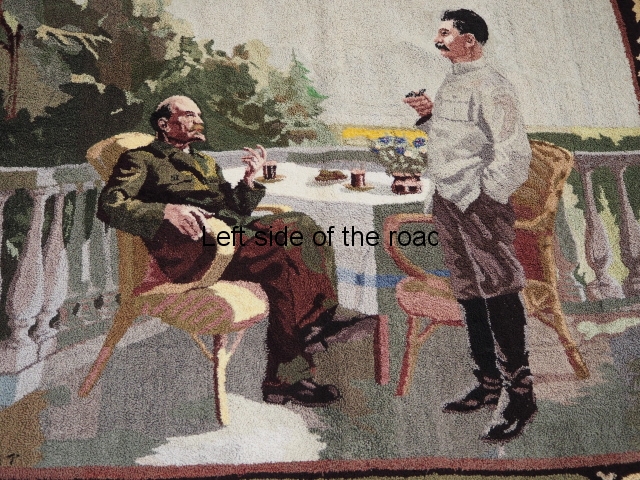
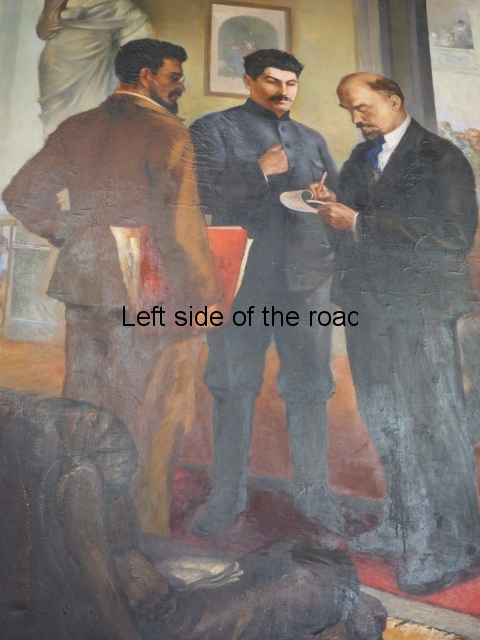
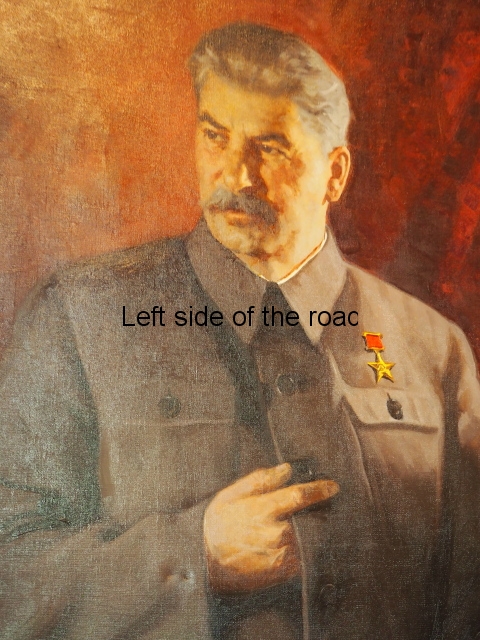
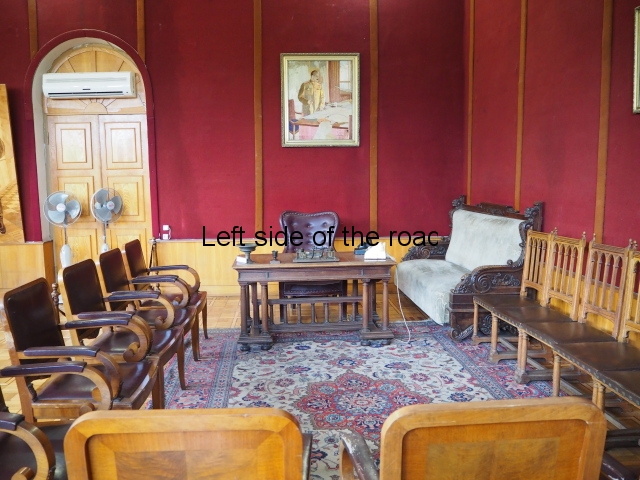
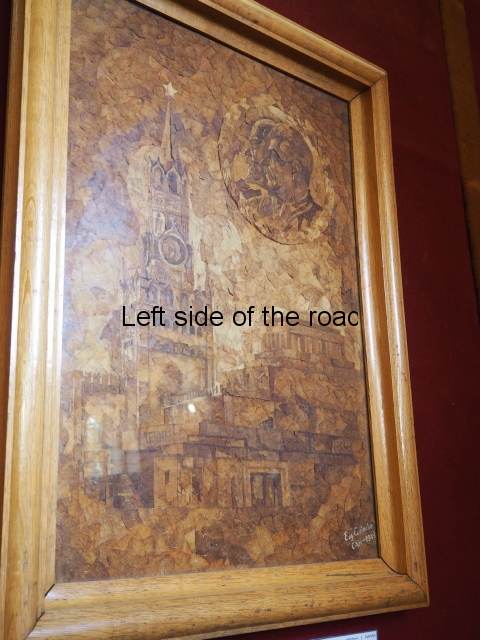
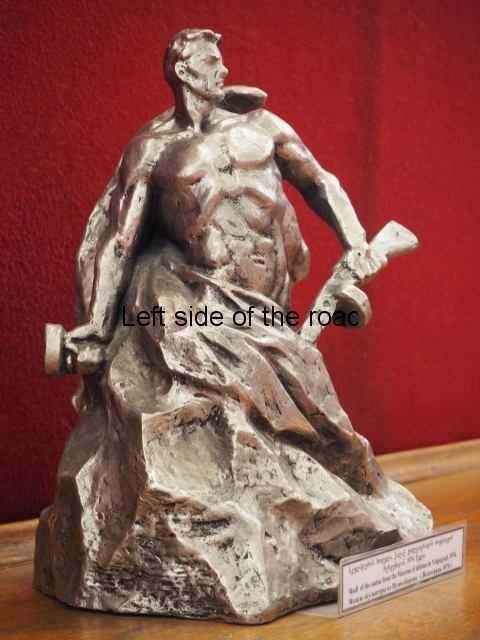
On leaving the first floor, where the majority of the exhibits will be found, by taking the right hand staircase this will lead you to the reconstruction of Stalin’s Kremlin Office (the first door on the right). Really the office is just the collection of chairs and sofas with a desk immediately on the right as you walk through the door. The rest of the space is taken up with further images of Stalin, both in paint and intricate marquetry; one of his ceremonial uniforms; two maquettes of the Stalingrad War Memorial and (quite unique) an image of both Lenin and Stalin made from tobacco leaves (just above the piano).

Stalin's armoured carriage

Stalin’s armoured carriage

Stalin’s Armoured train carriage

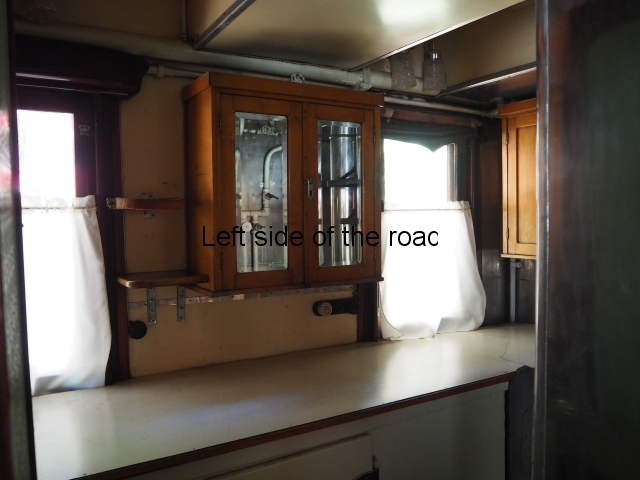
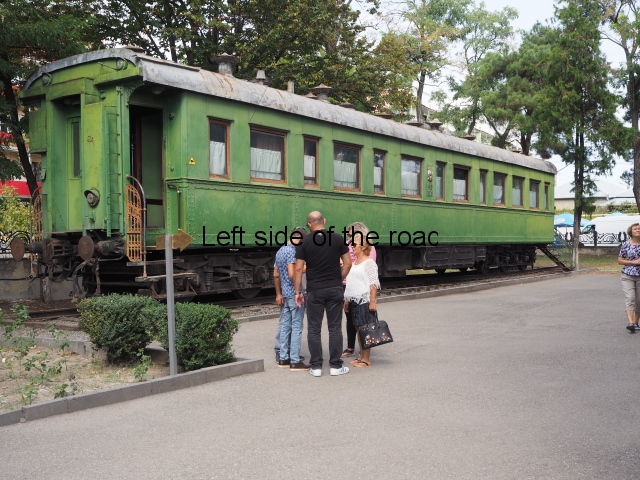
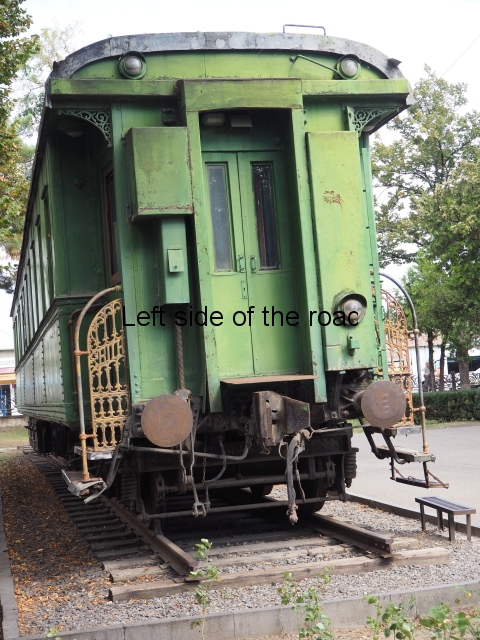
Outside the museum, to the left of the building, is Stalin’s armoured carriage. He didn’t like to fly and travelled to the major conferences with the US and UK ‘allies’ at Tehran, Yalta and Potsdam in this carriage. This can be visited as part of the general ticket to visit the museum.

Stalin's Birthplace, Gori

Stalin’s Birthplace, Gori

Stalin’s Birthplace

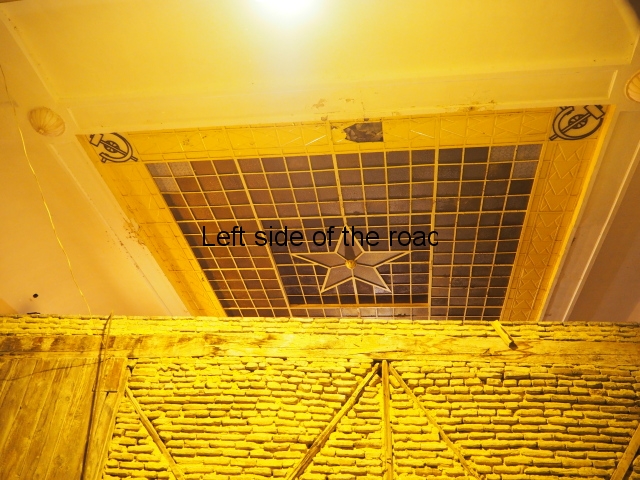
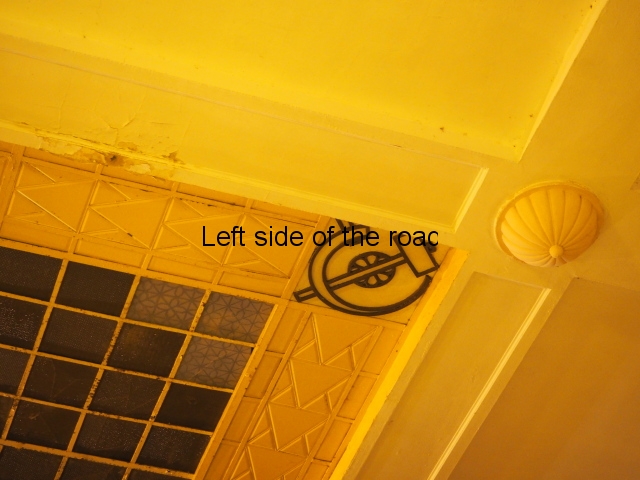
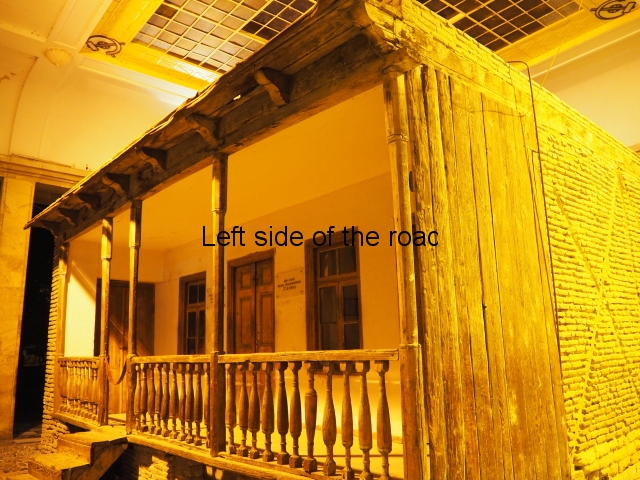
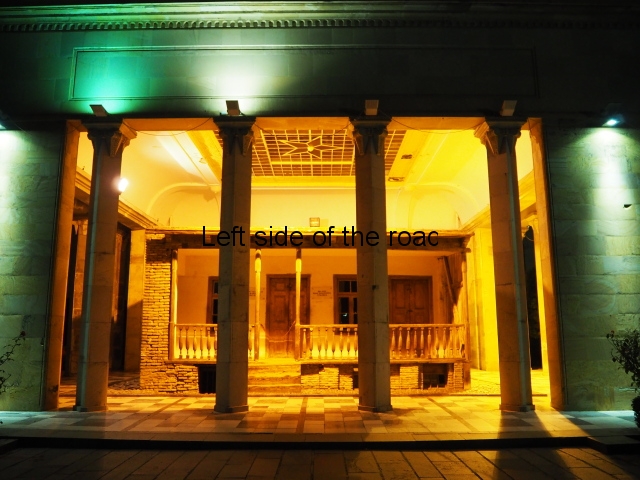
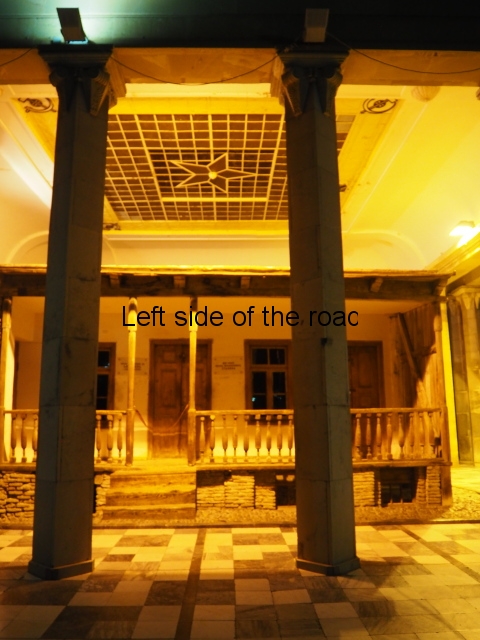
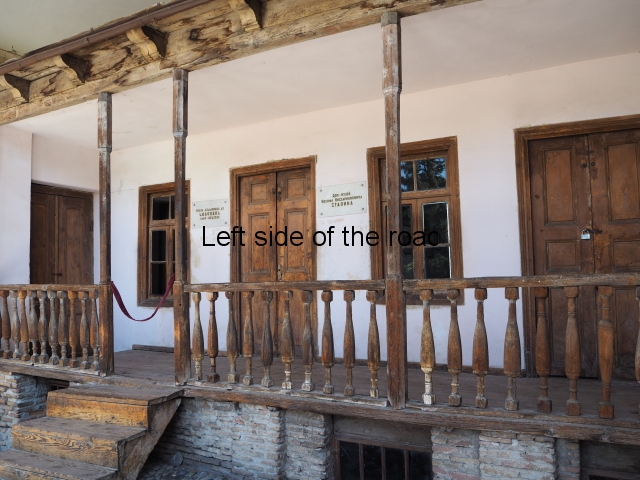
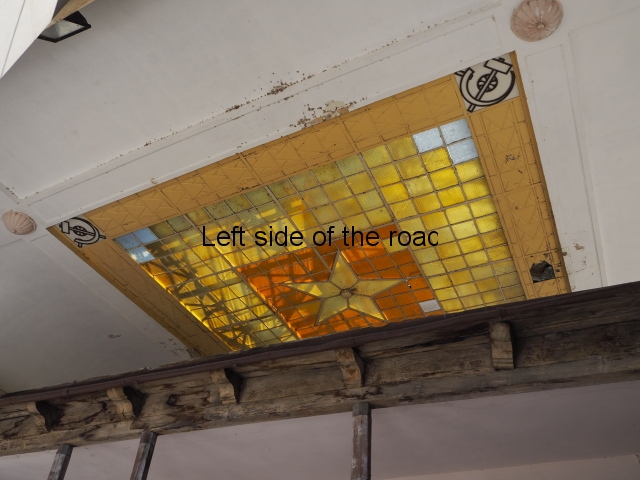
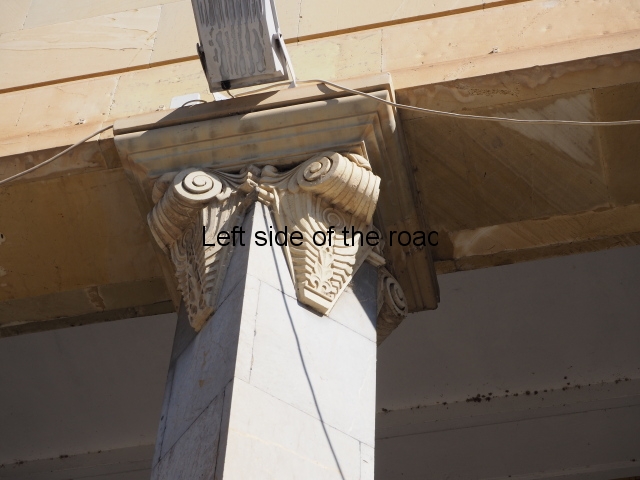
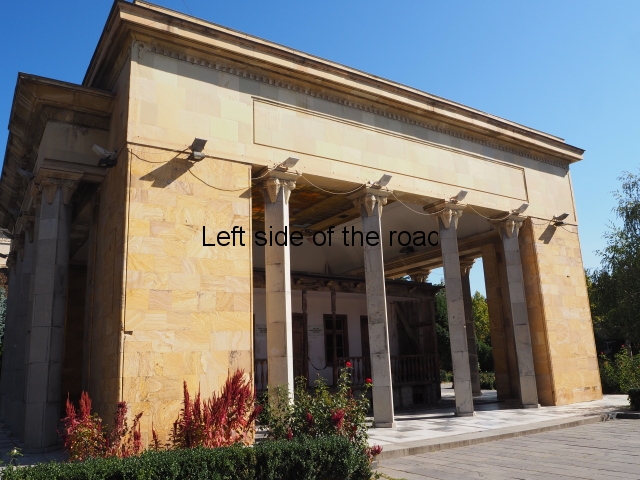
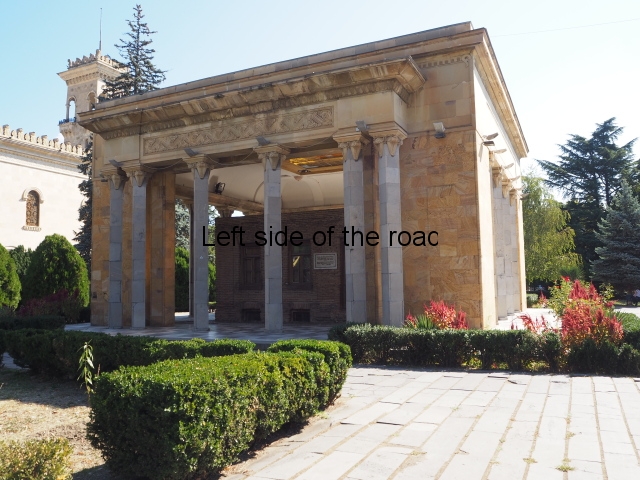
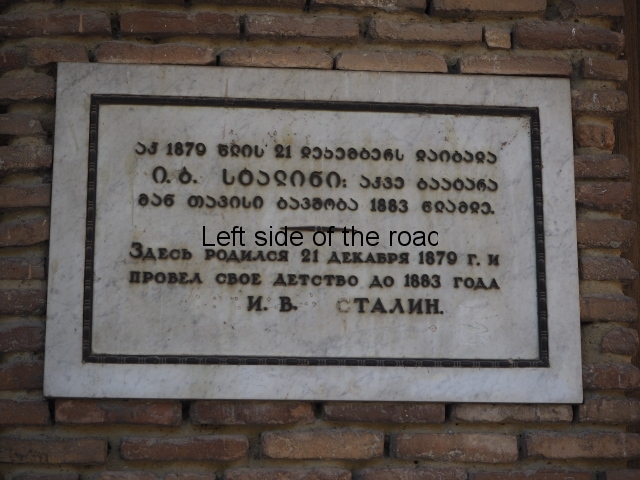
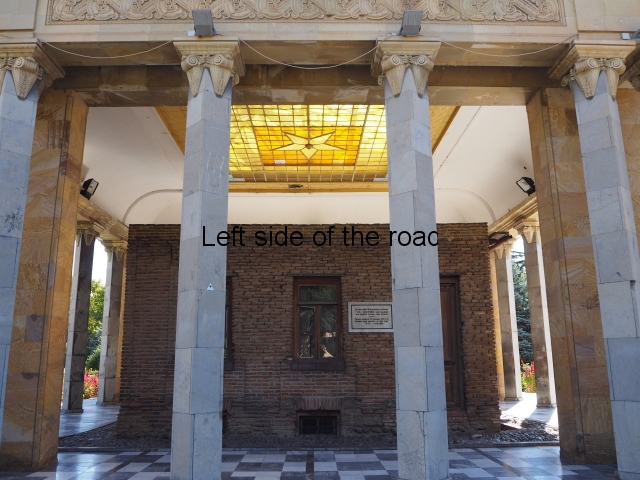
The humble building in which Stalin was born is almost unrecognisable now. Although restored to an almost new condition the two room building – of which on the tour you only see one – has been surrounded by a grand and almost temple like Doric structure. This is topped by a glass dome on which is a magnificent star and in each corner there’s a hammer and sickle symbol. This was erected in 1939. This is lit up at night and looks quite impressive with the various light temperatures, giving off a golden and green glow at the same time.

Related;

Rediscovered statues of Joseph Stalin

The Great Patriotic War Museum and War Memorial

Practicalities

Location

The Museum, Stalin’s Birthplace and the railway carriage take up what is the top of an inverted triangle of Stalin Park, with Stalin Avenue on either side and Kutaisi at the top. It’s right in the centre of town and not difficult to find.

Opening times

1st November – 1st April 10.00-17.00

2nd April – 31st October 10.00-18.00

Closed 1st January and Easter Sunday

Entrance

Visit of exhibition halls, memorial house and Stalin’s Railway Carriage:

General 15 GEL

Students 10 GEL

Schoolchildren 1 GEL

Under six Free

It’s not necessary to take the tour but for that extra bit of information it’s worthwhile. Unfortunately there doesn’t seem to be any set time for the tour but English tours take place quite regularly, at least between April and October. They take about 45 minutes so if you miss a tour my suggestion is that you find out the time of the next tour, more or less, have a walk around the museum and then head back to the entrance of Room 1 at the time the next tour will be starting. The tour takes in both the train carriage and Stalin’s birthplace as well as the museum.

GPS

N 41.98683

E 44.11330

DMS

41° 59′ 12.588” N

44° 6′ 47.88” E

More on the Republic of Georgia

1971 National Exhibition of Figurative Arts – Tirana

'Mother' - Mumtas Dhrami - 1971

‘Mother’ – Mumtas Dhrami – 1971

More on Albania ……

1971 National Exhibition of Figurative Arts – Tirana

The article below was first published in New Albania, No 6, 1971. It discusses the general idea of art in a socialist society, how the Albanians saw ‘Socialist Realism’ with mention of a handful of works (out of 180) that were displayed at the National Exhibition of Figurative Arts in Tirana in the autumn of 1971.

Emphasis, so far, in the pages on this blog related to Albanian art, has been placed on the Albanian lapidars – public monuments. There have been a few reasons for this: they are often large and out in the open, and therefore accessible to all at all times; some of them all under threat of decay from either neglect and/or vandalism – a number of important ones have already been destroyed by reactionary forces within Albanian society; they embody a uniquely Albanian approach to such monuments: and, even if in the public domain are often ignored – strangely people walk past works of art everyday (and not just in Albania) without taking notice of what they are passing or the significance they might have in the country’s history.

But ‘Socialist Realism’ in Albania was not restricted to the public sculptures and a great deal of material in all forms was produced from after Liberation in November 1944 until the capitalist supported reaction was able to re-take the land of the people for the benefit of exploiters and oppressors in 1990. However, these numerous works of art, that used to be part of the people’s heritage, are now under the control of the enemies of such political statements in oil paint and water-colours (as well as stone, bronze and wood). Many museums and art galleries have been closed and (no doubt) many works of art destroyed by the ignorant reactionaries or stolen by the opportunistic and avaricious. An obvious example is the looted museum in the town of Bajam Curri, in the north of the country.

However, there are still a few museums that still display examples of Socialist realist Art. Apart from the National Art Gallery in the centre of Tirana (which always has a permanent exhibition of art from the revolutionary, socialist period) a visitor to the country could investigate the modern art gallery close to the Bashkia (Town Hall) in Durres; the museum and art gallery in the centre of Fier; and the small gallery in the town of Peshkopia.
(Unfortunately I’ve never seen the statue of ‘Mother’ by Mumtaz Dhrami, that heads this post. He was, and still is, one of the most renown Albanian sculptors and such a piece of work demonstrates a very Albanian approach to sculpture, chunky and solid. I hope it still survives intact (but fear not). At the same time I have no knowledge either way. Other creations of Dhrami are: the magnificent Arch of DrashoviceEducation Monument in Gjirokastra; Mother Albania at the National Martyrs’ Cemetery; the (now virtually destroyed) Monument to the Artillery in Sauk; the large monument to Heroic Peza, at the junction to the town on the Tirana-Durres road; and the War Memorial in Peza town itself.)
(My notes/comments are enclosed in italised square brackets [note/comment])

Living colours

by Andon Kuqali

The feelings, emotions and thoughts of the working man, the master of the country, the new man of socialist Albania is the content of this year’s National Exhibition of Figurative Arts. The paintings, sculptures, drawings, and designs exhibited, aim at expressing this content through an art characterized by the truth, the reality of life.

Since the 1971 National Exhibition of Figurative Arts was to be opened before the celebration of the 30th anniversary of the founding of our Party and on the eve of its 6th Congress, the artists chose themes for their works from the history of the Party and the Albanian people during these 30 years, as well as from our revolutionary traditions, themes from the struggle and work to build our new socialist society. As a matter of fact, today even the most modest landscape or still life embodies this new content, because it exists in the very life of present-day Albania.

What strikes the eye in this Exhibition is that the paintings, sculptures and drawings have more light, more vigorous colours, more varied expressions of artistic individuality than those of the previous national exhibitions. This is important because national exhibitions in Albania are a sort of summing up of the best creative activity of our artists during two or three years, thus they show the course of development of our art at a given stage.

But those colours and variegation of form remain within a realist imagery. Turning away from superficial, manifestative compositions, our artists have tried to enter deep into the life of the people to portray it more truthfully, with greater conviction and artistry. The figures of workers and peasants, of partisans or of outstanding people are true to life, simple and this in no way hinders them from being full of virtue, human and heroic at the same time. Even the industrial landscape is presented in its intimate aspect as an integral part of the life of the working man with the richness of original forms and characteristic realistic colours.

The dawn of November 1941 - Sali Shijaku - 1971

The dawn of November 1941 – Sali Shijaku – 1971

[The house where the Albanian Communist Party (later to become the Party of Labour of Albania) was founded in 1941 is the one with a tree to the right of the stair to the first floor. It became a Museum of the Party after Liberation – it might be in private hands now (it definitely isn’t readily accessible.) The letters VFLP written in black on the white wall on the side of the building in the foreground (as well as along a wall at the very top of the painting) stands for ‘Vdekje Fashizmit – Liri Popullit!’ (‘Death to Fascism – Freedom to the People!’), the revolutionary slogan of the Communist Partisans. I don’t know where this painting might be at the moment. I hope it’s in the storeroom of the National Art Gallery. What goes against its public display are the four letters VPLP – modern-day fascists don’t like that!]
Alongside the tableaux in grand proportions which portray notable events from the history of the Party and Albania, or outstanding figures of communists and revolutionaries, the landscape ‘The Dawn of November 1941’ by the gifted painter Sali Shijaku is no less significant and profound. In reality, this is a composition in small proportions in which the great idea that the Party emerged from the bosom of the common people is expressed. It depicts a poor quarter of Tirana as it was, in the midst of which stands the house where the Communist Party of Albania was founded: an ordinary house like the others, except that from the two windows of the ground floor flows a cheerful light which spreads far and wide driving away the gloomy night of the occupation and reaction.

Albanian Dancers - Abdurrahim Buza - 1971

Albanian Dancers – Abdurrahim Buza – 1971

[I don’t know where the original of this painting by Abdurrahim Buza might be at the moment.]

Dancing is the motif of a number of works of this exhibition. ‘The celebration of liberation’ by N. Lukaci, is a composition in sculpture developed with rounded figures, powerful like the beats of a drum and representing a typical folk dance. ‘Albanian Dances’, by the veteran and very original painter, Abdurrahim Buza, is the tableau of a circular dance in which the lively silhouettes of men and women from all the districts of the countryside with all their warmth and colour move freely, expressing the happy unity of all our people.

Planting Trees - Edi Hila - 1971

Planting Trees – Edi Hila – 1971

[This used to be on display in the National Art Gallery in Tirana but not when I last visited in 2019.]

A soft breeze stirs the fragrance of the fresh-dug soil, where girls and boys are planting trees under a blue sky. This is the tableau ‘Planting Trees’ by the young painter Edi Hila, inspired by the actions of the youth, a song of spring for the younger generation of Albania who are growing up happy with a fine feeling for work, a fresh tableau with a dream-like quality, from the vitality of our reality.

The dynamism of the daily life of the workers, their enthusiasm at work in the factory, before the smelting furnace, their chance encounters in the streets, the clash of opinions in which the new man is tempered, are expressed in the strong lines in the series of drawings under the title ‘Comrades’ by Pandi Mele.

Comrades - Pandi Mele - 1971

Comrades – Pandi Mele – 1971

Like saplings in the bush, the children frolic and romp in Spiro Kristo’s delicately portrayed tableau ‘Springtime’.

The Children - Spiro Kristo - 1966

The Children – Spiro Kristo – 1966

[Unfortunately I haven’t been able to come across an image of the painting ‘Springtime’ to add here. Until I come across an image I’ll include an earlier painting by Kristo, the charming ‘The Children’. This is still on permanent display in the National Art Gallery in Tirana (as of 2019). In 2016 I took some friends to the gallery and one of them was (literally) shocked to see such a depiction of children on the walls of a national gallery. I didn’t understand his reaction then (or even to this day). he is of an age to have played with guns (and probably destroying the indigenous population of north America on many occasions and children are killing children in school killings in the USA on an almost weekly basis. This painting encourages an idea of national defence, of preparedness against external threat and invasion, and not of aggression which dominates the armed forces of imperialist countries – just consider the wars of aggression in Afghanistan, Iraq, Libya and Syria and the consequences for the population of those countries.]

In his monumental decorative tableau ‘Our land’, painter Zef Shoshi elevates the figure of the peasant woman, the untiring, hard-working cooperative member, who has won her own rights as a person with tender feelings and priceless virtues, the woman brought up amidst the collective work, in the years of the Party, as the people say. The drafting is connected and dynamic and is permeated by the colour tones of the wheat the soil, and the timber.

[‘Our land’ is another painting I have yet to see, either in actuality or in a photograph. However, this picture of a female skilled worker seems to capture the idea that Shoshi would have represented (confident, aware of her part in the construction of Socialism and a more than equal participant in the new society – a crucial and important aspect of Socialist Realist Art) in his entry for the 1971 National Exhibition of Figurative Art in Tirana.]

These are a few remarks about the 180 works exhibited.

Each painter and sculptor is represented here with works which reflect the world as he imagines it, that aspect of life, past or present closest to his heart, the essence of which he tries to communicate his emotions and thoughts to the viewers as directly and clearly as possible, through the emotions and thoughts of the artist who belongs to the people, an active participant in our socialist society in its revolutionary development. This is the source of the variety of methods of expression of each artist, the special individual features of each and, at the same time, of their common stand towards life. These are the features of socialist realism in Albania, an art, which serves the people and socialism, which aims at being an integral part of the spiritual life of the working class and of all the working people.

[Another painting which was part of the exhibition was one by the painter Lec Shkreli entitled ‘The Communists’. It depicts those Communists who were arrested by the regime of the self-proclaimed ‘King’ Zog just before the invasion of the country by the Italians in April 1939. The person in the foreground wearing glasses is Qemal Stafa – one of the founding members of the Albanian Communist Party.]

The Communists - Lec Shkreli

The Communists – Lec Shkreli

The article that referred to the 1969 exhibtion was entitled The Revolutionary Spirit in Albanian Painting and Sculpture.

Socialist Realist Paintings and Sculptures in the National Art Gallery, Tirana provides a comprehenive idea of the examples of Socialist Art that have been on display in the National Gallery in recent years.

More on Albania …..