The bas reliefs of the Vlora Palace of Sport


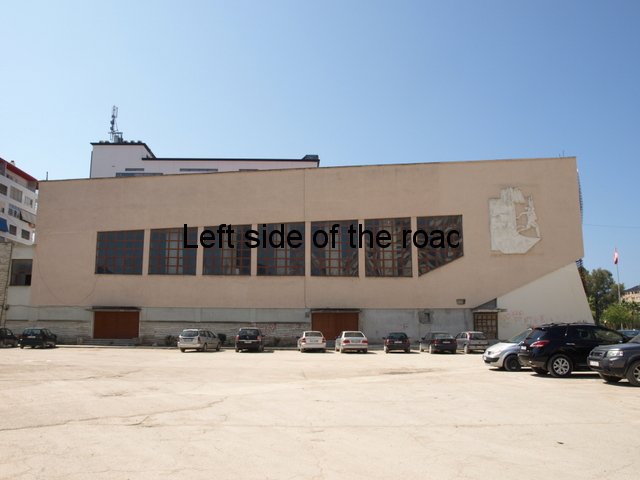
Facade of Vlora Palace of Sport

Façade of Vlora Palace of Sport

More on Albania …..

See also; The mosaics of the Vlora Palace of Sport

The bas reliefs of the Vlora Palace of Sport

Although they are being neglected, and sometimes need dedication and determination to view them, there are still a number of artistic works from the Socialist period on many of what would have been public buildings. The most impressive (and becoming one of the most neglected) is the grand mosaic on the façade of the National Historical Museum in Tirana. Another example, which can easily be missed, is the bas-relief on both the north and south sides of the Palace of Sport in the town of Vlora. Even more easily missed are the two interior mosaics on either side of what would have been, in the past, the main entrance to this sports centre.

The Palace of Sport (now the home of the town’s basket ball team, Flamurtari – the same name as the football team whose home ground is in the long-established stadium less than a hundred meters from the hall) is located at the bottom end of Rruga Sadiki Zotaj, the main street running from north to south through the town, at Sheshi Pavarësia (Independence Square). Although the façade, and the square in front of it, has had some cosmetic work done in recent years the money seems to have run out for any further modernisation of the interior of the main entrance. For this reason, to the casual visitor, the building looks abandoned – like so many public buildings dating from the 1970s and 80s – with graffiti scaring the white paint work and entrance to the court is now at the back of the building.

Flamurtari signifies ‘flag bearer’, not in the personal sense but in the figurative sense. Vlora ‘prides’ itself as being the town where formal independence was declared in 1912, hence the very large monument to the event at the northern end of the main street. So it’s the town that is the standard-bearer. This was emphasised during the time of Socialism but now gets formal acceptance by most of the so-called ‘democratic’ political parties whilst they preside over the very real giving away of that very independence so hard-fought for. For the workers and peasants the day of true independence was achieved on 29th November, 1944, when the Fascists were defeated throughout the country. That celebration is now side-lined and ignored by the bourgeois parties as it would mean a recognition of the role of the Communist Partisans in the National Liberation War.

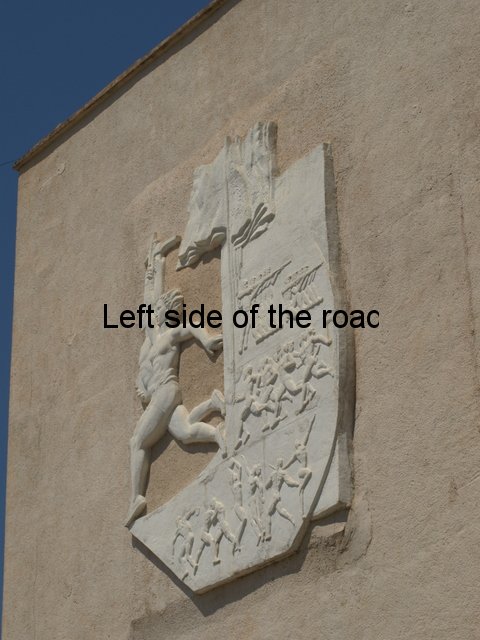
Southern Bas Relief

Southern Bas Relief

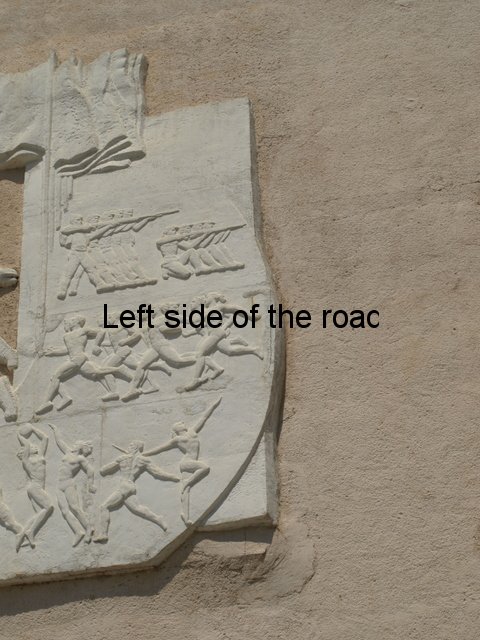
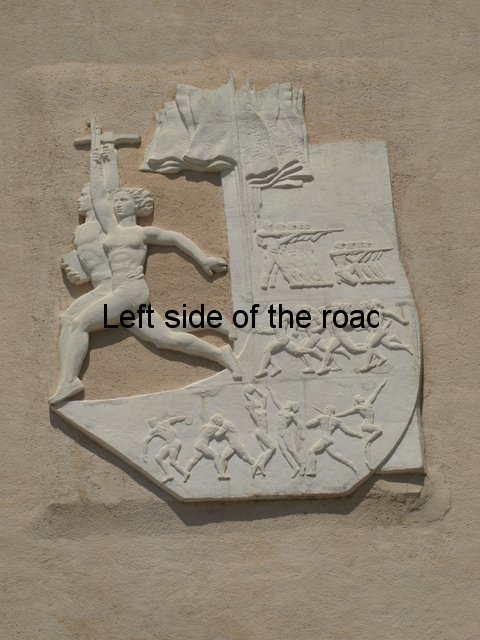
Of the two the bas-relief in the best condition is the on the southern face of the building, on the right as you look at the main entrance. This is probably solely down to the fact that it looks down upon one of the expensive bars attached to one of the hotels that are mushrooming throughout the country. The bas-relief is high up and as with all such of the Socialist period it tells a story.

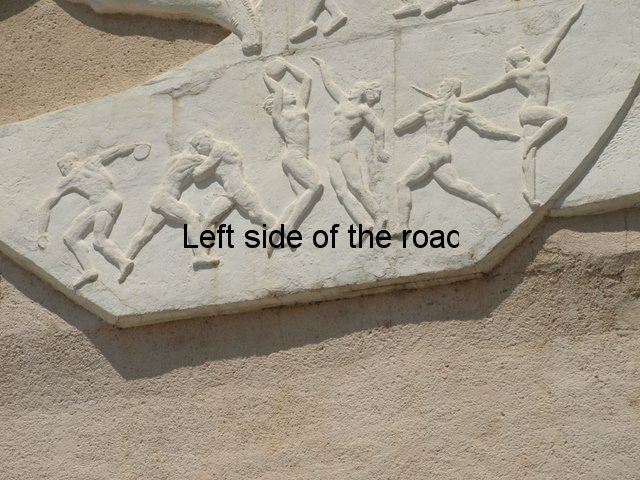
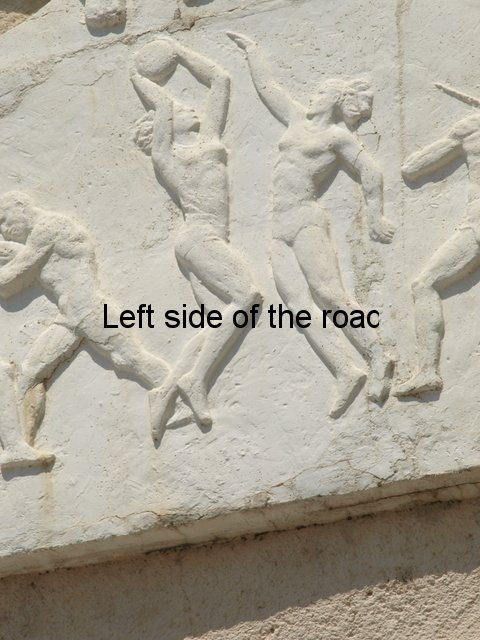
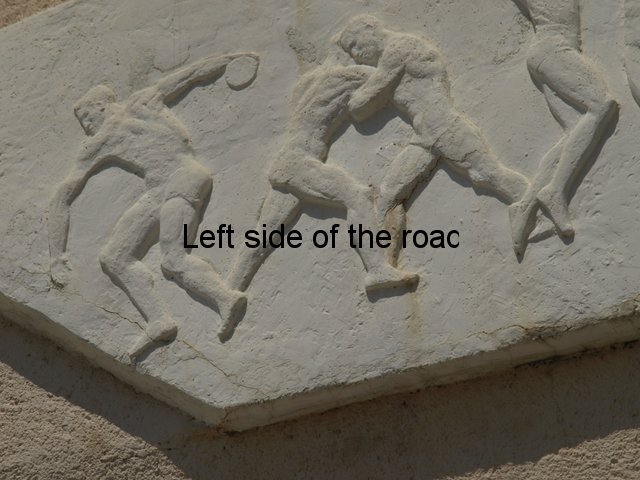
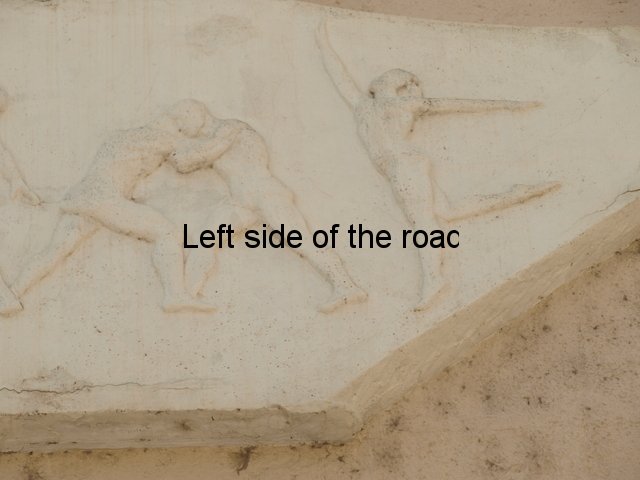
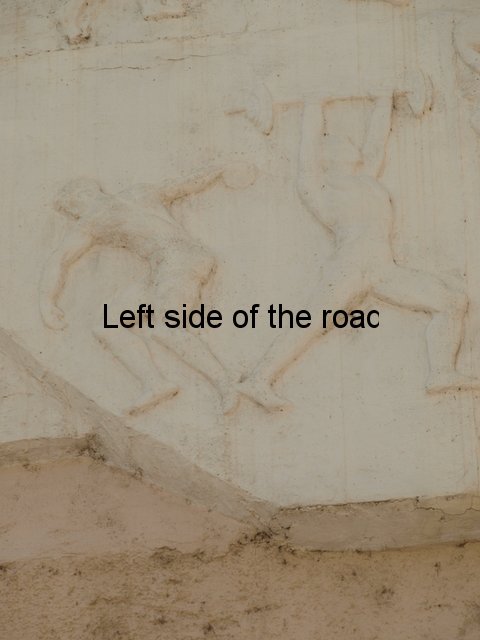
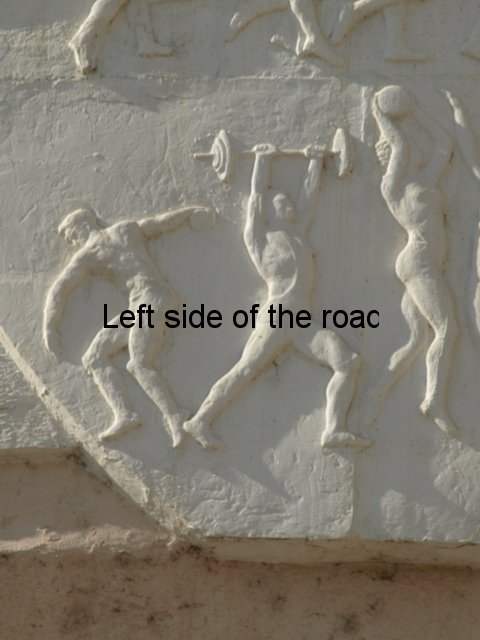
Starting from the bottom we have a number of athletes taking part in various sports, both representing sport in general as well as some of the activities that would have taken place in the building. On the extreme left is a male in the act of about to throw a discus. Next are two males wrestling. These images represent those sports that were practised in classical antiquity to date.

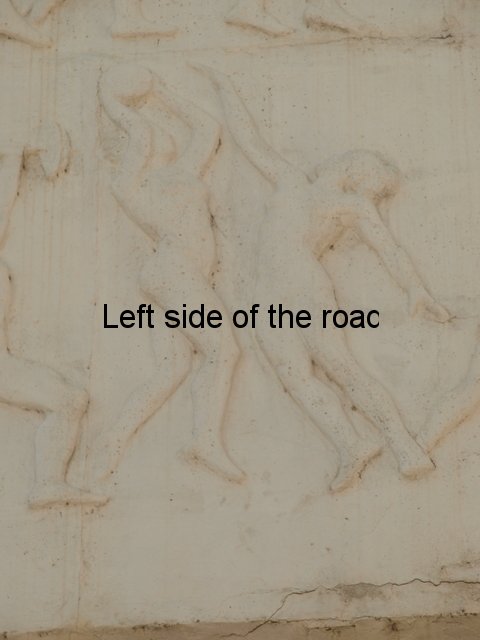
Matters are brought up to date with the next images of two females. One is in the act of leaping to throw the ball, clasped in both her hands, into an unseen netball ring. Her opponent is also leaping, her right arm high above her head, in an attempt to prevent the goal.

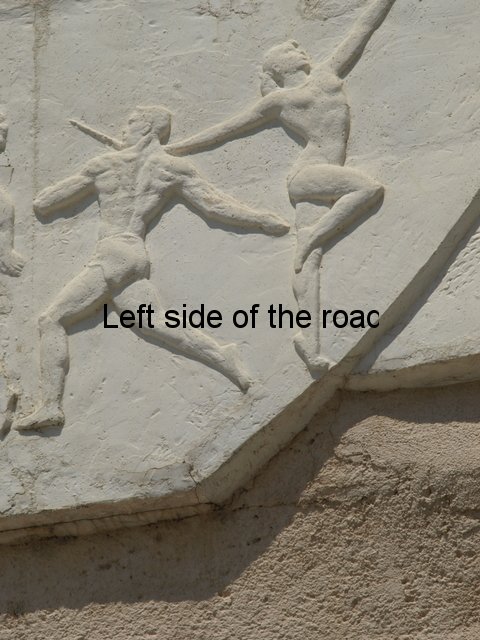
Next in line is a return to antiquity with a male with his back to us. His right arm is stretched behind him and in his right hand the he holds the shaft of a javelin. He is running forward and the tension can be seen in his body as he is just about to put everything into his throw. Finally, amongst this group, we have another female facing towards the back of the building. She has her arms outstretched, her right leg raised and bent at the knee whilst she stands on her toes on her left. The element of grace in this image indicates that she is a gymnast, following a floor exercise.

There is a suggestion of gender difference here as the males are involved in trials of strength whilst the women are following those sports which in the past were considered more appropriate for females.

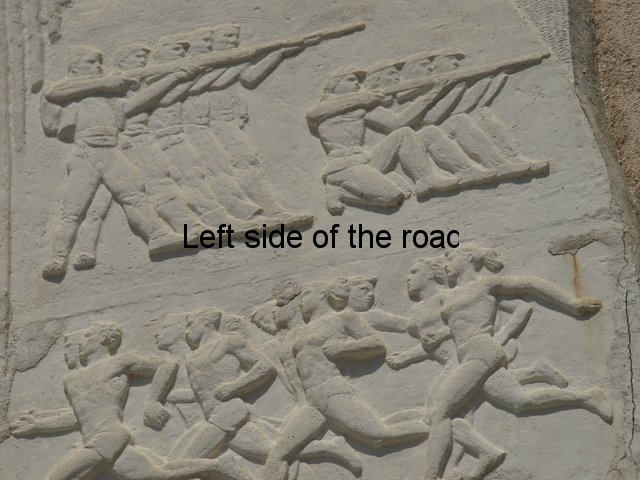
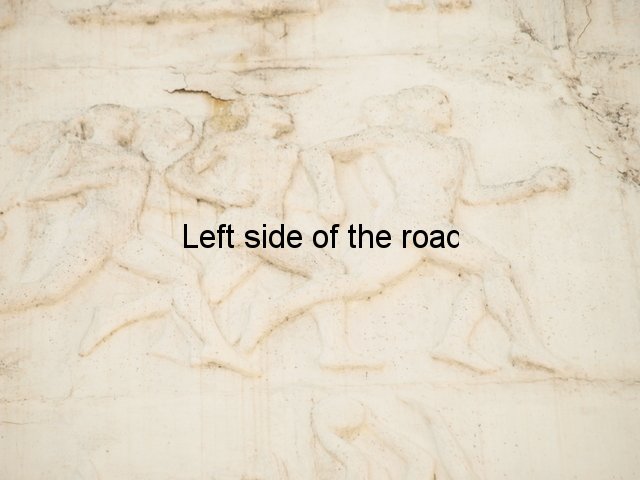
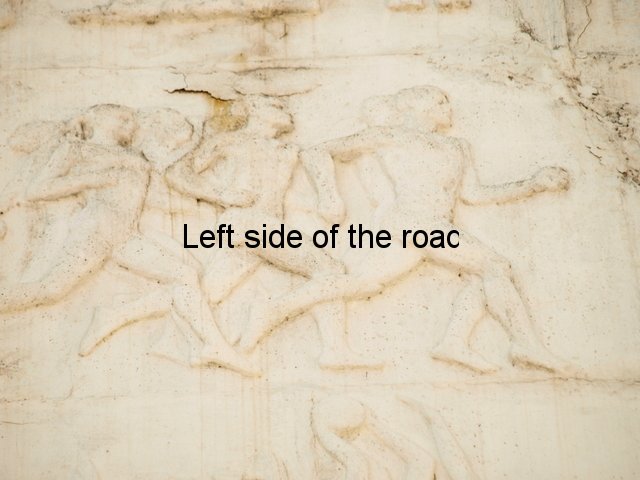
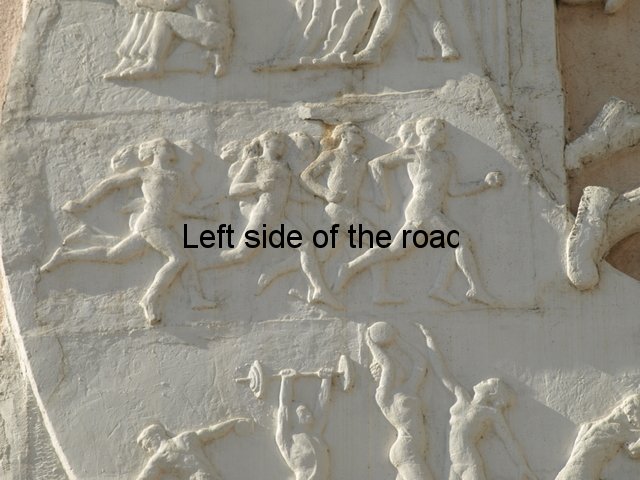
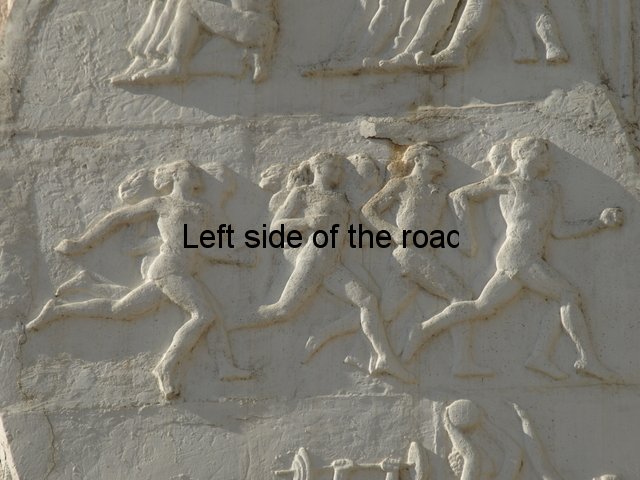
This traditional idea is challenged somewhat in the image above the first group. Here we have a group of ten runners, seven male and three female. The fact that the two genders are introduced in the same race seems to indicate that here is represented something akin to the modern-day marathons where gender plays no role in the entry qualifications. It also represents athletics in its purest and most basic, running needing no special equipment – despite what the sports manufacturing companies spend a fortune in promoting.

The three women are at the back of the group and for some reason one of them is actually looking backwards. As they are all running at full pace this is difficult to explain. The only time an athlete would be looking backwards would be at the time of changeover in a relay race but this doesn’t make sense here.

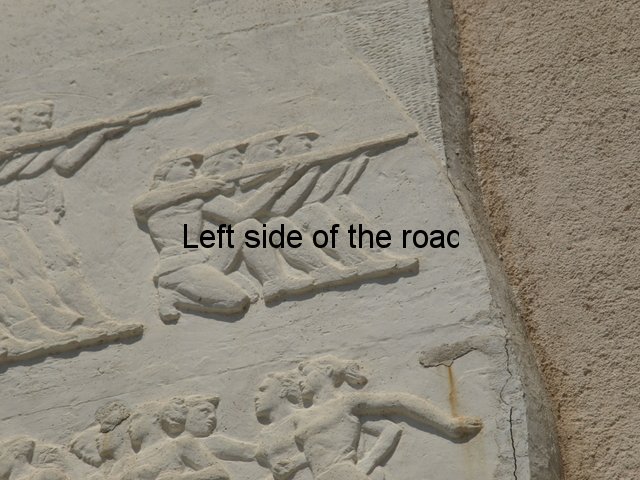
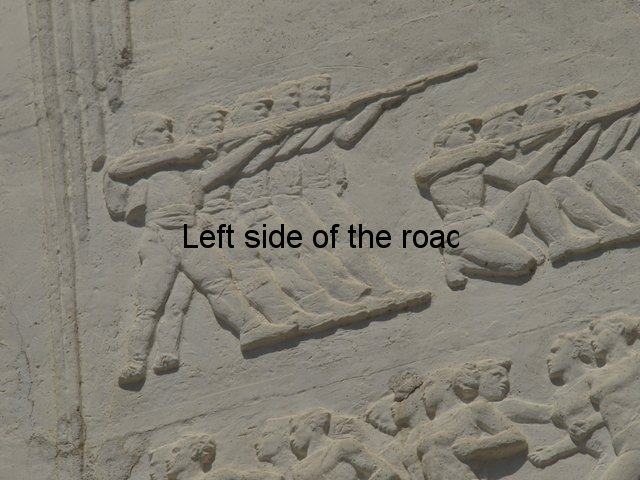
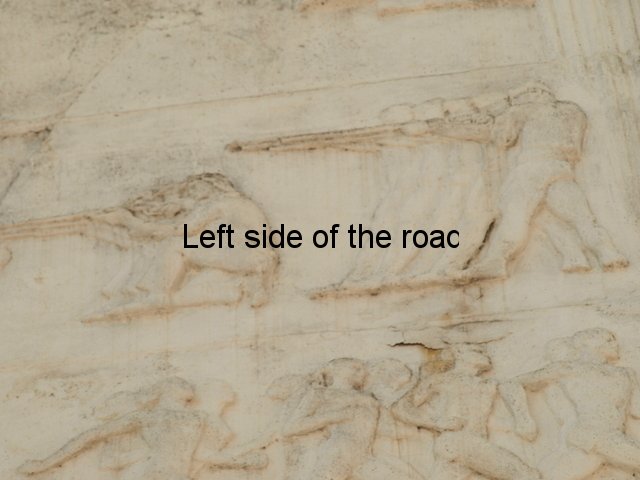
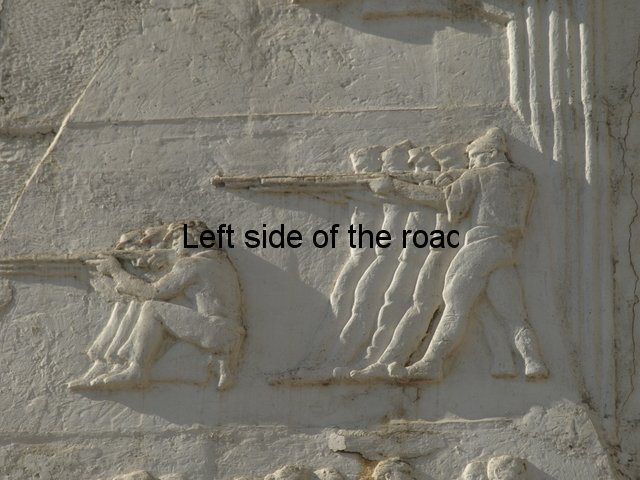
The idea of any gender difference gets blown out of the water in the final panel on the left hand side of this bas-relief. Here we have a group of five standing males (with their left legs forward) and four kneeling females (their right knees on the ground, the foot being bent, whilst the left leg is bent at the knee and the foot firmly place on the ground for stability) all in the act of firing, or about to fire, their weapons. The rifles are pressed against their shoulders, their left hands on the barrel and their right fingers on the trigger.

Rifle Practice

Rifle Practice

The figures are presented in a row, the one behind slightly in front of the one before, the symmetry of their stance being demonstrated by the left legs of the males stepping forward and the left, bent, leg of the females. This all gives an impression of depth on a flat plane.

As is almost always the case in Albanian Socialist Realist Art there is an indication that Socialism is something that represents all the people, from whatever part of the country they might come call their homeland, whether they be peasants or workers. The male closest to the viewer is dressed in the jacket and hat that is most associated with the mountains. He also seems to have a brez (a wide cloth belt) around his waist, as seen on the statue of Bajram Curri in the northern town which bears his name. We only really see the heads of the figures behind the first but all the faces are different and they all display different characteristics but it’s not easy to define ethnicity. What can be seen is that two of the others are wearing caps, the last two being bare-headed.

From the images of the women we can get no idea of their background, all of them being dressed in what, at the time, would have been, more or less, the uniform of the militia. This, for women, meant a step away from tradition as although it might be very attractive in its own right such clothing was not entirely practical for modern warfare – although there are images of fighting women in traditional clothing in lapidars such as the Arch of Drashovicë. All four of the women are wearing caps and we can see the long hair of the female closet to the viewer.

Here I don’t think that the rifle shooting is being introduced as a sport as it might be considered nowadays. However there is a link between sport and the armed militia. Physical activity would have been encouraged during Socialism and such Palaces of Sport built in all towns and villages to promote the well-being of the people. After centuries when the vast majority of the population would have been living a subsistence existence the last thing on the minds of the ruling class would have been the promotion of a strong and healthy working class or peasantry – especially one that knows how to use modern weapons. On the other hand a Workers’ State depends upon an armed and trained militia to defend itself against the many attacks made by the defeated capitalists.

(Witness the hysteria in capitalist countries about any weapon in the hands of ordinary people whilst at the same time the state spends billions on weapons which are accessible only to their puppet armed forces in times of conflict – which can just as easily be used against their own population if the workers ever decide to get up off their knees and oppose oppression and exploitation.)

When it comes to nutrition things haven’t changed a jot in the present day. The cheapest foods available in the vast majority of countries tends to be the most unhealthy in the short and long-term. Just consider the proliferation of fast food outlets throughout the world and in present day Albania the cheapest food is the fatty meat and ‘E’ numbers laden sauces that make up sufflaqe, or its local variants.

It has to be remembered that military service was obligatory for all young people in Albania during Socialism and there is no point in having weak and sickly soldiers (of whatever gender) to defend the homeland. The poor health of so many young men after a century and a half of the Industrial Revolution in capitalist Britain showed how badly the working class had fared in that time and was dramatically demonstrated when they were expected to go to the front in the murderous, imperialist war of 1914-19 (euphemistically called the ‘Great War’ by some).

Another aspect that should never be forgotten, and a matter I have constantly stressed when writing about Albanian Socialist Realist Art, is that in these images the women are armed. Armed with modern weapons but also with an ideology that uses that armed force for the benefit of women within the general society. So far, on this blog, when describing the lapidars, when weapons are an integral part of the image, the only one where the women have NOT been armed is on the bas-relief in Bajram Curri, a later piece of art which, in some ways, presaged the future.

Even though armed and provided with more equal rights than in any other country worldwide the Albanian women, just like the men, threw away those conditions in favour of short-term material gains and so-called bourgeois ‘freedoms’. This has led to the present situation where the country has lost any semblance of independence and with an economy that is totally at the whims and mercy of international financial interests and investment.

Although the primary focus of this bas-relief is towards the front of the building, looking from right to left, the firing men and women are directing their anger towards the back of the structure, otherwise they would be shooting their comrades in the back.

All of the images so far have been placed on a background in the shape of a lower case J. I have tried to work out the meaning of this but without success. Working on the basis that all aspects of such a work of art mean something this one has got me beat.

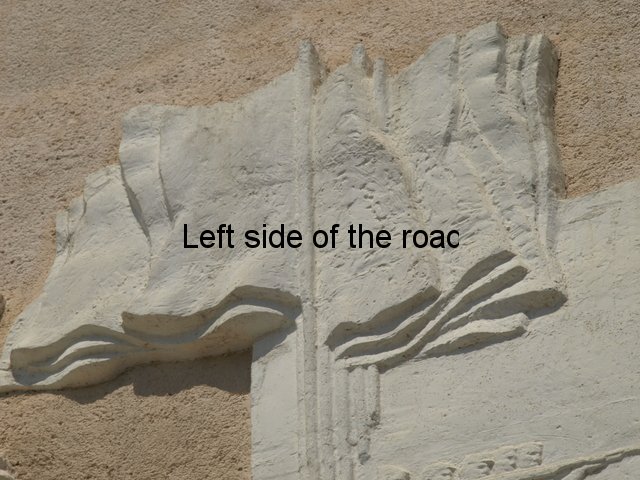
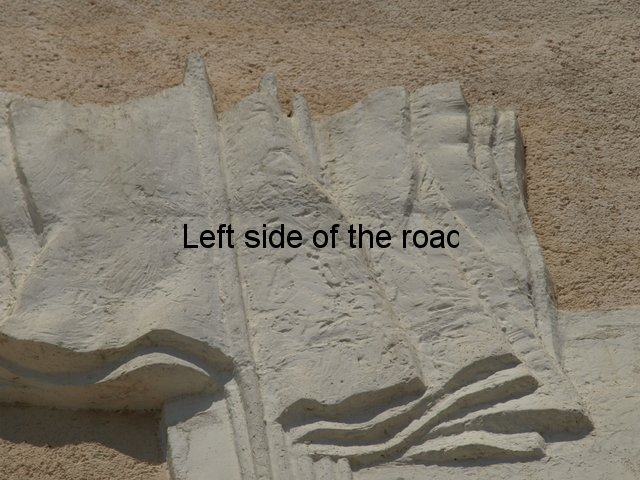
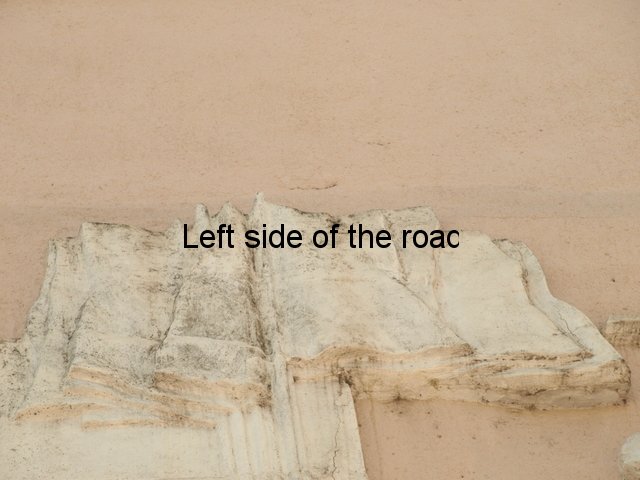
What is relatively clear, however, is the grouping of the flags at the top of the image, above the sporting and military figures. There are an uncountable number of them, at the top of flag poles whose serried ranks again give an impression of depth. However they are fluttering in both directions. This is obviously impossible. As I’ve stated elsewhere Socialist Realism doesn’t mean realistic imagery, it’s allegorical and attempts to tell a story in a new and innovative manner.

Banners above the military

Banners above the military

One interpretation of this image is that it’s a transitional stage to what we see as part of the main image to the left, that they are leaves of a book and, by extension education in general. Sporting expertise without education just provides society with such as the rich, mindless and illiterate footballers in the modern game, unable to string two words together in any known grammatical structure. Being able to kill people without an understanding of the political situation in which this killing takes place only produces mercenary killers and not liberation fighters.

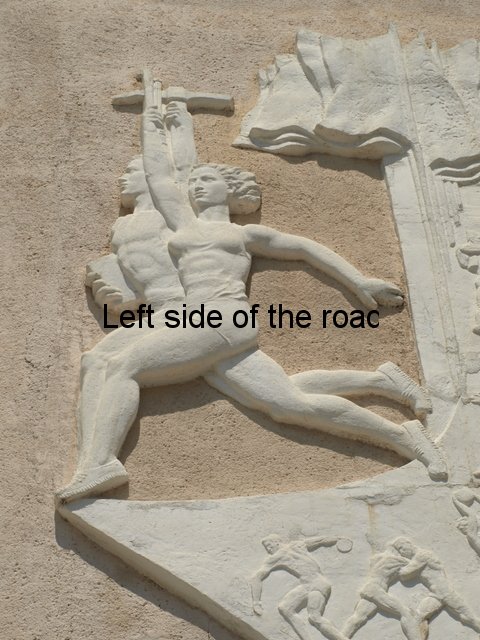
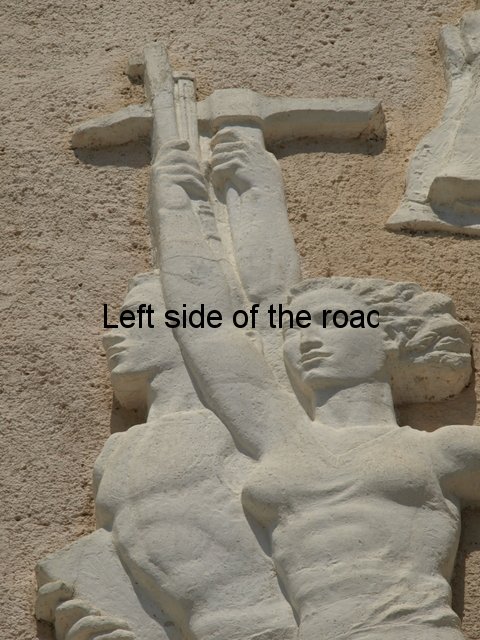
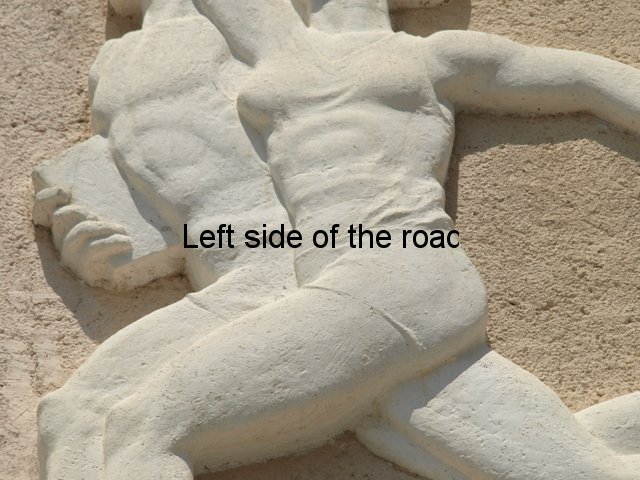
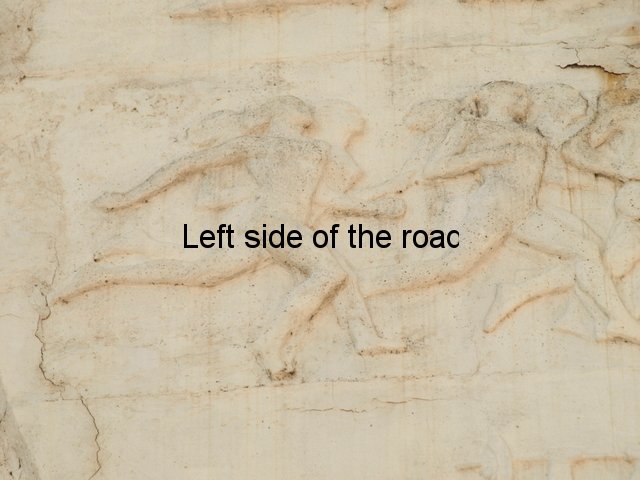
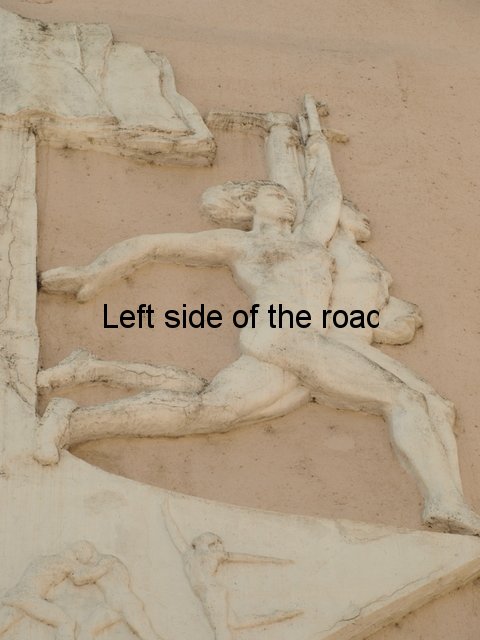
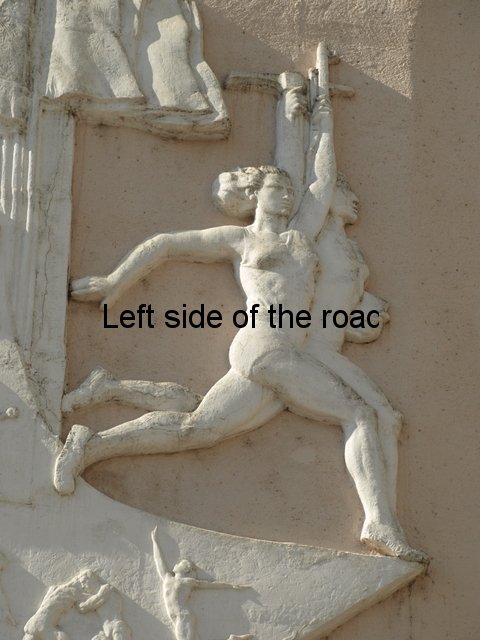
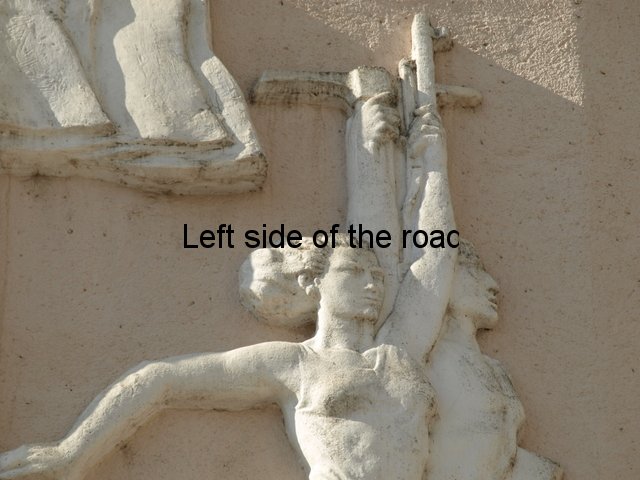
The main subjects of this bas-relief are two athletes, a man and a woman, running flat out, their legs as wide apart as is possible when in a race. They are running on the bottom curve of the ‘J’ and their hands reach as high as the flags. There’s obviously a classical reference here, the only difference being that the two figures are clothed, the man with shorts but bare-chested whilst the female wears shorts and a T-shirt (female public nudity not being an element of Socialist Realism). On their feet it is easy to make out that they are wearing running shoes.

They are runners but not only runners. Within this image there are a number of ideas. We have the fact that they are healthy and fit, capable of strenuous activity that is not connected with work but for pleasure.

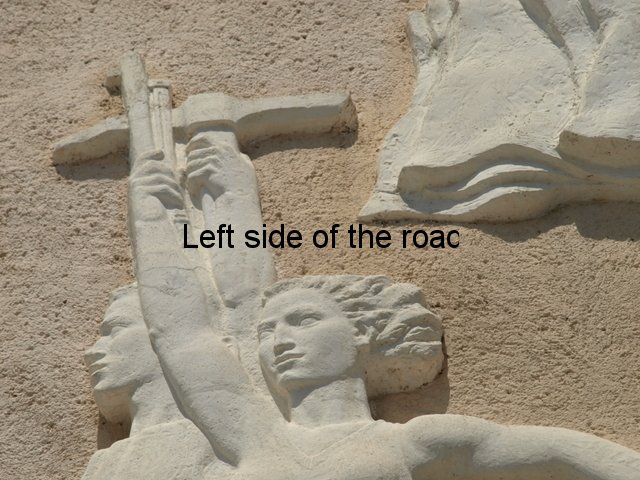
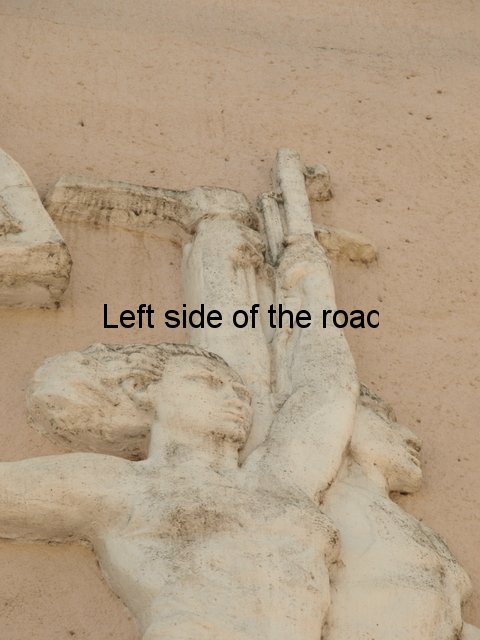
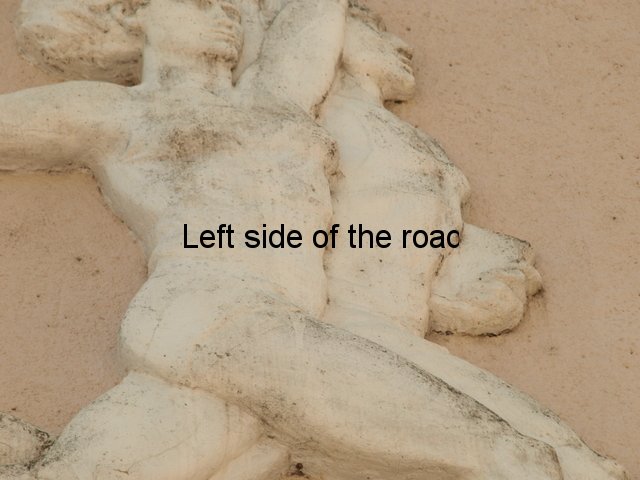
The woman is closest to us. She has her left arm fully outstretched behind her and her right arm is fully extended above her head. In that right hand she holds a rifle close to the end of the barrel, the rest of the weapon hidden by her arm and body. Her face is in semi-profile and her long hair flows out behind her by the force and speed of her forward movement.

Allegory of Socialism

Allegory of Socialism

The male is partially hidden by the female. His left arm is fully extended above his head, parallel and just behind the right arm of the woman. His hand grips the handle of a pickaxe just where the shaft meets the metal cross-piece. To all intents and purposes the rifle and the pickaxe are touching. This is in reference to the revolutionary slogan of the Party of Labour of Albania ‘advancing towards Socialism with the pickaxe in one hand and the rifle in the other’. This is interpreted as meaning that work alone will not achieve Socialism unless it is protected by the same level of force of those capitalist and imperialist forces who seek to deny working people the control over their own lives and the wealth of their country.

As if it is not enough to run with a heavy pickaxe held high he is also carrying a large book in his right hand, pressing it against his waist.

The whole combination of elements surrounding these two young people is an attempt to show how the society – at the time of its creation – was going forward towards Socialism. This relief was almost certainly inspired by the statue of the ‘Worker and Kolkhoz Woman’ (1937) by Vera Mukhina, presently situated at the Exhibition of Achievements of National Economy in Moscow.

This bas-relief is in a good condition and it looks like it has very recently been cleaned and repainted. As I’ve already stated it faces down on a fancy cafe attached to a new 4 star hotel. It’s good that this ‘public face’ has been respected – but as so few people actually look up higher than their own eye level I don’t know how many have actually noticed this unique and interesting piece of history.

Unfortunately fate has not been as kind to the mirror image that is in a similar location on the north side of the building. I say a ‘mirror image’ but that’s not quite the case.

Northern bas relief

Northern bas-relief

Most of the elements on the south facade are repeated but with a few minor differences. On the bottom panel where five different sports are represented, new ones have been inserted. From left to right we have; discus throwing, weight lifting, netball, wrestling and a female gymnast. Those which are repeats are the same as on the south side apart from the stance of the gymnast. She is still engaged in a floor exercise but here her left leg is on the ground, her right leg raised high behind her. Her right arm is raised high above her head and her left stretched out behind her with her head bent back.

The weight lifter, a male, looks like he has just achieved success in the jerk technique, his left leg bent and his right out behind his body, providing the balance.

The running group above is also slightly different. It’s still a mixed gender group, bunched up as in the early stages of a distance race but this time there are only seven runners.

At the front are two males running almost together, there being little seen of the runner behind apart from his legs. The runner fourth – as is the one in fifth, sixth and seventh – place is a female, we know this by their long hair, flowing behind them. It’s impossible to make out any of the facial features of the runner in fourth due to deterioration of the image.

Long hair for males wasn’t common in Socialist Albania and the press and governments of the capitalist west made a big issue of this in the 1970s when visiting young people were ‘obliged’ to have a haircut at the border if they wanted to get a visa. Whether this was more of an urban myth, promoted to denigrate Socialism, is more than likely it being almost impossible at that time to arrive at the border and obtain an entry visa – very much like it is at present on seeking entry into the belly of the capitalist beast, the United States of America. Stones and glass houses comes to mind.

Anyway, the length of the hair is still the clue to the gender of any person on any public Albanian art from before 1990 – their being no comparative artistic endeavour produced under capitalist controlled Albania. That’s not a surprise, how can you represent the idea of hope and a future when the measure is the amount of material goods one has and in a system that is prone to economic crisis. The image of a rich man or woman surrounded by all they can possess would be seen more as a parody rather than an aspiration for those without anything.

In the panel that shows both men and women firing rifles the stances are very much the same, the men standing and the women kneeling, but here the number of women has been reduced to three whilst the men stay at five.

However, the ethnic element is still present with the male who is most visible being dressed in a traditional country jacket and hat whilst the other four sport modern caps or go bare-headed.

The arrangement of the flags is the same and the only significant difference between the two main characters of the story is that what they held in their right hand on the south facade they now hold in their left, and vice versa.

Deterioration to north facing bas relief

Deterioration to north facing bas relief

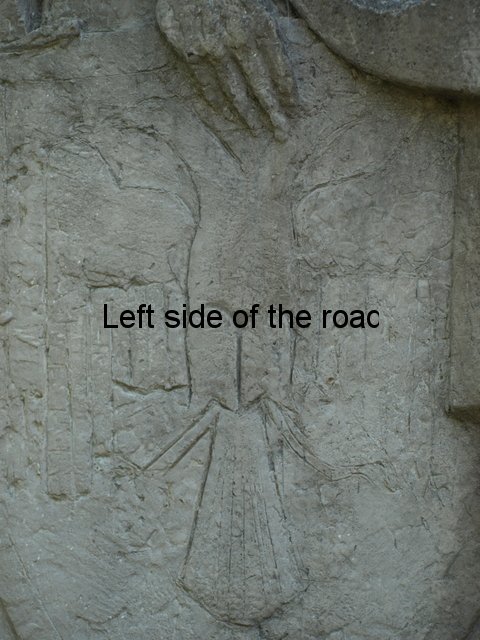
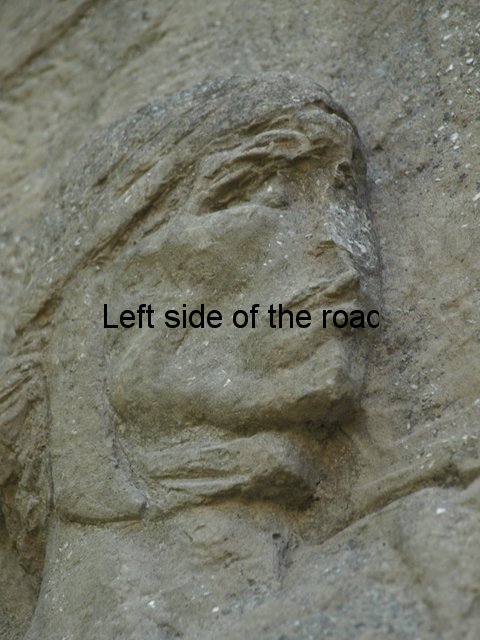
As I’ve stated before his bas-relief is not in as good a condition as the one on the other side of the building and hence is sometimes difficult to read clearly. It’s north facing and doesn’t get the same amount of sunshine and that has led to a proliferation of black mould. Lack of cleaning and maintenance also means that the plaster is starting to come away in places. This deterioration is quite noticeable in the five and a half years between my visits to the Vlora Palace of Sport. It also suffers from looking out over a dusty, dirt car park and probably not noticed by the vast majority of people who might pass by. A little bit of tender loving care wouldn’t go amiss – although I think that’s highly unlikely to happen in the near future.

Of the artist I have no information whatsoever. Normally such works would have been created by local sculptors, especially in the late 1970s early 80s when I estimate this building was constructed. But who I have yet to discover.

Location

The erstwhile Palace of Sport is found set back from the road at the bottom end of Rruga Sadiki Zotaj at Sheshi Pavarësia (Independence Square). This is close to the roundabout that takes you right to the docks and ferry port and straight on to the hotels and beaches (coming from Fier).

GPS

N 40.454991

E 19.487818

DMS

40°27’18.0″N

19°29’16.1″E

See also; The mosaics of the Vlora Palace of Sport
More on Albania …..

Bashkia Mosaic – Ura Vajgurore

Bashkia Mosaic – Ura Vajgurore

Bashkia Mosaic – Ura Vajgurore

More on Albania …..

Bashkia Mosaic – Ura Vajgurore

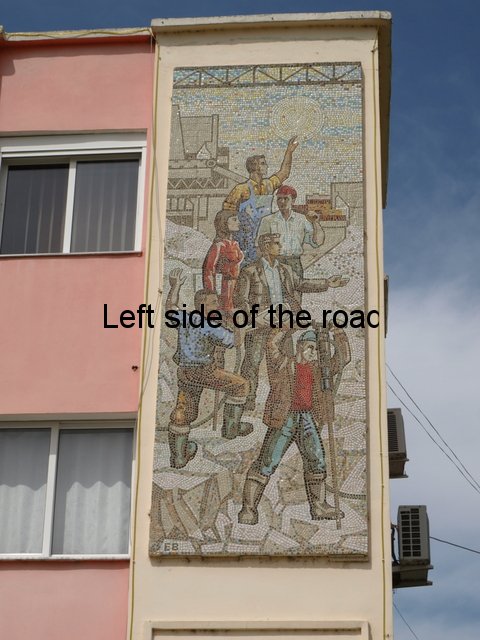
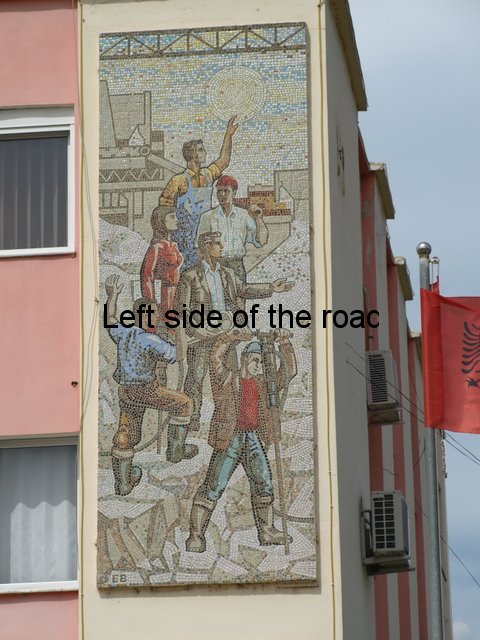
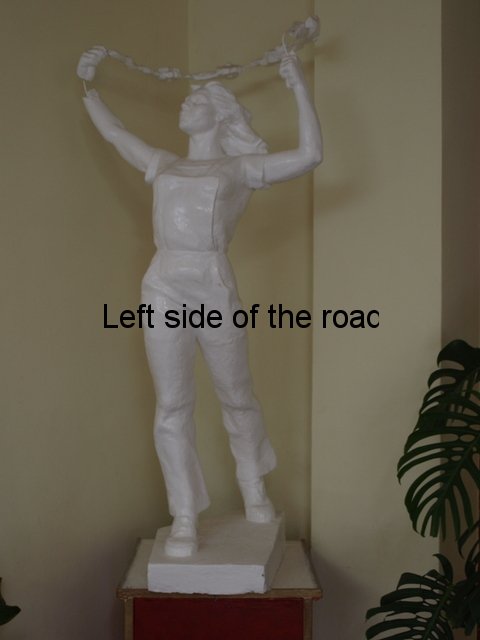
The more I see of them the more I like the mosaics that were created in the Socialist period of Albania’s history. In many ways they capture a feeling of optimism and hope for the future which other art forms just can’t achieve. Yes, paintings can do that but the very scale of mosaics, out in the public view all the time, just seems more immediate. Mosaics have been around for a long time but in the past representing non-existent, mythical goods or the ‘rich and famous’. Those created in Albania in the 1970s and 1980s put the working class and peasantry into the forefront, showing that their lives are important and, if they but know it and chose to take on the task, that a better future will be theirs. Such is the mosaic on the façade of the Bashkia (Town Hall) of Ura Vajguror, between Berat and Kucove, in the centre of the country.

Although the work of the Albanian Lapidar Survey has quantified most of the lapidars in the country the project had to chose when to stop and so many art works such as mosaics aren’t listed. That makes it all more of a pleasant surprise to come around a corner to be confronted by this little masterpiece. One of the roads in the centre of this small town was being pedestrianised and hence the traffic was forced to go in a different direction, offering me the opportunity to see the mosaic for the first time, although I had passed close by a number of times in the past.

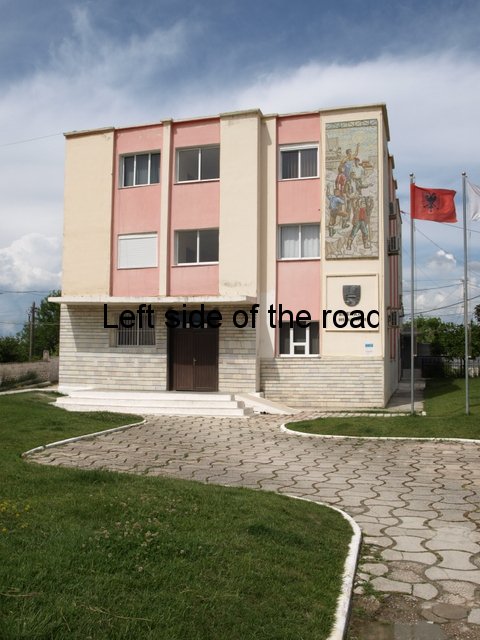
The Bashkia itself is a relatively modest building, a square, three storey concrete building which is made special by a subtle consideration of the entrance, with a curved approach path, a very short flight of steps up to the main door, stone work on the ground floor before the monotony of the concrete (painted in cream and pink) and this magnificent, rectangular mosaic which covers the right hand side of the building, the height of the upper two floors. Below the mosaic sits a large bronze crest of the town.

However, I’m at a bit of a lost to describe exactly what it depicts and the story it is trying to tell the viewer.

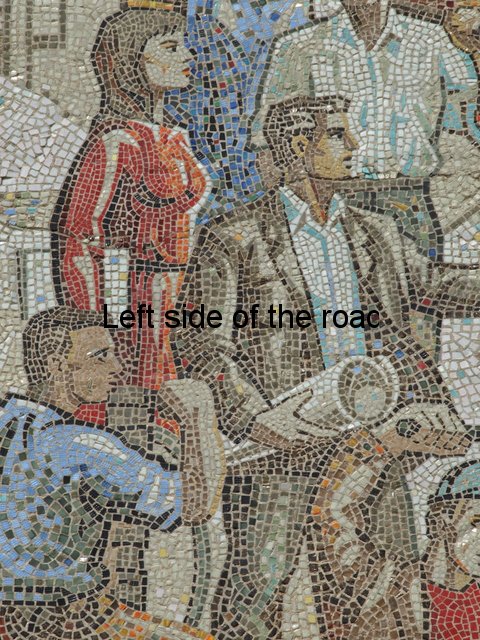
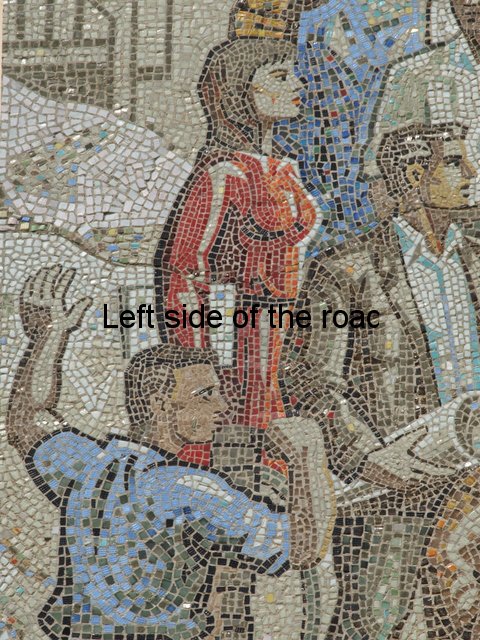
What is shown are six individuals (five men and one woman) standing in what looks like a quarry. The surface upon which they stand is uneven and has many levels as if rock has already been extracted. That part makes sense as there is a lot of quarrying of marble and granite throughout the country, large lorries with huge blocks of stone being a common sight on the mountain roads. Whether this marble is of the quality of the famous Carrara from Italy I don’t know, but you do see a lot of it being used all over the country.

Bashkia Mosaic - quarry worker

Bashkia Mosaic – quarry worker

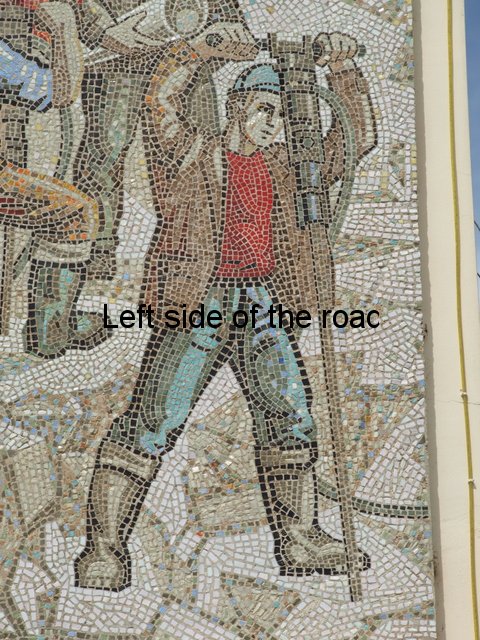
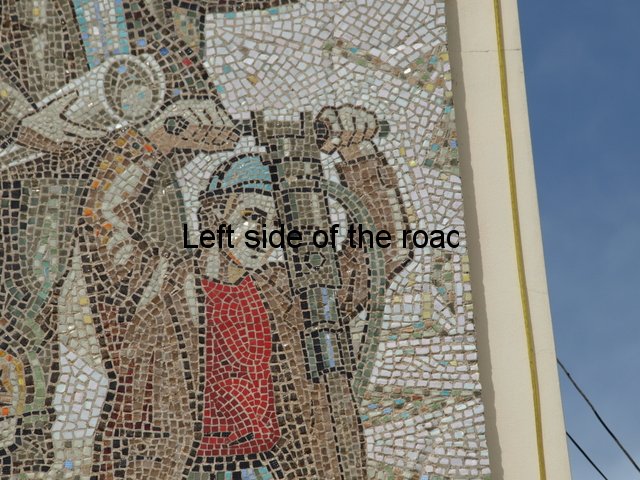
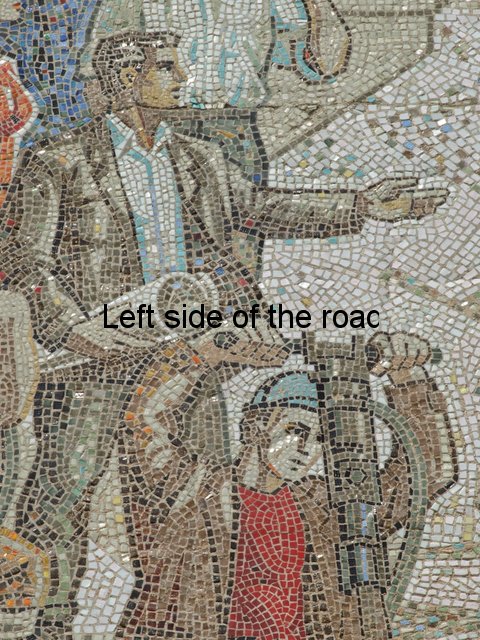
In the forefront, in the bottom right hand corner, is the only person who is actually working and we see him face on. This is one of the males who is operating a pneumatic drill with a very long bit, the sort of drill that is used to make the holes into which explosives will later be placed to crack open the mountain. Either that or making a series of holes along the length of a rock face in such number that it weakens the hold of the mountain on the rock so that it can be prised free.

He wears a blue hard hat, a leather jacket over a red shirt, jeans and heavy, protective boots. He’s looking down at were his drill is positioned and is concentrating on the job in hand.

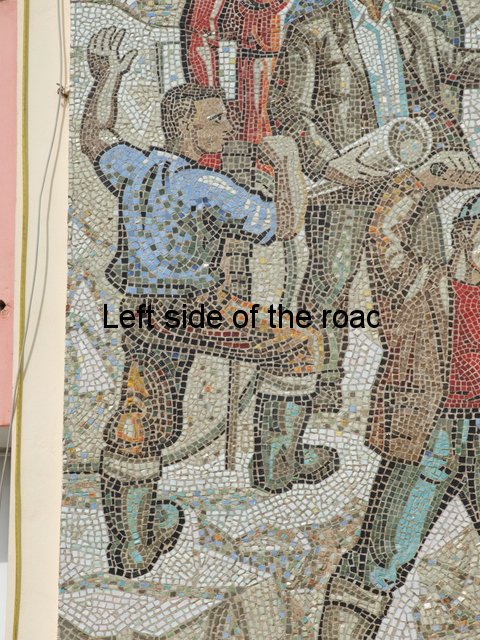
To his left is another worker with a similar drill, but this time it’s not in operation. He has his back to the viewer and we see his face in profile. His right hand is on the drill but his left arm is raised above his head and he seems to be waving to some unknown and unseen person or persons off the mosaic. He doesn’t have a hard hat (something which would have Health and Safety representatives in the UK nowadays tearing their hair out – although it is a sad reflection on our times that safety concerns for workers in far too many countries is actually getting worse rather than better as the years go by), wears a blue shirt and brown trousers. His feet, as with his comrade, are in heavy protective boots and are on a different level, stressing the unevenness of the ground.

Above and to his right, virtually in the centre of the panel, is a manager, technician, an ‘intellectual’. We know this because he’s dressed in a grey suit with a white, open necked shirt and ordinary shoes on his feet. In his right hand he holds a large rolled up piece of paper, a plan or diagram of some kind. He is likewise in profile and is looking out of the right hand side of the panel. His left arm is outstretched in front of him, the palm facing us. He is also, as is the non-working driller, seemingly indicating to someone out of sight.

Bashkia Mosaic - 'intellectuals'

Bashkia Mosaic – ‘intellectuals’

If we could feel his hands we would probably find that they are soft as a baby’s and not calloused as would be the hands of the drillers. And this is an important matter. The artist here is depicting a group of workers as if they are equals, working for a common goal. But the very nature of the depiction shows an inequality amongst them. The technician isn’t getting his hands dirty and has a role that is slightly different from the other workers in the quarry. Overcoming this discrepancy between ‘workers of hand and brain’ was one that no Socialist society has been able to achieve, so far, and would have been one of the contributory factors in their decline and failure.

Behind him is a young woman in a red dress who is also in profile, looking ahead of her to the right hand side. She is also an ‘intellectual’. A red dress is not the working clothes in a quarry and she holds a book of some kind in her right hand. Also her long brown hair, free flowing, is not the style of worker.

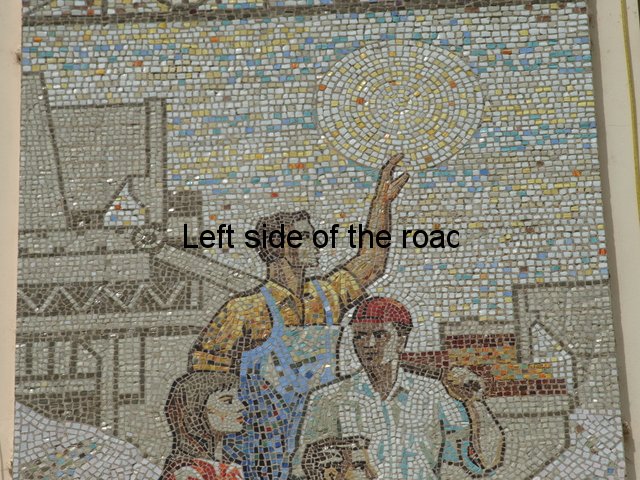
A third office worker, this time another male, is a bit higher up. He wears a white shirt and ordinary trousers and appears to be wearing a red hard hat. His left arm is bent at the elbow and his fist clenched, the hand being at the level of his shoulder. This could be the clenched fist Communist salute but I’m not sure why, in this context. He appears to be looking in the direction of the woman, not out of frame as are so many others.

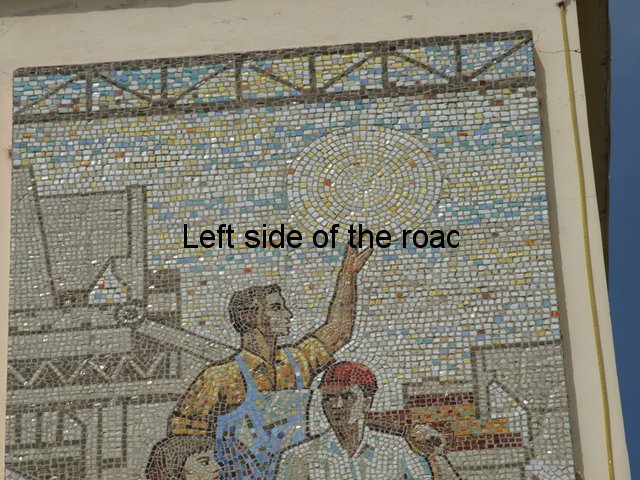
The final figure in the tableau is another worker. He is again in profile and looks out to the right. He’s wearing blue overalls over a yellow shirt and has his left arm high above him as if he is waving to someone out of the scene. His fingers cross the edge of a large circle that is presumably supposed to represent the sun. However, such a large sun would seem to be out of place. Having seen the results of so much political vandalism I am starting to think that there might have been something more relevant to Socialist construction. This space would be perfect for a large red or golden star – both of which would turn an image of a factory into a political statement. Yet another conundrum.

Bashkia Mosiac - The Sun?

Bashkia Mosiac – The Sun?

The background to the bottom two thirds of the image is of a quarry. The top third is taken up with images of a factory complex. As the rest of the image shows a quarry presumably this is a factory which works in the cutting and polishing of the stone quarried below. The largest part of the factory is on the left and there appears to be a conveyor belt of some kind to bring the stone up from ground level. At the very top edge of the mosaic is a black gantry. On the right are lower buildings and it would make sense if these were the offices, especially as we have office workers in the rest of the image.

That is what is depicted but what they are looking at and what the meaning is I have yet to work out. Who are they waving to out of scene? What is it that is so important that it concentrates the attention of the majority of those on the mosaic? I don’t know if I’ll ever find out the answer to those questions. Did I miss something and there’s a companion piece elsewhere on the building? I’ll have to wait until I have an opportunity to check it out.

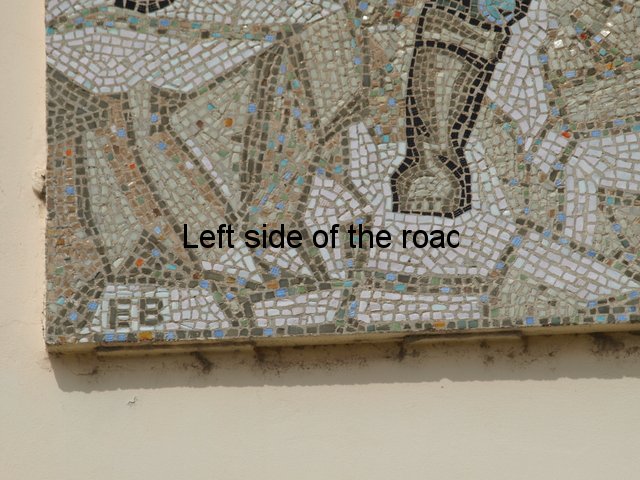
This is one of the works of Socialist Realism that is ‘signed’, the letters EB appearing in the bottom left hand corner. I have yet to discover what those initials stand for but the fact that there is any indication of the artist on view would seem to suggest this is probably a creation of the 1980s, when the identity of the artists began to appear on such art works.

Ura Vajgurore Crest

Ura Vajgurore Crest

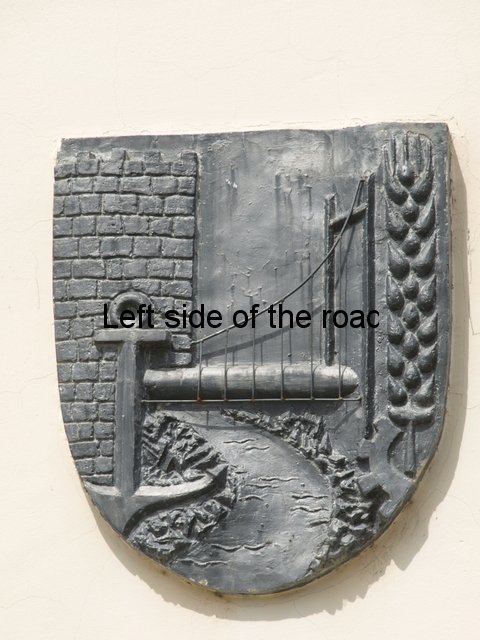
Completing the decoration on the front of the building is the crest for the town. The name of the town, Ura Vajguror means ‘Bridge over the Vajguror River’ and that’s what we see in the centre of the crest. On the left hand edge is a crenellated wall but I’m not aware of any ancient monument near-by (but that’s probably more down to my ignorance than anything else). Strangely at the bottom left there’s an anchor as the town is a long way from the sea and I can’t see any river close by as being navigable. On the right there’s a tall head of corn below which is a small arc of a cog-wheel, representing he collective farms and the factory complexes that would have existed during the Socialist period – all gone now.

Location:

The Bashkia is located in the centre of the town, on the left hand side of the main road heading in the direction of Kucove (if coming from the direction of Fier).

Lat/Long:

N 40.77453

E 19.87944

DMS:

40° 46′ 28.308” N

19° 52′ 45.984” E

More on Albania …..

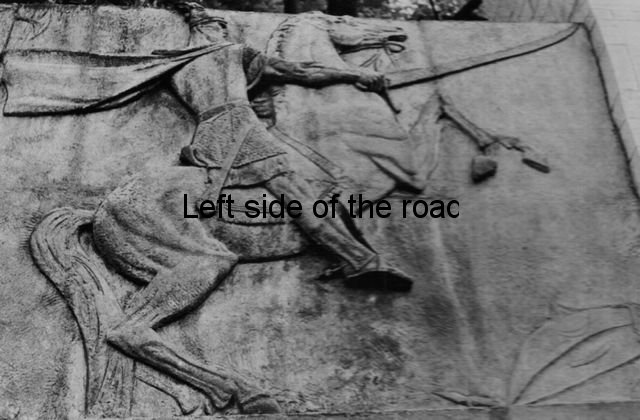
‘Skenderbeu’s Wars’ bas-relief in Gjirokaster

Skenderbeu's Wars, Gjirokaster, Hector Dule, 1968

Skenderbeu’s Wars, Gjirokaster, Hector Dule, 1968

More on Albania …..

‘Skenderbeu’s Wars’ bas-relief in Gjirokaster

Many of the lapidars in different parts of Albania have suffered from vandalism and neglect. This is sad as it is displays a lack of respect of the Albanians for their heritage. Those with a particular Socialist message have suffered the most, attacked by the monarcho-fascists when the country was going through a period of anarchy in the late 1990s. Caught up in this denial of the past are also some of the monuments dedicated to the country’s ancient ‘national hero’, Skenderbreu, and a bas-relief called ‘Skenderbeu’s Wars’ the ‘stone city’ of Gjirokaster has likewise being ignored and allowed to fall into decline.

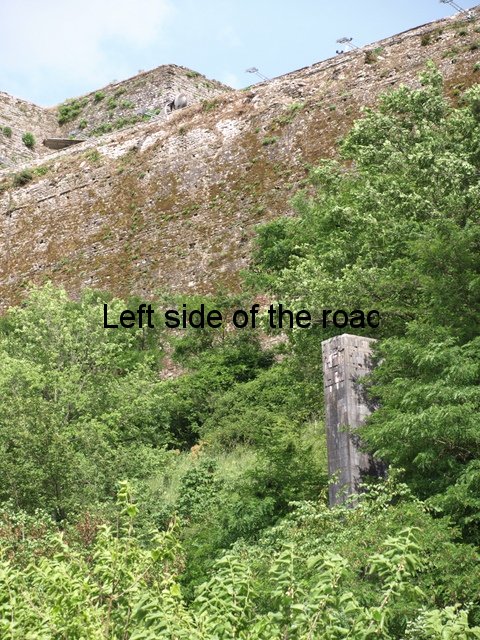
The monument is located just above the old town, where the road starts to zigzag as it heads up to the entrance of the castle. This is the north facing side of the hill and is covered with trees and bushes which, in the heat of summer, make for one of the most pleasant locations in the city to cool down. However, this is not the best kind of climate for the bas relief created by Hector Dule in 1968. In Albanian it’s official title is ‘Lapidar kushtuar luftrave të Skënderbeut’ which translates as: ‘Monolith dedicated to Skenderbeu’s Wars’.

I’m sure that during the period of Socialism the area would have been kept clear but over the last 25 years or so the trees have been allowed to grow and if you didn’t know what you were looking for would easily miss whilst passing only a few metres away.

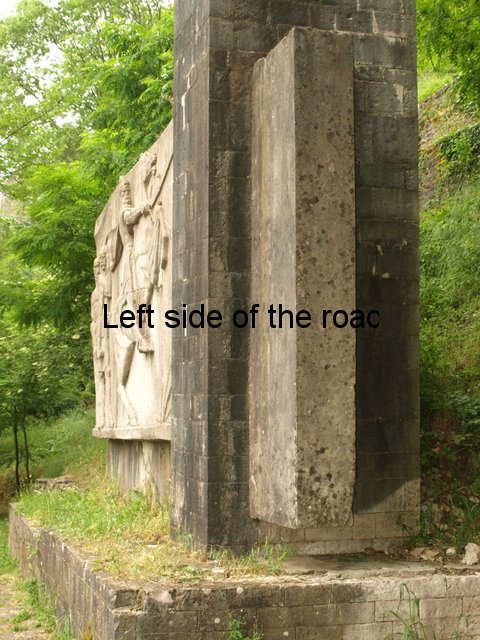
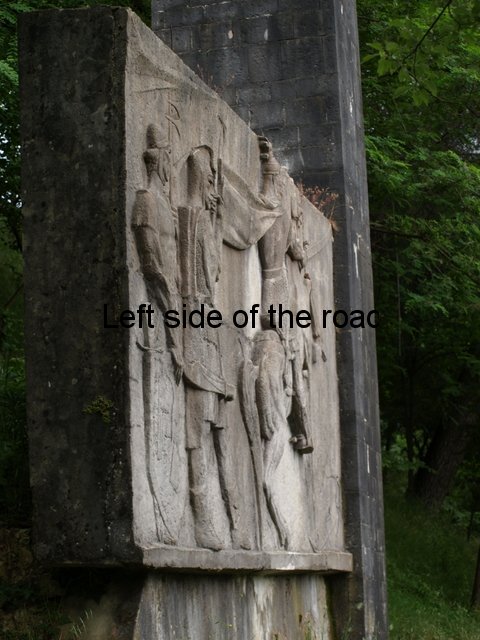
The monument consists of two parts – a concrete panel with images from the time of the Skenderbreu wars and a black stone column about twice the height of the panel to which it is attached.

The construction of the bas-relief is different from all the others I seen so far in that the constituent parts were obviously created elsewhere and then brought to the site to be put together. There are 4 square sections (on the left) and a larger, rectangular section on the right. Most later lapidars of similar materials appear to have been created on site. This was perhaps made possible as expertise and the technology improved as this depiction of Skenderbreu is one of the earliest of the sculptural lapidars.

This is not to say that Albanian lapidars didn’t exist before 1968. As the article ‘About the film ‘Lapidari” in Vol 1 of the Albanian Lapidar Survey points out the first lapidars appeared as soon as the National Liberation War had ended – if not before with the placing of simple grave markers over the bodies of some of the fallen Partisans. However, it was not until the mid-1960s that the Party of Labour of Albania decided that these locations would be an ideal place to develop both Socialist Realist Art as well as create an educational and propaganda tool for the promotion of the Socialist ideal – this was the start of Albania’s Cultural Revolution.

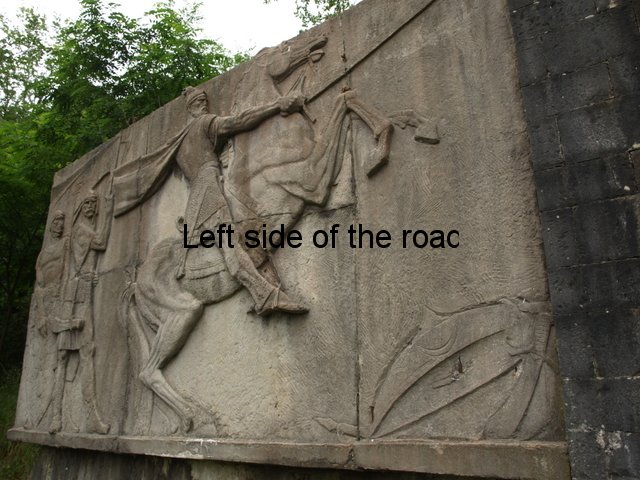
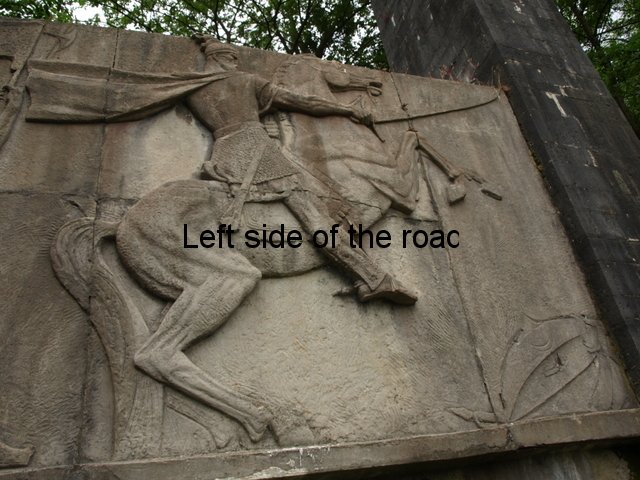
There are three males depicted, Skenderbreu himself and two of his followers. Skenderbreu is seated on a rearing horse and takes up more than two thirds of the space whilst the two soldiers stand behind him on the left hand side of the panel.

Here it’s worth well mentioning that the image that all Albanians have of Skenderbreu is one very much created in the mid 20th century by the sculptor Odhise Paskali who created the first sculpture of him in 1939, a head and shoulders bust. From then on that was the image and look that has been perpetuated by all subsequent artists. This ‘created’ image was as a result of the fact that no images exist of Skenderbreu as a fighting man, the only ones I’ve seen are of him when he was well past his fighting days. So here we have another situation where reality has been sacrificed for visual effect.

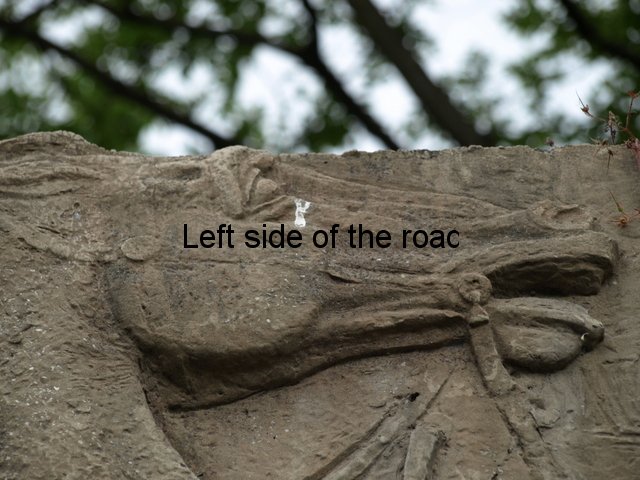
Although a fan of Dule’s work I’m not a fan of this particular piece. The image of the female Communist over the entrance to the main hall of the Palace of Congresses, for example, is a stunning piece of work but here the image is let down by how he has portrayed the horse – it’s a really ugly horse for a steed that would charge into war. Such horses had be be even more fearless than their riders as they weren’t able to rationalise the environment into which they were forced to go. But this horse looks thin, weak and afraid.

Skenderbeu's Horse

Skenderbeu’s Horse

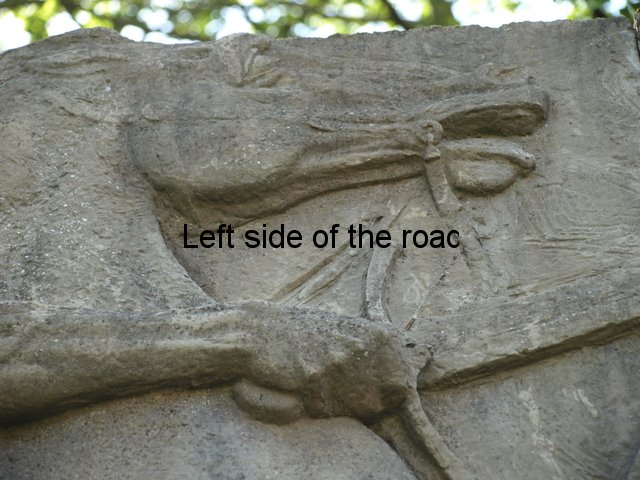
Its hind quarters, especially, appear as if the hide had been removed and is reminiscent of some of Michelangelo’s sketches of the muscles and ligaments of living creatures he produced 500 years ago. The horse is reared up on its hind legs, front hoofs pawing the air as if it were just at the point of beginning a charge but it doesn’t look too happy about it. To me the proportions of the head are wrong, it looks to small and gaunt for what, at that time, was the version of a tank. The size and speed of the horse was as much a weapon as the rider with whatever vicious cutting instrument he was carrying. The other thing that’s strange about this horse is that he has an incredibly, ridiculously even, long tail, trailing on the ground as it rears up.

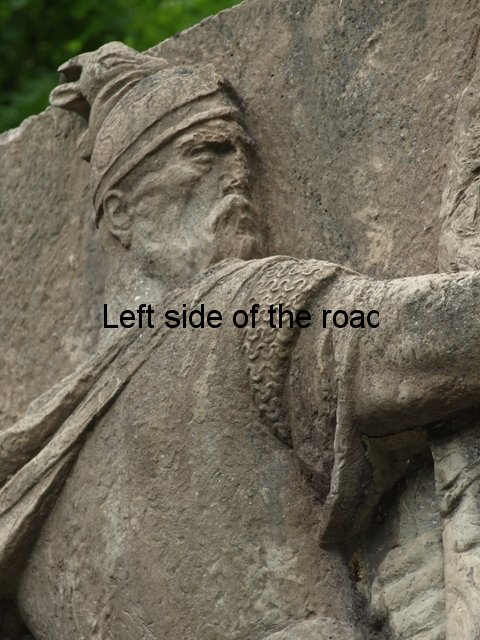
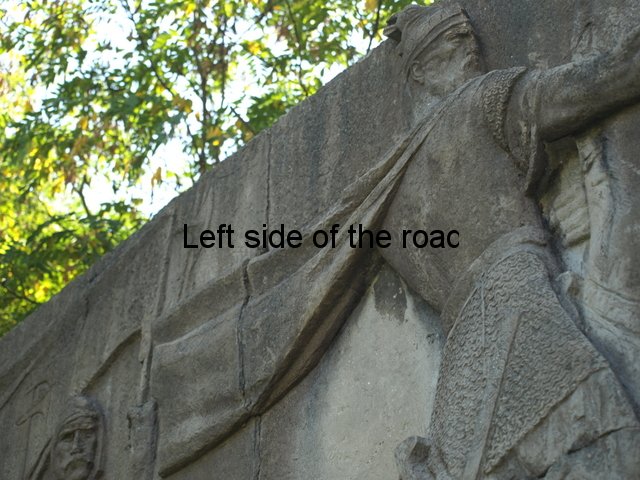
If the horse is hesitant then Skenderbreu certainly isn’t. He has the steely look of determination that such warriors would have had with their faith in their own destiny. But, again, this is Paskali’s image and not Dule’s, the younger sculptor following an older master’s lead. And as always in such images the fighter is shown wearing a helmet with the Kastrioti (his family name) emblem, that of the small head of a ram with long, swept back horns. Here the horns are slightly shorter than normal as that part of the sculpture is beyond the edge of the panel and would have been a weak point if made any longer. (At the same time as the look of Skenderbreu is a Paskali invention I’m not too sure whether the design of the helmet was something else that appeared first in the 20th century.)

Skenderbeu

Skenderbeu

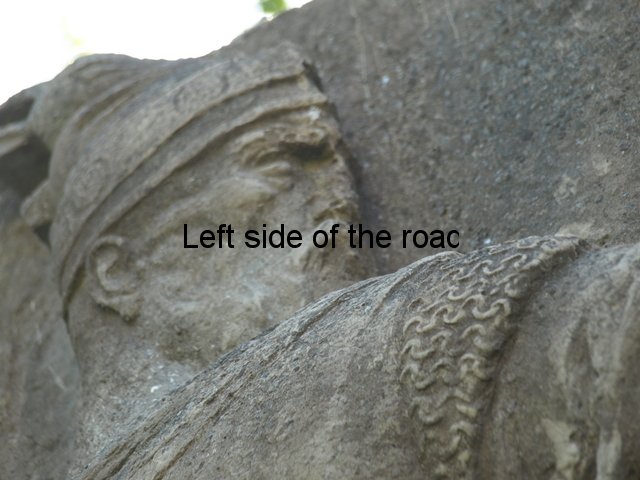
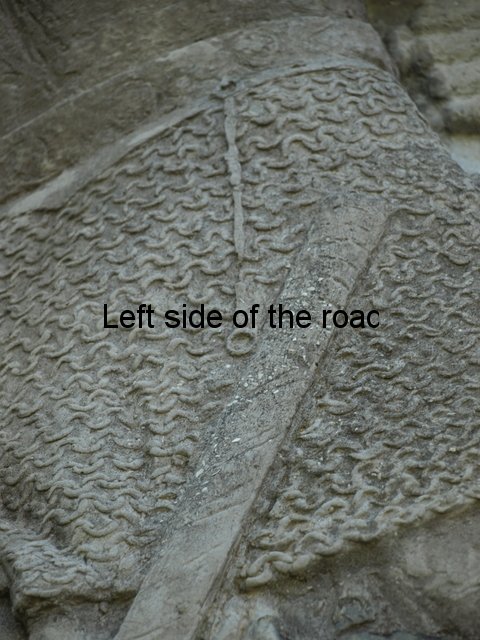
His face is in semi-profile. Dule has him looking slightly to his right, and it’s possible to see the features of the determined face, covered in the obligatory bushy moustache and beard of the time. He is well protected for the period, wearing a chain mail shirt over which he appears to have the top half of a suit of armour. Around his waist can be seen a short skirt of chain mail so this is probably a chain mail doublet.

He has leg guards but it’s not possible to make out from what they are made. He’s wearing some armour but not the full suit that would have been more common at the time in Western Europe so it’s possible these guards were made of leather. What is possible to see is a design around the ankle area, just before his foot is shown in the stirrups, so giving the impression that aesthetics were also part of battlefield etiquette.

His right arm, bare from just below the shoulder, is stretched out in front of him and he is holding a long sword, slightly curved at the end. This extends way in front of the horse, Skenderbreu’s hand holding the hilt of the sword close to the horse’s neck. The empty scabbard of this sword is shown hanging from his waist, over the chain mail skirt. His left hand can be seen gripping hold of the bridle between his body and the back of the horse’s neck.

Finally, when dealing with Skenderbreu, we have his cape which is doing something it couldn’t, and that’s flying out a long way behind him. The only way this would have been possible in real life was if he was charging at full tilt, but that’s impossible on a horse that is rearing up. Either a full blown charge or an incredibly strong wind, neither of which are possible here.

Being a lord Skenderbreu has a real saddle and the rear pummel can be seen at his back. As well as that there are intricate designs on the blanket and a relatively sophisticated stirrup for his feet.

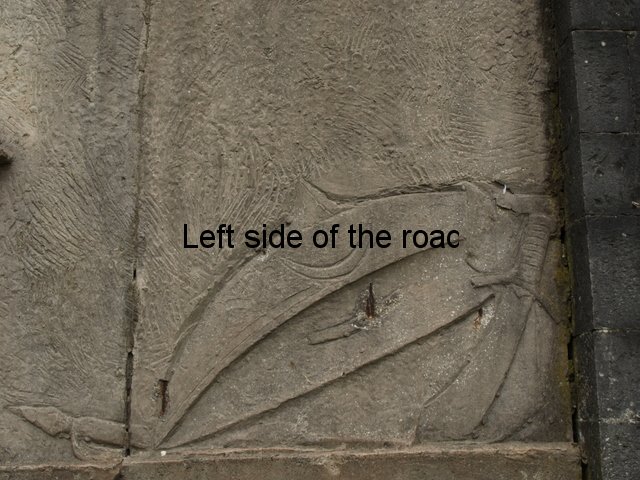
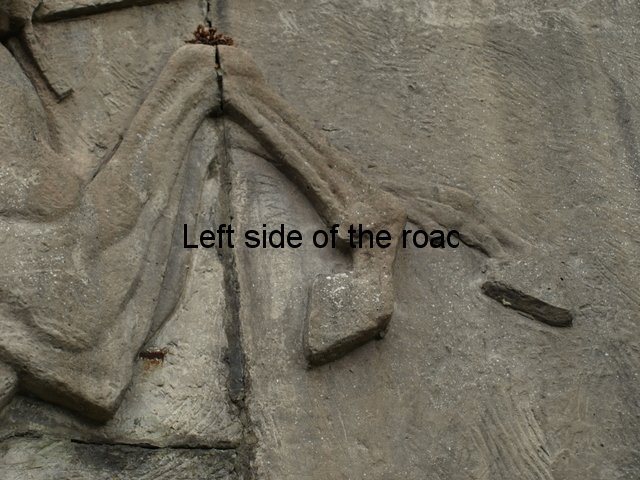
In the bottom right hand corner we are shown that Skenderbeu was victorious in this conflict. Here are the discarded weapons, a scimitar, a shield (with the crescent moon symbol of the Ottomans) and a ferrule at the top of the opposition’s standard, now laying in the dirt, no longer fluttering proudly in front of a powerful army.

War trophies

War trophies

This little collection of trophies is very reminiscent of pictures of another famous warrior fighting against Moslem invaders – Santiago (Matamoros) of Spain. In countless paintings depicting his miraculous intervention in the mythical Battle of Clavijo of 834 (more or less) the battlefield is always littered with discarded symbols of the invaders defeat.

This influence from earlier Christian iconography should neither be considered strange or alien to early Socialist Realist Art. As with ‘Shoket’ in Permet Martyrs’ Cemetery (the work of Odhise Paskali) any and everyone in the early stages of a Socialist society will be carrying with them the influence and baggage of the society that preceded that socialist construction. That will show itself in works of art as well as in language and ways of thinking. It is changing this thinking that is the most difficult task facing Communists after the revolution.

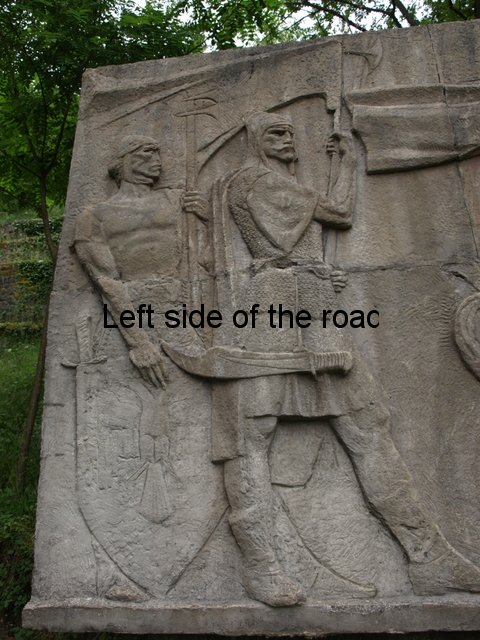
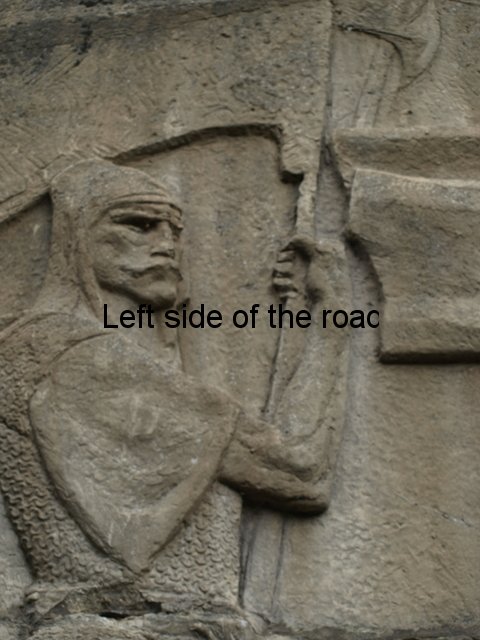
The first soldier behind Skenderbreu and his horse is the standard bearer. He is shown holding the pole of the independence army’s flag. His right hand grips the pole just below the flag (the tensed muscles showing his strength) whilst his left holds it close to his waist. He has the same look of determination on his face as his leader. He also has a bushy moustache but no beard – perhaps that was the private domain of the lords of the land.

Skenderbeu's foot soldiers

Skenderbeu’s foot soldiers

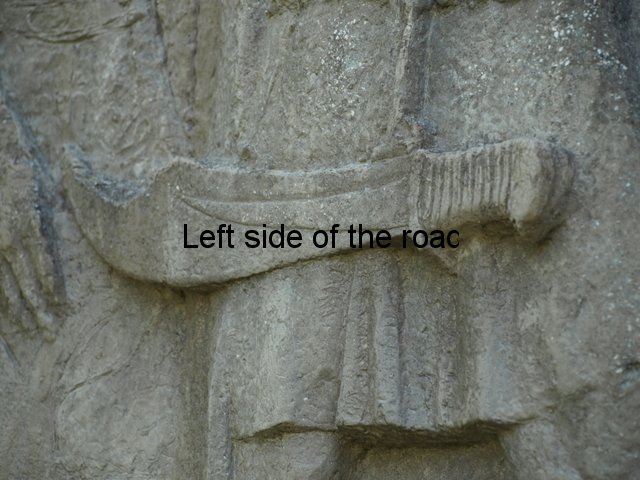
He is also relatively well protected and armed. He has a chain mail vest that extends to the level of his groin which is over a loose sleeved shirt and a fustanella (the skirt like garment worn by men). Like Skenderbreu he is bare armed. His shins are bare and on his feet he wears the standard shoe and socks of the 15th century. Hanging from his waist, so that it lays against his body horizontally, is a short scimitar style sword. I didn’t think these were common in the Albanian army at the time so perhaps what we are seeing here is a trophy of war. (Soldiers in all wars have done this, picked up something from the enemy if it is considered to be of better quality than what is in their possession.) It’s not clear but he appears to have a long cloak that’s attached to a cape that is on his head, the one piece for protection against the weather.

Appearing just before the flag and above Skenderbreu’s flowing cape is the image of a long handled axe, attempting to give the impression that there are more actors in this scene than are actually shown. This is a trick Dule uses on a number of occasions to give a feeling of depth, for example, with the fore hoofs of the horse.

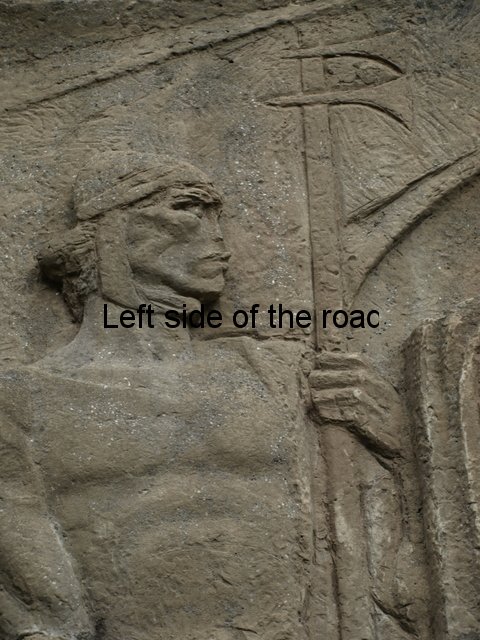
The third soldier stands at the left hand edge of the panel. We are definitely moving down the pecking order now. He is heavily armed but poorly protected. He has something on his head but it looks nothing other than a skull cap (and not a traditional cap with which I am familiar). He’s wearing a close fitting t-shirt top and his arms are bare. It’s difficult to see exactly but he also looks to be wearing a fustenella.

His left hand is gripping the long pole of a double-headed axe at shoulder height – these battles weren’t overly sophisticated, it seems. They just hacked and thrust at each other with as many pieces of sharp metal they could muster, the winners were the ones who hacked the most – an extremely bloody victory.

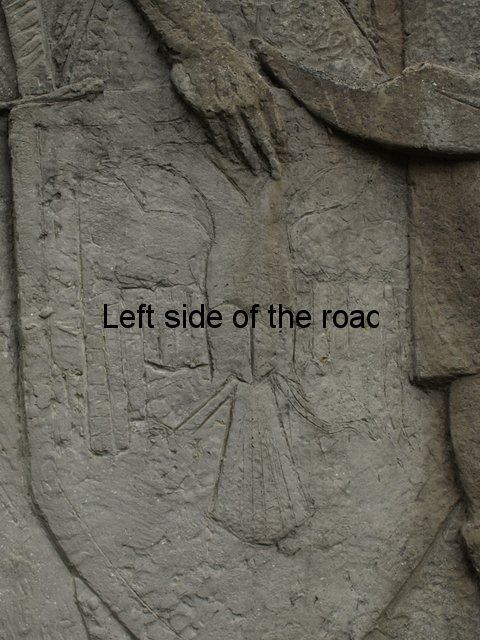
The double-headed eagle

The double-headed eagle

His right hand is holding a large shield, the point of which is resting on the ground, half way along its top edge. On this shield can be made out the image of the double-headed eagle, the symbol of Skenderbreu, which then became the emblem of Albania when it declared its (short run) independence in 1912 and which became – with the addition of a gold star – the official flag of the People’s Socialist Republic of Albania after 1944. We only see the hilt but there’s a long sword behind the left hand edge of this shield.

The face of this soldier is also strange, compared to the other two males shown. It’s back to the style of the horse with it’s frailty and almost a sense of fear. This face is also short of facial hair of any kind. This is the foot soldier who would have been in the thick of battle and who would have suffered the heaviest casualties.

I’m not too sure whether Dule is making a statement about these ‘national heroes’. Yes Skenderbreu fought for independence from the Ottoman Turks but he was first and foremost an aristocrat and landowner. He was fighting for the right to oppress the ordinary Albanian peasant, not for some utopia where all would be equal.

Here we have that stratification, that class division, in society shown by the very clothes the fighters in the same army used. Those at the ‘top’ got most protection and that got less as you closer to the foot soldiers, the basis (however ‘great’ the leader or general) of any army, then and since.

I don’t like this bas relief for the very fact that it ‘celebrates’ the lord who led he fight for national independence but not for the liberation of the people. I also don’t really understand why the myth around Skenderbreu was perpetuated as much as it was during the Socialist period. You don’t have to make such an individual so important just to prove you hadn’t forgotten the past.

Individuals from the past are problematic for a Socialist society. In Britain, for example, some see the person of Boudecia as a heroine as she fought against the Romans in AD60. However, they conveniently forget that first she was a collaborator and then, in seeking revenge for wrongs she considered the Romans had committed against her, became a mass murderer and, in modern parlance, a war criminal.

If Dule’s approach was as I’ve just suggested then I warm to the sculpture but still don’t consider it one of his best. If that was the underhand manner in which he depicted the ‘national hero’ he should be praised for subverting the common held image.

The Monolith

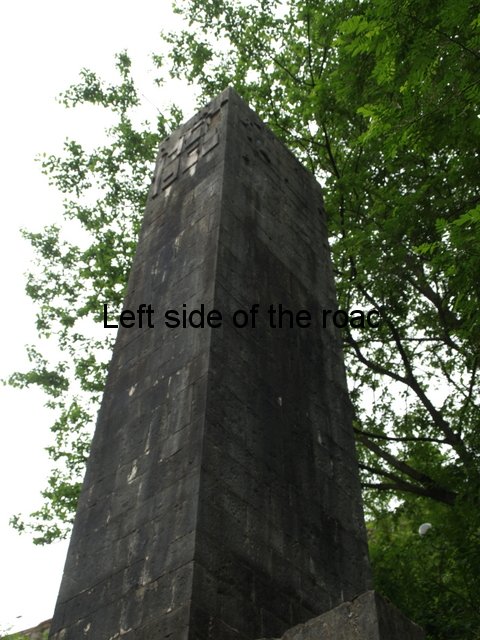
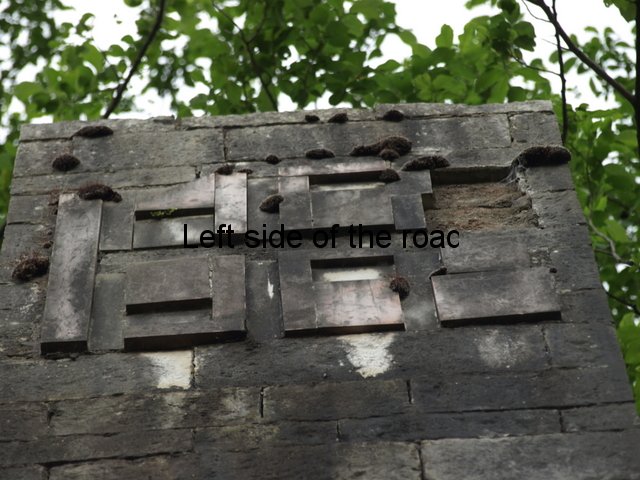
Whilst the panel with Skendebeu and his soldiers is made of concrete the monolith is made of black, local granite. This is more than twice the height of the panel and stands out from the surrounding trees, indicating where the monument can be found.

Top of the monolith

Top of the monolith

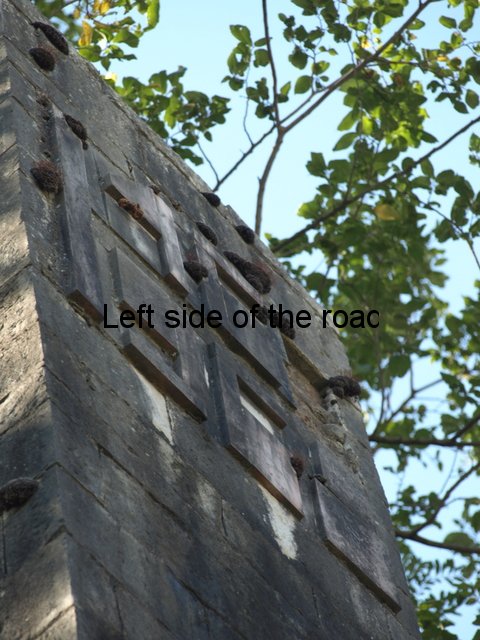
However, with so many lapidars, this monolith provides another enigma, conundrum. At the very top of the column the stones are arranged in such a way as to suggest that there was some sort of slogan, message which could be seen from far off. Now it is impossible to make out what those letters would have been. It doesn’t make sense for there not to have been something there originally. For most of its height the column is completely regular, it’s only at the top that that regularity is broken.

I can only assume that this is yet another example of conscious vandalism.

Condition

As mentioned before the trees in the vicinity of the monument have just been left to grow unhindered and it’s quite possible to pass close by and not know it exists. However, it is the lack of maintenance of the monument itself that serious problems are starting to emerge.

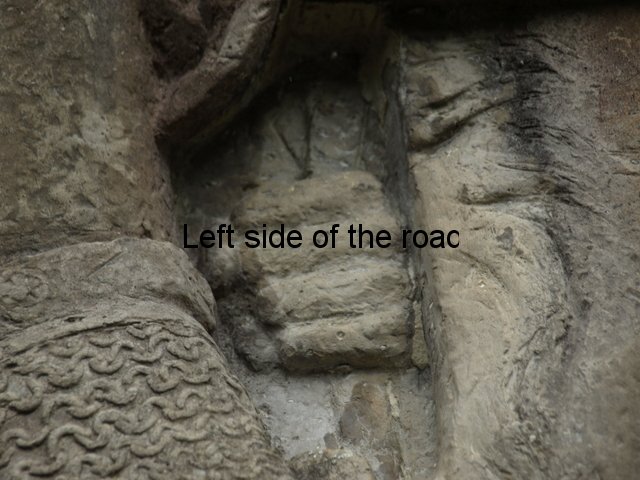
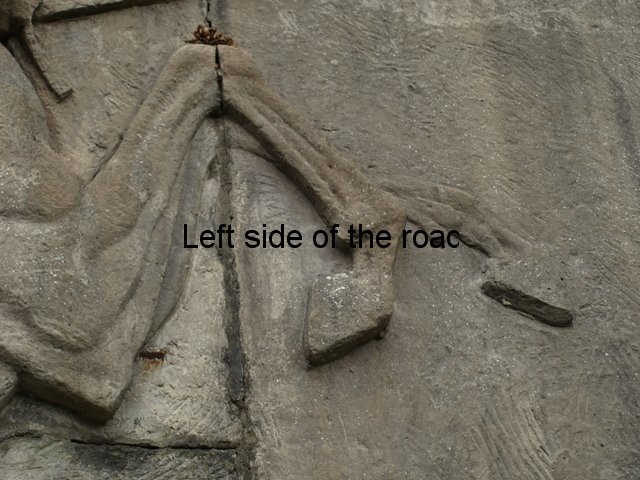
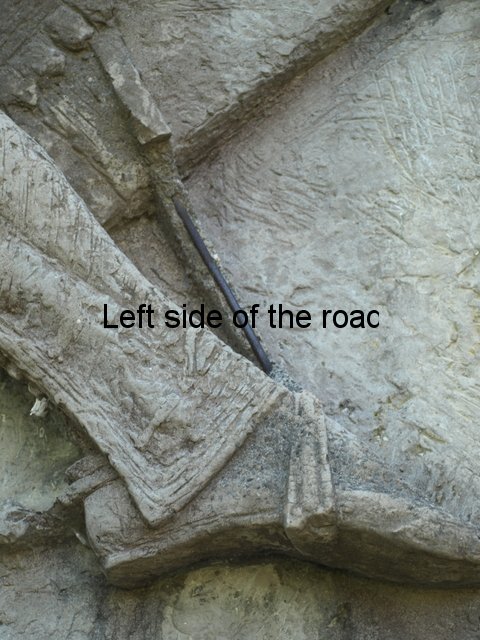
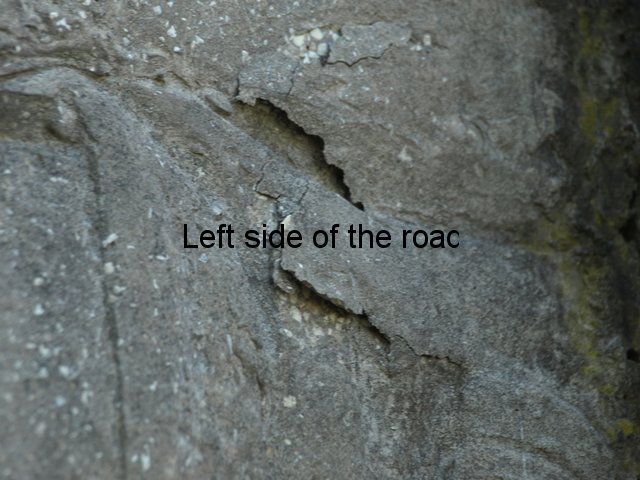
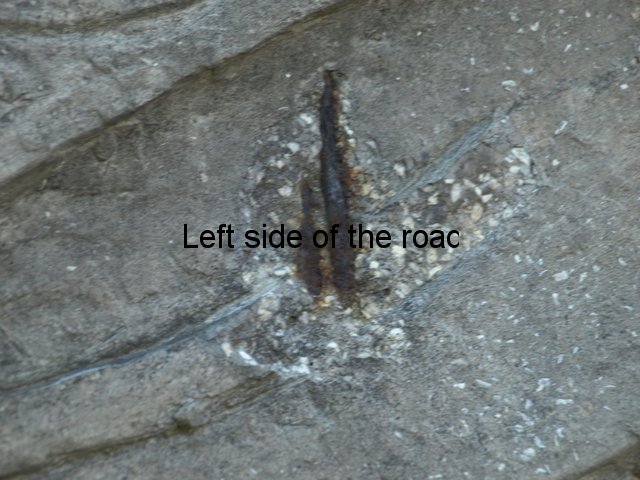
The bas-relief is constructed with iron wires throughout and some places these have been uncovered as the concrete has crumbled. The iron then starts to rust and this must have a knock on effect. There are a number of places where this is evident, for example, by Skenderbeu’s foot, and a little bit of restoration would prevent the situation from deteriorating and thus causing irrepairable damage. In places the concrete is breaking down to such an extent that you could actually pull pieces off with your fingers. At the same time, considering there’s been little care of the lapidar for 25 years the monument it has survived well – demonstrating that it was well made in the first place.

Result of vandalism

Result of vandalism

There’s also a place on the sculpture where there seems to have been some deliberate vandalism. The nose and part of the face of the soldier on the extreme left has broken away. This looks like someone has had a lucky hit with a stone and a piece of concrete has broken away. There’s also an indication that Skenderbeu’s nose has been the target for some wag.

Location:

From Sheshi Çerçiz Topulli go up hill along Rruga Gjin Zenebisi. At the crossroads at the top go left along Rruga Gjin Bue Shpata. As the road goes around to the left take the steps that go up on the right. On arriving at a small cafe take the path to the left, pass the stone tables and seats ‘stolen’ by the cafe and the monument is 20 or so metres away.

Lat/Long:

N 40.07375099

E 20.13939497

DMS:

40° 4′ 25.5” N

20° 8′ 21.8184” E

Altitude:

325.6 m

More on Albania …..