Colonnade mosaics – Lake Valae Morilor – Chișinău – Moldova

Colonnade mosaics, Valae Morilor

Colonnade mosaics, Valae Morilor

More on Moldova – on the Post-Socialist Countries – Eastern Europe and Asia page

Soviet-era mosaics in Cahul – Gagauzia

Soviet Mosaics – Bălți – Moldova

VI Lenin and Palace of Culture Mosaic – Ribniţa – Pridnestrovie

Colonnade mosaics – Lake Valae Morilor – Chișinău – Moldova

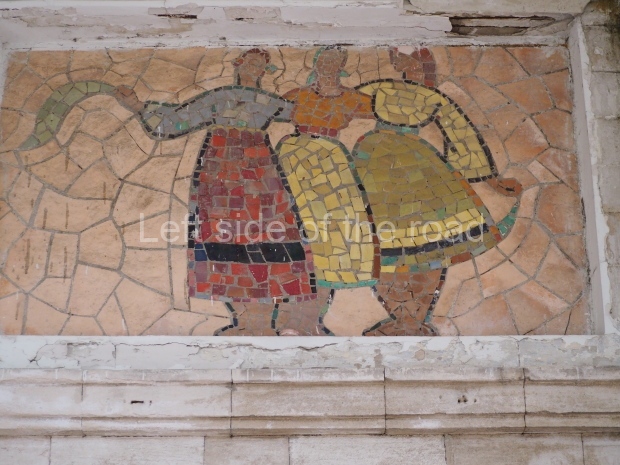
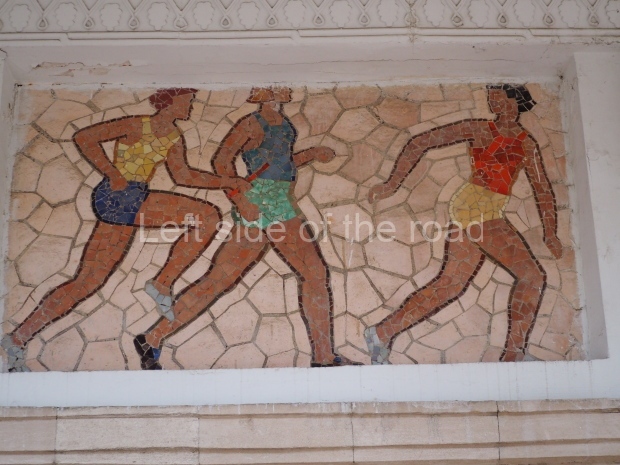
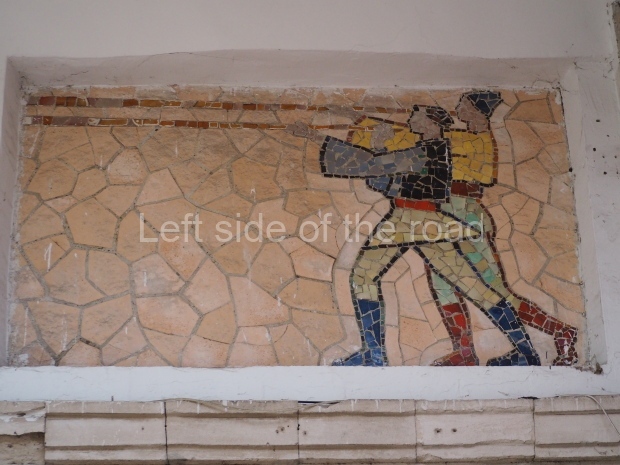
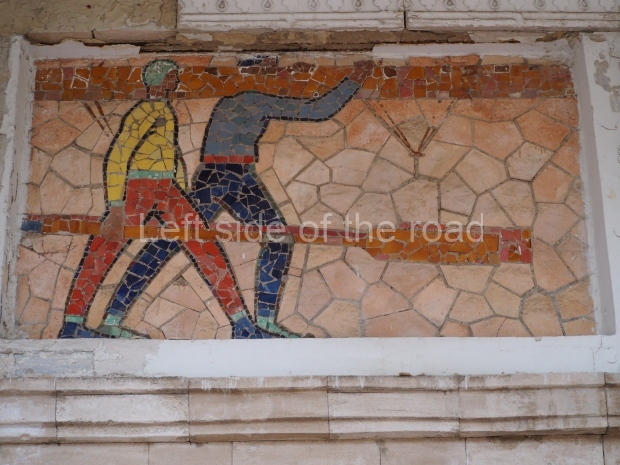
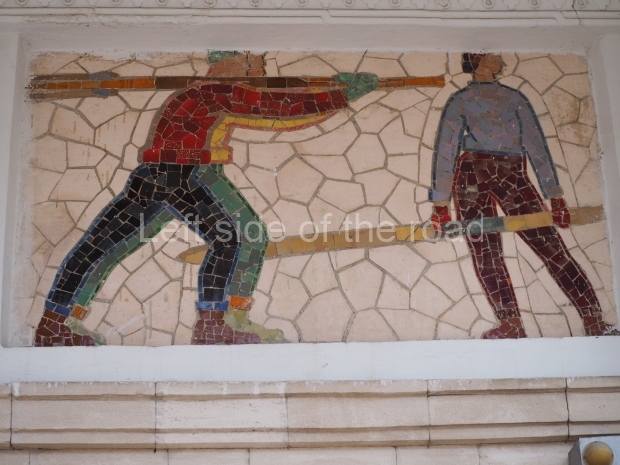
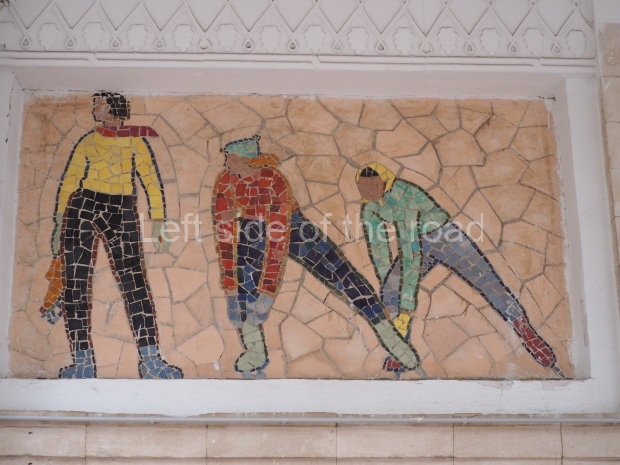
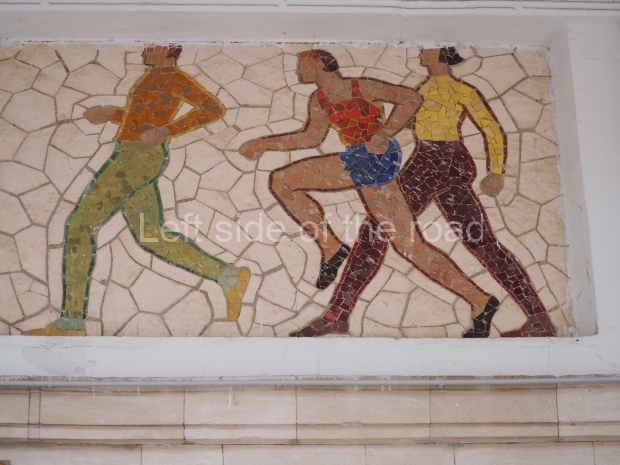
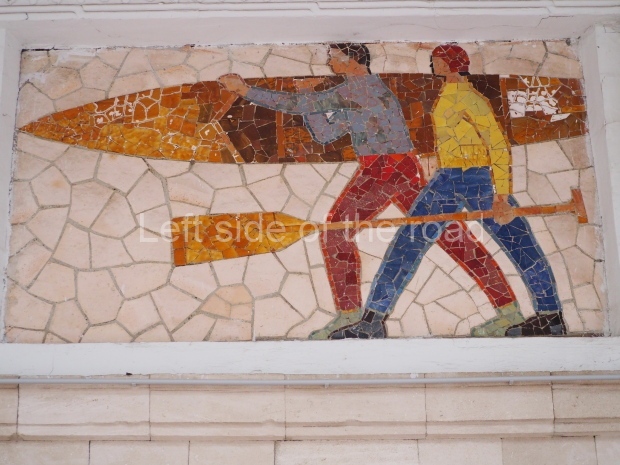
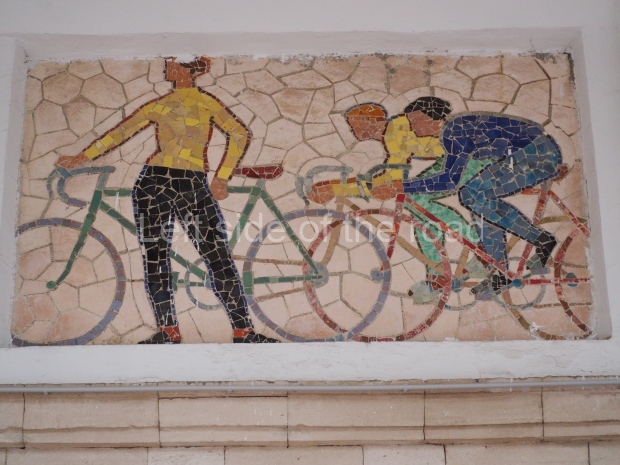
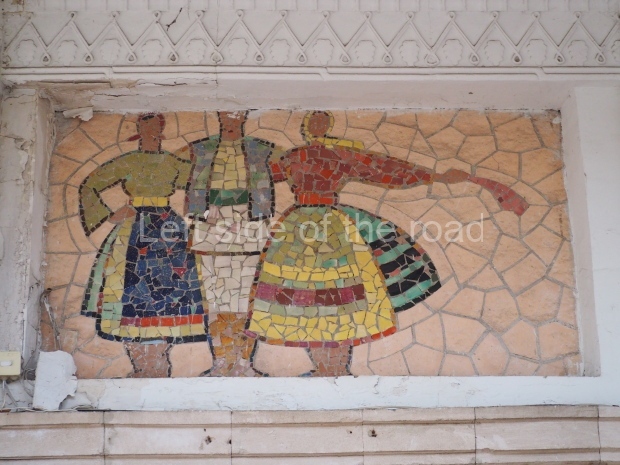
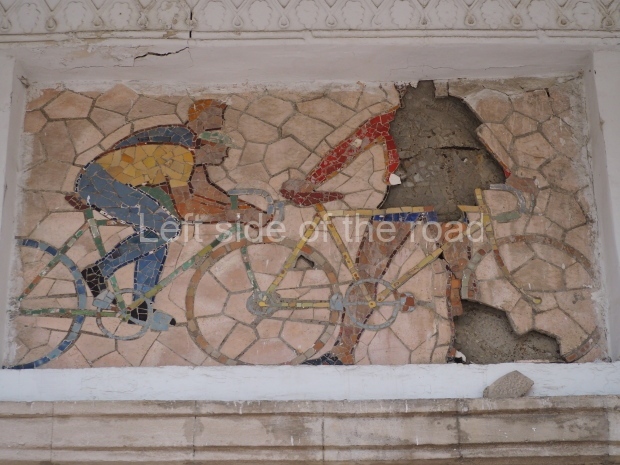
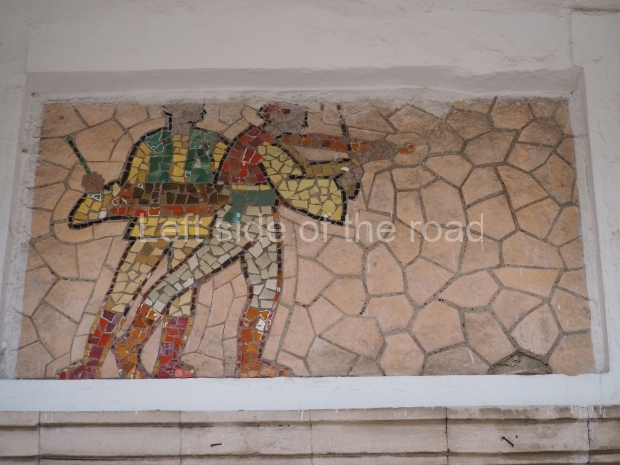
On entering the park of Lake Valae Morilor at its western entrance, coming from the centre of Chişinău, visitors pass by low buildings on either side which are fronted by a neoclassical colonnade. However, if people are in a rush in getting to the lake and going down the Cascade Staircase (an impressive 218 granite steps) they are in danger of missing a series of 12 mosaic panels which are installed above the windows of these one storey buildings.

They depict activities that used to (and probably still do) take place in and around the lake; skating, cycling, running, canoeing, traditional folk dancing, playing a Moldavian fluier (a long, narrow, wind instrument which is/was a traditional instrument of shepherds), playing a violin/fiddle, rowers, relay running and cross country skiing.

Unfortunately, they haven’t been cared for and a few have a few chucks of the mosaic missing and the surrounding plaster work is also stating to crumble.

Some background to the lake and park

It was originally called the Central Park of Culture and Rest of the Leninist Komsomol and was established in 1950. The lake was dug by young Soviet volunteers of the Komsomol, completed in 1952 and so was named Komsomolskoye Ozero (Komsomol Lake).

[If you go to the Valae Morilor Lake don’t forget to make a visit to the Lenin, Marx and Dimitrov monument at the far side of the park from the granite steps – near the exhibition area.]

Artist;

Alexander Kuzmin

Architects;

V. Novikov and F. Nutovich

Created;

Mid-1960s

Location;

At the top of the Cascade Staircase at the eastern entrance to Valae Morilor Lake; right next to the bus stops on Alexei Mateevici Street and just across the road from the State University of Moldova.

GPS:

47.01847 N

28.82253 E

How to get there;

The park and lake are only a short walk westwards from the Fine Arts Gallery and the National History Museum.
More on Moldova – on the Post-Socialist Countries – Eastern Europe and Asia page

Soviet-era mosaics in Cahul – Gagauzia

Soviet Mosaics – Bălți – Moldova

VI Lenin and Palace of Culture Mosaic – Ribniţa – Pridnestrovie

The mosaic ‘Energy’ on the CET 1 power plant – Chișinău – Moldova

CET 1 on Strada Vadul lui Vodă 5

CET 1 on Strada Vadul lui Vodă 5

More on Moldova – on the Post-Socialist Countries – Eastern Europe and Asia page

Soviet-era mosaics in Cahul – Gagauzia

Soviet Mosaics – Bălți – Moldova

VI Lenin and Palace of Culture Mosaic – Ribniţa – Pridnestrovie

The mosaic ‘Energy’ on the CET 1 power plant – Chișinău – Moldova

S.A. Centrala electrică cu termoficare nr.1 Chişinău (S. A. Power Plant with district heating No.1 Chişinău – CET 1) was first constructed in 1951 for both electricity generation and to provide hot water for communal heating. This system was common in Soviet Republics and these are the industrial units, with large chimneys, you’ll see in the centre of many towns and cities – looking somewhat incongruous amongst the residential buildings.

From what I’ve been able to find out it ceased providing hot water to residential buildings some time ago. Presently there seems to be a lot of clearance of older residential properties and the construction of modern apartment blocks – a process of yuppification where heating is on an individual basis.

When I was there, towards the end of 2025, the whole site looked abandoned so I’m not sure if these buildings will last much longer.

This is unfortunate as along the side of the building (that fronts onto the main road) is a very large Soviet era mosaic. This is something I like about Soviet art in its various forms – it was used to make the mundane more attractive. This reached its pinnacle in the decoration of the Moscow Metro system. If any ‘art’ were to be installed in the vast majority of cases on capitalist structures it would be in the form of advertising hoardings designed to promote even more consumerism.

The mosaic itself is long and narrow and fills the space between the windows on the ground floor and the windows on the first floor.

The mosaic is made up of seven panels which, basically, tell the story about the function of the building. The central panel has a large image of a male. A capitalist interpretation would describe this male as a God of Fire – but a Socialist interpretation would describe him as representative of those who worked in the plant and, from their labour, kept the fires burning and the machinery functioning to create the heat needed to produce the hot water for local distribution and the turbines running for the production of electricity.

This image has the back of his left hand pressed against his forehead and around his outstretched right arm flames shoot out in all directions. He is pointing to the workers, depicted in the last two panels, (on the left hand side) who work to provide the communal heating for the neighbourhood.

On the right hand side of the central male we first get a stylised representation of electricity with lightening bolt images. This is followed, at the extreme right side edge of the mosaic, of workers by the turbines.

In the very bottom right hand corner the mosaic is ‘signed’. However, some of the tiles are missing but it’s still possible to make out the name of the mosaic artist Alexander Kuzmin – who worked in Moldova but was born in Kostroma in Russia in 1939. In Cyrillic there’s К(уз)ьм(и)н – the letters in brackets are missing. This is followed by the date, which is also damaged, but other sources quote the year as being 1988.

There are some places where tiles are missing but any such damage does not really have a great impact on the image. If we take into account the age and the fact that it is unlikely there has been any significant maintenance since the early 1990s, it is in a remarkably good condition. How it will survive the wrecking ball is another matter.

It’s best seen in the winter when the trees are not in leaf as much of the mosaic will be obscured by the trees in front of the building in the warmer months – a bit like the historical mosaic on the Lenin factory in Bălți.

Artist;

Alexander Kuzmin

Created;

1988

Location;

On the part of the building, to the left of the tall chimney, facing the main road at Strada Vadul lui Vodă 5.

GPS;

47.02691 N

28.86510 E

How to get there;

Trolleybus No. 7 from Alexander Pushkin Street in the city centre passes right in front of the building. Get off at the bus stop before CET-1 – otherwise it’s along and complicated walk back. It’s also not far from the North Bus Station, look for the tall, red and white chimney towards the east.

More on Moldova – on the Post-Socialist Countries – Eastern Europe and Asia page

Soviet-era mosaics in Cahul – Gagauzia

Soviet Mosaics – Bălți – Moldova

VI Lenin and Palace of Culture Mosaic – Ribniţa – Pridnestrovie