A Reflection of the Progress of our Figurative Arts

November 8, 1941-1976, 35 years of Party - Frano Ashiku

November 8, 1941-1976, 35 years of Party – Frano Ashiku

More on Albania ……

View of the world

Ukraine – what you’re not told

A Reflection of the Progress of our Figurative Arts

Introduction

This article first appeared in New Albania, No 6, 1976. The bi-annual Figurative Arts Competition and Exhibition seemed to have been postponed from 1975 and instead took place in 1976 to coincide with the 35th Anniversary of the Founding of the Party of Labour of Albania.

On this occasion the sculptor Muntaz Dhrami was invited to write the introduction.

Muntaz Dhrami (Merited Artist)

The Exhibition of Figurative Arts dedicated to the 35th anniversary of the founding of the Party of Labour of Albania has been opened in the halls of the National Gallery of Arts in Tirana. This is one of the biggest displays of our national arts. Over 445 works by 378 artists represent the highest ideo-aesthetic and professional levels in our painting, sculpture, graphics and applied arts. This is a beautiful collection of colours, form and line, which embodies the great ideas of our people’s revolution.

In these works our art-lover finds the important historical theme, especially, glorious pages from our National Liberation War, from the heroism of our fighters and workers, the portraits of heroes and of ordinary people, those who are changing the face of Albania today.

This land has a master - Sabaudin Xhafer

This land has a master – Sabaudin Xhafer

In the Exhibition the self-sacrificing toil at the work-sites of the construction of socialism, the beautiful landscapes of our transformed homeland, the figures of partisans, of the metallurgists smelting the first Albanian steel, are strikingly reflected. The life and work in our socialist countryside is beautifully and poetically portrayed in the Exhibition.

The works on display in this exhibition have all been produced within the past two years. Among them we find many powerful compositions with great emotional force, a wide range of individual talents, an artistic language which is simple and understandable to the people, and works with an innovatory flavour. They are far removed from any hint of cosmopolitanism or dictate imposed by other countries.

The metalurgist - Kristaq Rama and Hektor Dule

The metalurgist – Kristaq Rama and Hektor Dule

In the best works one can see the broad contact which the artist has had with the vivid life of the working people. They are the fruit of the great inspiration which has gripped every artist who has gone among the people and really got to know their heroic life at first hand.

A good part of the works have been subjected to open discussion with the ordinary people. The studios of our artists are always open to the public, and broad creative discussions are often conducted in them. Our art has a thoroughly democratic spirit, which stems from its proletarian partisanship. A number of artists have set up their studios for years on end at building sites. Others compose their works cheek by jowl with workers and cooperative members, where they open their own exhibitions with motifs from the work of workers and cooperative members. Later these works are brought to the Central Exhibition. Regional Exhibitions of Figurative Arts have been opened in all districts, like those of Shkodra, Vlora, Korça, Lushnja, Saranda, Gjirokastra, Burrel, Durres and so on, at which the broad masses of workers give their opinions on the works which will be exhibited at the Central Jubilee Exhibition.

The Party will be our Mother - Liliana Cefa

The Party will be our Mother – Liliana Cefa

The art-loving masses who are concerned that our new art should flourish and progress, have become not only the inspiration of our artistic production but also the principal suppliers of new talents.

In addition to older artists, more and more young talents are militating in our ranks. Likewise more and more amateurs are working alongside our professional artists. Thus, in this Exhibition alone, over 130 young artists, among whom nearly 30 amateurs exhibited for the first time. Alongside the young artist who has graduated from the secondary school of art or from the Higher Institute of Arts, in this Exhibition we find works by the folk artist or the relief carved in stone by the 70-year old Highlander, Llesh Vorfi.

By following this course, our art has gained maturity and the warmth of our soil, the strength of youth which our socialist system imparts. Works of art, which have become close to the people and belong to the people, aid them in their day to day life.

Mio Sokoli - Sali Shijaku

Mio Sokoli – Sali Shijaku

Our art is forging ahead, full of vitality and originality; far removed from any formalist and modernist absurdity. It has become an integral part of the spiritual life of our working people, whose interest is continually mounting. Thus we artists are made more deeply aware of our responsibility as creators and our confidence to turn out better and more beautiful works, is increased.

The Exhibition of our Figurative Arts marks a new level in the upsurge and maturity of our arts, opening new opportunities for further progress.

More on Albania ……

View of the world

Ukraine – what you’re not told

2021 starts with continuing Zionist attacks on the Palestinian population

More on Palestine

View of the world

Ukraine – what you’re not told

2021 starts with continuing Zionist attacks on the Palestinian population

Israeli airstrikes damage children’s hospital and school in the Gaza Strip

Ramallah, January 23, 2021—Israeli warplanes launched five missiles at targets in Gaza City in late December, damaging a children’s hospital, school, center for disabled people, and several residential buildings.

Israeli airstrikes struck areas in the north, east, and west of Gaza City. The Israeli attacks damaged the Gaza Center for People with Disabilities, the Shuhada Gaza School, and the Mohammad Al-Dura Children’s Hospital, all located in the At-Tuffah neighborhood of Gaza City, according to information collected by DCIP. The Israeli military claimed the attacks targeted Hamas locations in response to rockets fired from the Gaza Strip towards Israel.

When the missiles struck the area, 16 Palestinian children were patients in the children’s hospital, including three in the intensive care unit. An ensuing power cut interrupted patient care at Mohammad Al-Dura Children’s Hospital.

“The explosions caused great bewilderment among the sick children in the hospital,” Dr. Majed Hamada, Head of Mohammad Al-Dura’s Children Hospital, told Defense for Children International – Palestine. “The explosion shattered ten windows,” he added, telling DCIP that none of the patients or staff sustained injuries.

“I was going to bring medication for the kids when I saw the sky turn red,” Eman Bilal, a nurse at the hospital, told DCIP. “After that, we heard the huge explosion that shook the building and shattered the windows. Everyone at the hospital panicked, parents were scared to the point they started carrying their sick children and running towards safer rooms.”

The Gaza Center for People with Disabilities in At-Tuffah, which provides educational and training services for 60 students with disabilities aged between 14 and 28, sustained damage that interrupted classes and other services for at least one day. Around 20 windows were shattered and three doors were damaged, according to the director of the center, Salah Al-Amasi.

The Shuhada Gaza School, also in the At-Tuffah neighborhood, sustained damage to 52 windows and five doors during the airstrikes, according to the principal, Ihab Quqah. The building is home to both the Shuhada Gaza Public School, which educates around 620 pupils aged between 6 and 11 years old in the morning, and UNRWA’s Al-Daraj School, which educates 1000 pupils aged between 6 and 14 years old later in the day.

“Israeli forces’ use of explosive weapons in densely populated civilian areas in the Gaza Strip is very likely to have indiscriminate effects,” said Ayed Abu Eqtaish, Accountability Programme Director at DCIP. “While no casualties resulted here, Israeli forces regularly treat Palestinian public infrastructure in the Gaza Strip as acceptable collateral damaging and attacking essential facilities such as hospitals and schools.”

International humanitarian law prohibits indiscriminate and disproportionate attacks and requires that all parties to an armed conflict distinguish between military targets, civilians, and civilian objects. Israel as the occupying power in the Occupied Palestinian Territory, including the Gaza Strip, is required to protect the Palestinian civilian population from violence.

Israeli warplanes struck a United Nations-run school in a United Nations Relief and Works Agency (UNRWA) compound in the Al-Shati refugee camp located in the northwest of Gaza City on August 13, 2020, according to documentation collected by DCIP. The munition did not detonate on impact. UNRWA officials confirmed reports that the UNRWA Beach Co-Educational School ‘D’ in the Al-Shati refugee camp was damaged by an Israeli missile that did not detonate. Students were not allowed on the premises, having only returned to school less than a week earlier following a five-month school closure in response to the COVID-19 pandemic.

DCIP and numerous other human rights organizations have extensively documented Israeli forces’ targeting of schools, hospitals, and other civilian infrastructure in the Gaza Strip, as well as the killing and maiming of children in and around such infrastructure.

DCIP’s investigation into all Palestinian child fatalities during the Israeli military’s assault on the Gaza Strip in summer 2014, known as Operation Protective Edge, found overwhelming and repeated evidence that Israeli forces committed grave violations against children amounting to war crimes. This included direct targeting of children by Israeli drone-fired missiles and attacks carried out against schools. In at least three incidents, Israeli forces carried out indiscriminate or disproportionate attacks against schools.

This article first appeared on Defense for Children International – Palestine

Israeli forces kill 17-year-old Palestinian boy, allege attempted stabbing

Ramallah, January 26, 2021—Israeli forces shot and killed a 17-year-old Palestinian boy Tuesday afternoon in the northern occupied West Bank after the teen allegedly attempted to stab an Israeli soldier nearby.

Attallah Mohammad Harb Rayan, 17, from Qawarat Bani Hassan, a town located southwest of the occupied West Bank city of Nablus, was shot dead by Israeli forces around noon at the Hares Junction near the illegal Israeli settlements, Revava and Barqan, according to documentation collected by DCIP. Israeli forces shot Attallah after he allegedly carried a knife and attempted to attack an Israeli soldier stationed at the junction, according to Israeli army radio. 

“Israeli forces frequently resort to lethal force in circumstances not justified by international law,” said Ayed Abu Eqtaish, Accountability Program Director at DCIP. “Children suspected of committing criminal acts should be apprehended in accordance with international law and afforded due process of law.”

Under international law, intentional lethal force is only justified in circumstances where a direct threat to life or of serious injury is present. However, investigations and evidence collected by DCIP regularly suggest that Israeli forces use lethal force against Palestinian children in circumstances that may amount to extrajudicial or wilful killings.

Attallah is the first Palestinian child killed by Israeli forces in 2021. In 2020, Israeli forces killed nine Palestinian children in the occupied West Bank, including East Jerusalem, and the Gaza Strip, six of whom were killed with live ammunition, according to documentation collected by DCIP. 

Israeli forces killed 17-year-old Mahmoud Omar Sadeq Kmail on December 22, after he allegedly shot at Israeli paramilitary border police forces deployed in occupied East Jerusalem’s Old City. On December 4, Israeli forces shot and killed 15-year-old Ali Ayman Saleh Abu Alia in Al-Mughayyir, a village northeast of Ramallah in the occupied West Bank. Ali did not present any threat to Israeli forces at the time he was killed, according to documentation collected by DCIP. The Israeli military has reportedly opened an investigation into Ali’s killing following international condemnation of the killing.

Israeli forces are rarely held accountable for grave violations against Palestinian children, including unlawful killings and excessive use of force. According to Yesh Din, an Israeli human rights organization, around 80 percent of complaints filed with Israeli authorities by Palestinians for alleged violations and harm by Israeli soldiers between 2017 and 2018 were closed with no criminal investigation opened. Of complaints where a criminal investigation was opened, only three incidents (3.2 percent) resulted in indictments. Overall, the chances that a complaint leads to an indictment of an Israeli soldier for violence, including killing, or other harm is 0.7 percent, according to Yesh Din.

This article first appeared on Defense for Children International – Palestine

More on Palestine

View of the world

Ukraine – what you’re not told

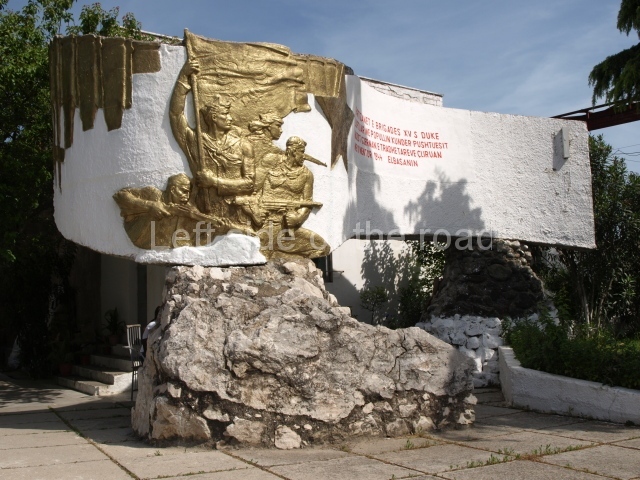
Monument to the 15th Partisan Assault Brigade – Elbasan

Monument to the 15th Partisan Assault Brigade - Elbasan

Monument to the 15th Partisan Assault Brigade – Elbasan

More on Albania ……

View of the world

Ukraine – what you’re not told

Monument to the 15th Partisan Assault Brigade – Elbasan

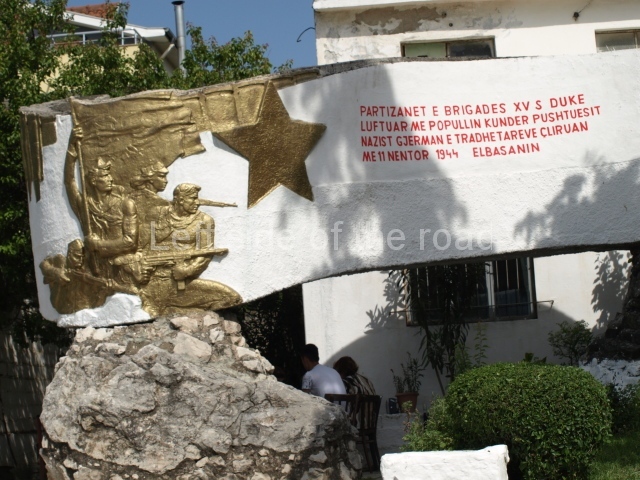
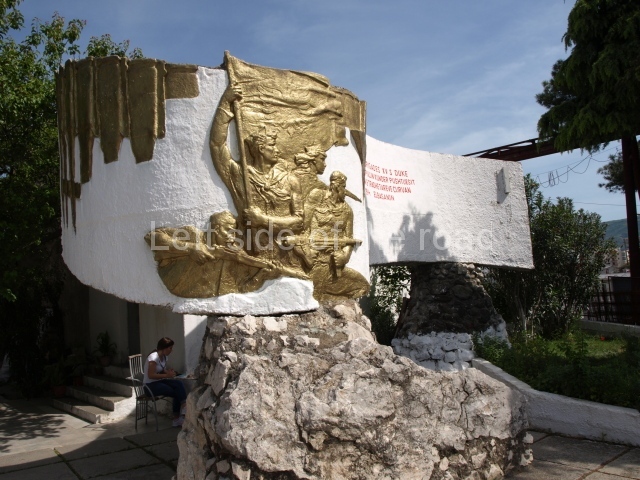
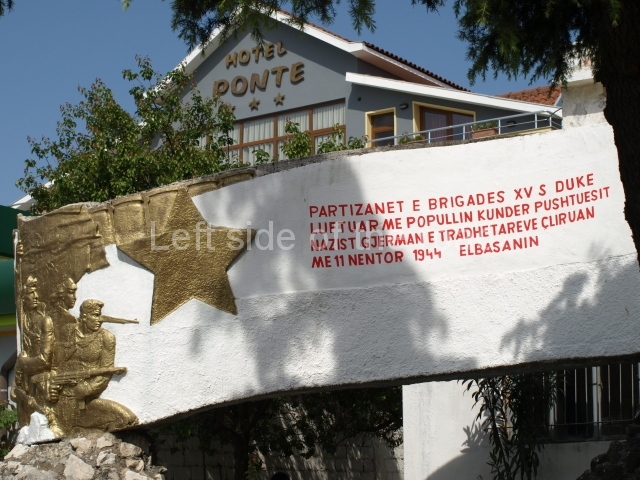
I must admit I have a little bit of a difficulty in working out exactly what the shape of this monument is supposed to represent. It’s like a huge belt or a ribbon. It starts at the back on the left-hand side and then comes back on itself in a big curve towards the front, where you have the main sculptural group, and then gently curves towards the back of the monument and finally straightening out slightly as it gets to the edge at the right-hand side – it’s a bit like a huge hook.

Not sure exactly the dimensions but it’s roughly 3 metres in width, which remains the same along its whole length, which I would estimate around about 15 metres in total.

There’s a sense of movement in this static, heavy concrete structure.

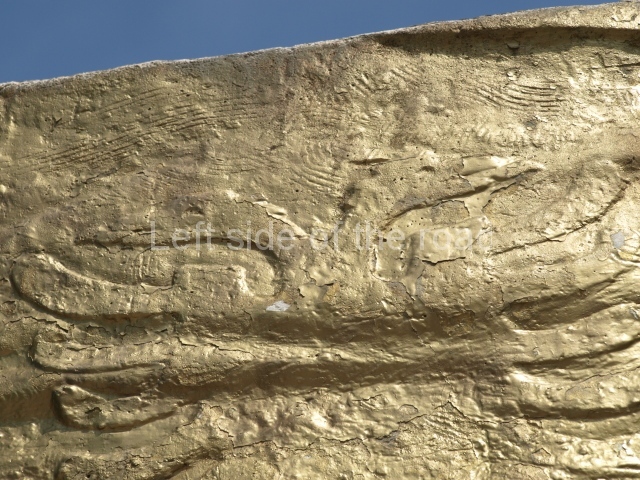
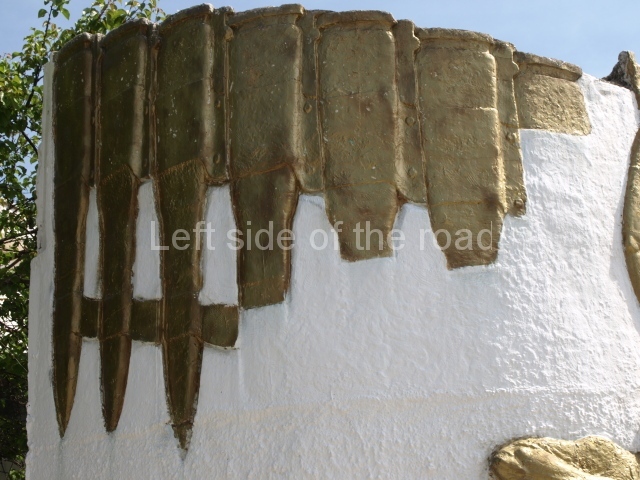
There’s a physically large clue on the left-hand side that it might be representing an ammunition belt because there are huge bullets on the extreme left. However, these cartridges seem to get absorbed by the lapidar and apart from the top of the casings disappear as they get close to the main sculptural group, only to re-emerge again at the edge of the flag.

The whole structure is about 2 metres above the ground – sometimes slightly less, sometimes a bit more – and the monument itself sits on two piles of rough rocks which are cemented together. This introduces the idea of the mountains, which is quite common in Albanian lapidars. On the left these rocks provide support directly underneath the sculptural group and then towards the right-hand side is another pile taking the weight.

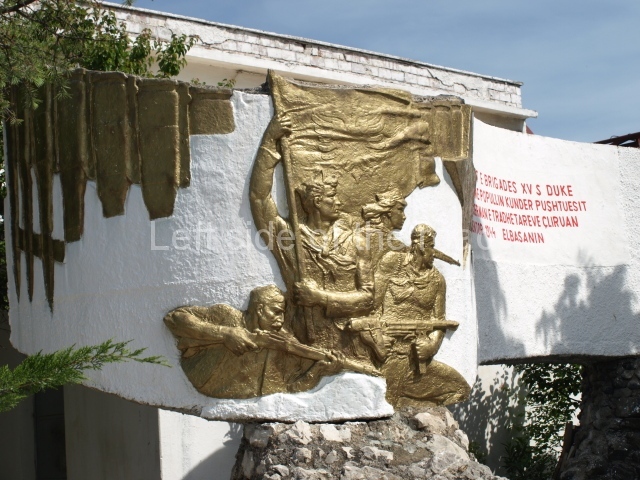
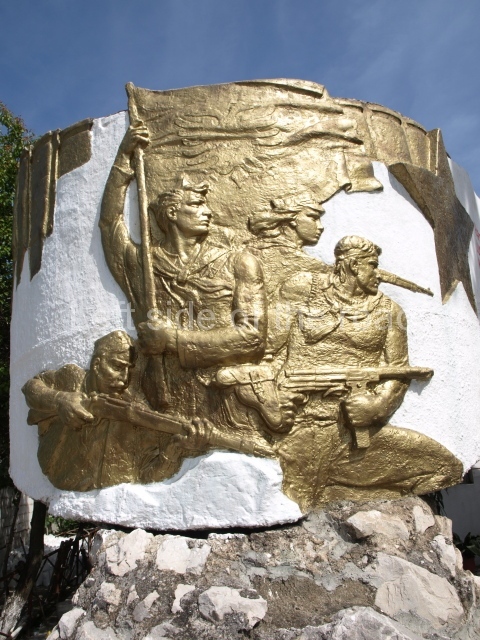
The principal artistic element and the image which immediately draws your attention is the stone bas relief of four Partisans, grouped together above the left-hand support pile.

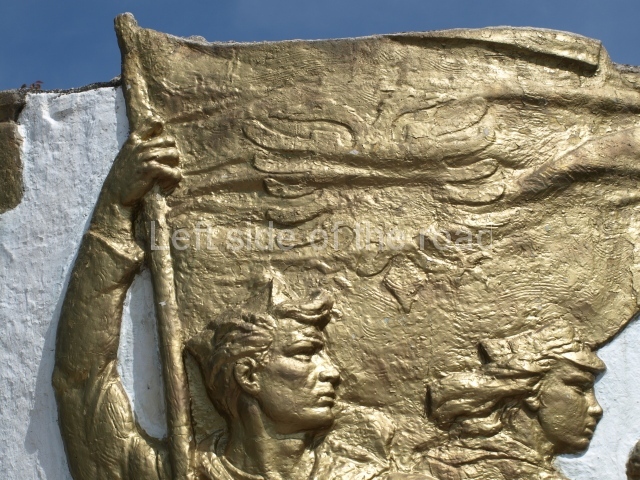
The individual which dominates the image is the male figure of the standard bearer who is on the left of the group – and slightly higher. We also see much more of him, virtually the whole of his body above the waist. He stands face on but his head is turned to his left so we get a right profile. His right arm is raised and his hand grips the flagpole near its top point whilst his left hand grips the pole at waist level. He is a Partisan in full uniform, wearing a cap with a star at the front and tied around his neck is what would have been a red scarf. On his left hip is a buttoned-up, leather holster, only the butt of the pistol visible.

The flag, the flag of the Communist Partisans, flutters in the wind that’s coming from the left as we look at the image. The very top of the flag is the only part of the tableau that breaks the confines of the concrete shape. This would have been a red flag and on it would have been a black, two-headed eagle (an image used by Skenderbeu in the 15th century, through the period of Socialist construction between 1944 and 1990 and to date). However, during the National Liberation Anti-Fascist War and the period of Socialism there would be a small gold star in the space just above where the two heads separate.

The stars were the target for the reactionary, fascist, nationalist forces that gained control of Albania in the early 1990s and many of them on lapidars throughout the country have been the subject of masking or obliteration. Although most of the monument in Elbasan remains in good condition the star on the flag has been erased. If you look carefully at the space above the eagle heads, almost to the top of the lapidar, it’s possible to see that someone has applied ‘fresh’ plaster to level out the area and erase the star. The parallel marks as evidence of this ‘alteration’ are to be found nowhere else on the lapidar.

Monument to the 15th Partisan Assault Brigade - Elbasan - missing star

Missing star

Two of the other Partisans, one female the other male, are similarly looking towards their left. This is where the action is and they are on the way to the battle. They are also in profile but there’s still a lot of information, even though we don’t see much of them.

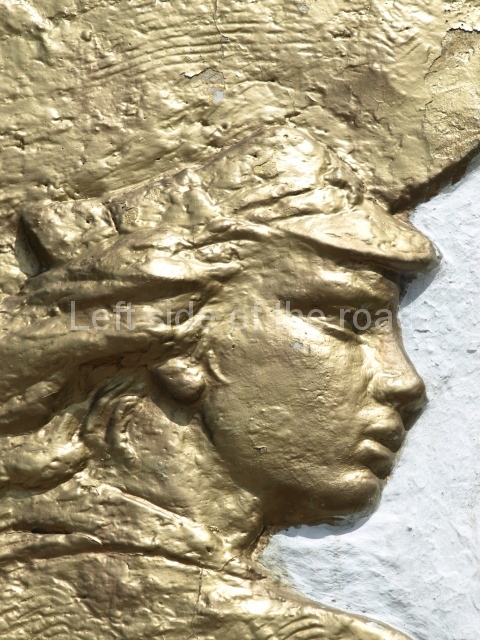
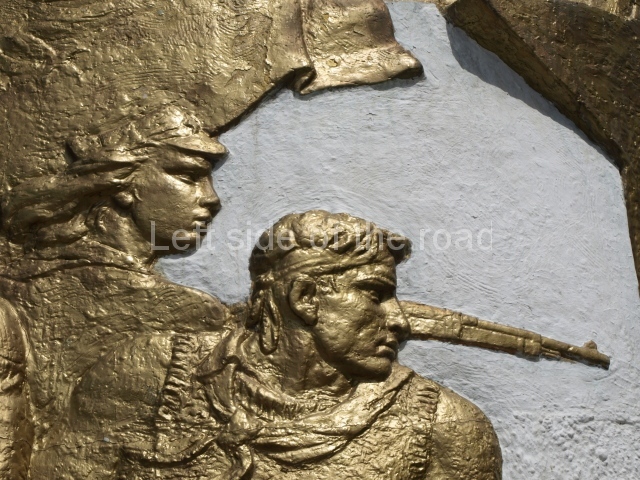
The female Partisan is partially hidden by the standard bearer but she is also in uniform. She wears a cap and the edge of the star is evident on the front, her long hair flying behind her as she moves quickly forward. It also looks as if she has a red scarf around her neck. In virtually all the lapidars relating to warfare when a woman is depicted she is always armed (as in the mosaic on the facade of the National Historical Museum in Tirana) although the men aren’t. This lapidar is no different and the sharp end of her rifle is seen poking out behind the head of the fighter on the right of the group.

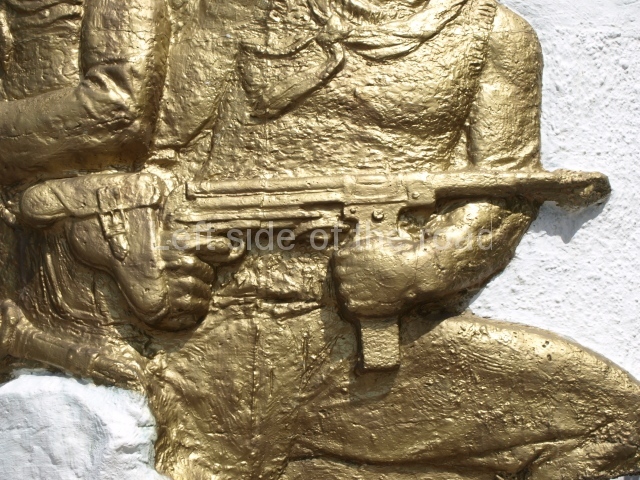
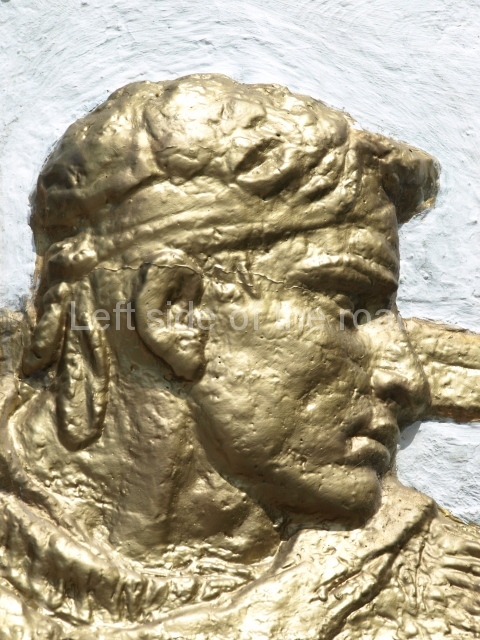
In front of her is a young male Partisan from the countryside. In the lapidars the distinction is often made about those Partisans from the countryside by depicting them in the traditional clothing of the mountain people. He’s not in a formal uniform but is dressed in a woollen vest, his shoulders and arms bare. Around his forehead is a sweat band, the knot tied at the back of his head. But his political allegiance is shown by the (red) scarf around his neck. At waist level he holds a sub-machine gun, his right finger on the trigger and his left hand holding the gun at the magazine. His posture is the same as the woman, moving forward towards the battle, his left knee bent to give the impression of the effort to get there quickly.

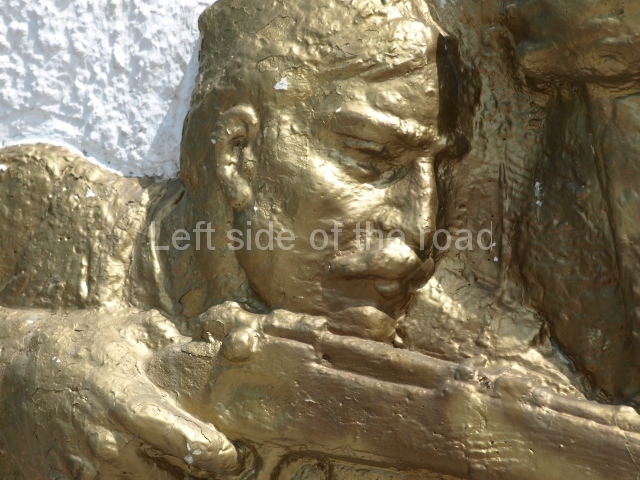
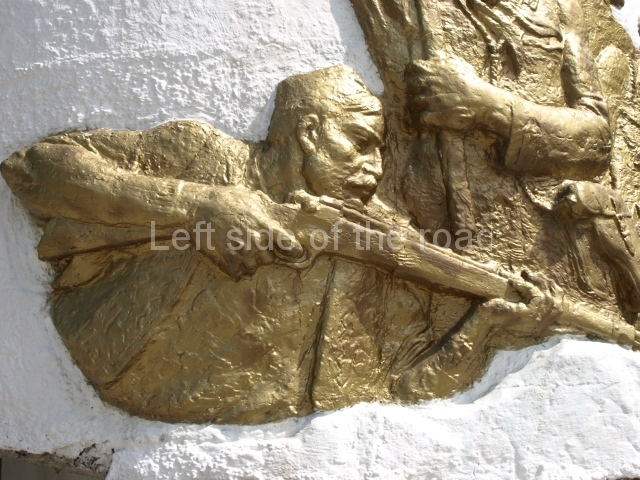
The fourth member of the quarter is not moving forward. He is an older man from the countryside, he is wearing a waistcoat and on his head a traditional cap (a qeleshe) but one on which is a star. All the people in this image are Communists. Additionally, it’s almost a trope when it comes to depicting older men from the mountains, he’s boasting a bushy moustache. He’s aiming his rifle and pointing downwards with his right finger on the trigger and holding the barrel of his rifle in his left hand. The Partisans, knowing the terrain, would always aim to select the location that was to their greater advantage and this representation of firing downwards appears in other lapidars such as the amazing star at Pishkash. And the mountain top design of the plinth supporting the monument adds to this impression of mountain warfare, he seems to be shooting out of the bas relief into a mountain environment – like someone walking out of a screen of a film.

Everything indicates that this is an ambush of a Nazi column in the mountains.

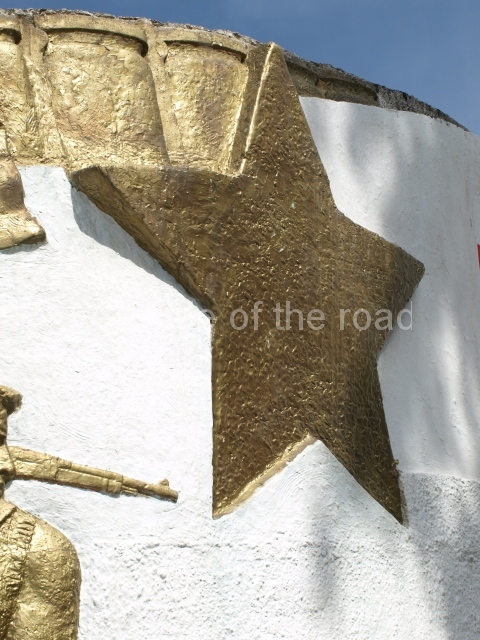
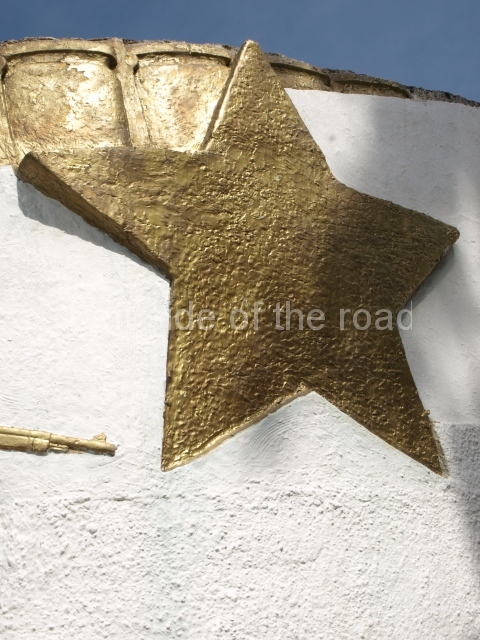
Where the right hand side of the flag ends we can see the top casings of three gigantic bullets. These then merge into a large, five pointed star which appears to be leaning away from the lapidar at the top but which merges into the concrete at the bottom. It’s more than half the width of the concrete ribbon, so more than a metre from point to point. The very tops of the casings of the cartridges then reappear briefly on the other side of the star until they finally disappear.

The concrete base on which the bas relief sits has curved slightly towards the back of the lapidar creating a partial circular space in the rear but then the panel straightens up and extends for about half the of the total length to the right.

The top left-hand quarter of this now unadorned panel has been plastered so that it provides a smooth face on which are painted (now) in red letters the following;

Partizanet e Brigadës XV S. duke luftuar me popullin kundër pushtuesit nazist gjerman e tradhëtarive çliruan më 11 nëntor 1944 qytetin e Elbasanit

which translates as

To the Partisans of the XVth Assault Brigade who, with the people, struggled against the German Nazis and traitors to Liberate the city of Elbasan on 11th November 1944

(This re-writing of the inscription in red paint must have been completed around the beginning of 2015 as the image in the Albanian Lapidar Survey (Volume 2, page 205) catalogue shows a different version.)

Towards the extreme right-hand edge of the monument there is something attached to the concrete – looking like a rectangular box. I’m not too sure whether this is something which was there originally and supporting another element of the story (but can’t really imagine what). There are signs, holes and general markings, that indicate that whatever was there was more extensive.

(One of the problems of there being so many lapidars to document is that I don’t always ‘see what’s there’ at the time of my visit. It’s only when time and magnification on the computer screen that some aspects become ‘visible’. If I ever get the opportunity to return to Elbasan I’ll try to remember to ask the pertinent questions.)

Generally, this lapidar is in a very good physical condition. There doesn’t appear to be any damage (apart from the mystery markings on the extreme right-hand side) and although it’s unlikely that the bas reliefs would have been painted in gold paint originally at least the painting has been done with an element of care and professionalism, as has the signwriting of the inscription.

Unfortunately, there’s no information available of the artist who created this lapidar – nor of the date of its inauguration. The features of the quartet are very clear, distinctive and detailed – you would recognise the models (I’m sure, if you saw them. This would seem to indicate one of the more accomplished sculptors and it’s very pleasing to see that the detail has remained intact despite the troubled times the country, and consequently the Socialist monuments, went through – especially in the 1990s.

Its present condition and the fact that has had a relatively recent ‘renovation’ and attention would seem to indicate that it has local support and protection. Whether that be from the local community or the municipality is impossible to say.

Nonetheless, this is an important lapidar in the country as it has attributes which I haven’t seen repeated elsewhere.

Location

In the large square created at the junction of Rruga Kadri Hoxha and Rruga Çerçiz Topulli. This is a bit of a transport hub and looks like it might be the site of a recently installed roundabout. It’s just over half a kilometre east of Elbasan Castle in the centre of the town.

GPS

41.11280498

20.07384798

DMS

41° 6′ 46.0979” N

20° 4′ 25.8527” E

Altitude

137.4

More on Albania ……

View of the world

Ukraine – what you’re not told