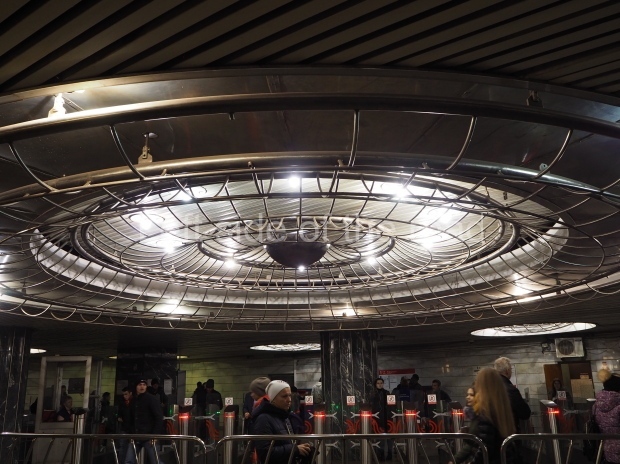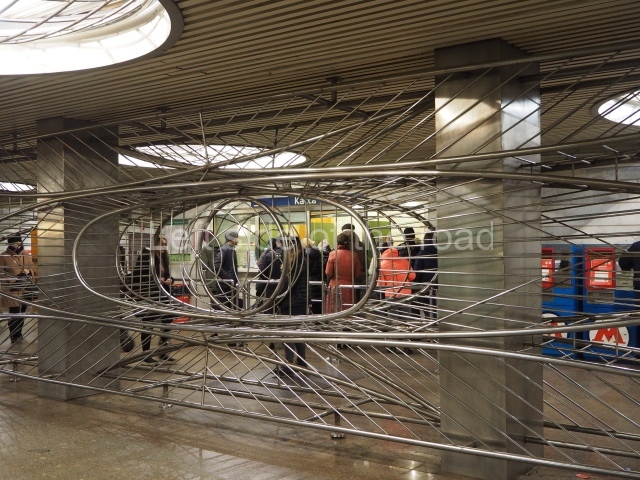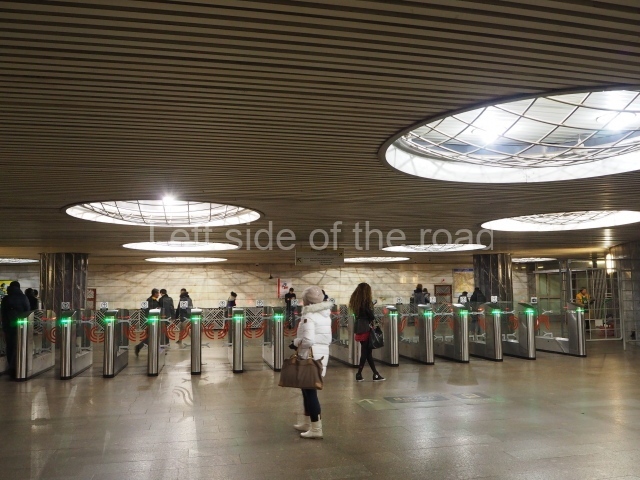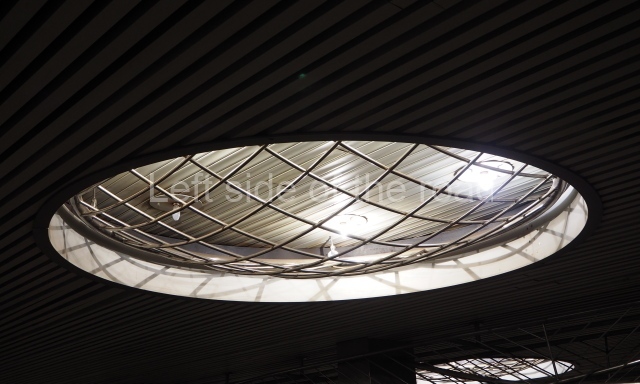
Moscow Metro – Biblioteka Imeni Lenina – Line 1

Biblioteka Lenina

Biblioteka Lenina

More on the USSR

Moscow Metro – a Socialist Realist Art Gallery

Moscow Metro – Biblioteka Imeni Lenina – Line 1

Biblioteka Imeni Lenina (Библиоте́ка и́мени Ле́нина, Lenin’s Library) is a station on the Sokolnicheskaya Line of the Moscow Metro. The station was opened on May 15, 1935 as a part of the first stage of the Metro. It is situated in the very centre of the city under the Mokhovaya Street, and is named for the nearby Russian State Library (called the Lenin Library in 1925 –1992). Its architects were A. I. Gontskevich and S. Sulin.

Biblioteka Imeni Lenina - Line 1 - 02

Biblioteka Imeni Lenina – Line 1 – 02

To prevent the disruption of traffic, Biblioteka Imeni Lenina was built using underground excavation rather than cut and cover even though the station ceiling is just two metres (6.5 ft) below ground level. Soil conditions and the narrowness of the space in which the station was to be built necessitated a single-vault design, the only one on the first Metro line. The entire excavation was only 19.8 metres (65 ft) wide and 11.7 metres (38 ft) high. The main station vault was built from rubble stone set in concrete and reinforced with an iron framework. This was lined with an ‘umbrella’ of bitumen-coated paper to prevent groundwater from seeping into the station. The station was finished with plaster, yellow ceramic tile, and marble.

Biblioteka Imeni Lenina - Line 1 - 01

Biblioteka Imeni Lenina – Line 1 – 01

The station originally had two entrance vestibules, one at either end. The southern vestibule, located between the old and new buildings of the State Library, is shared with Borovitskaya. The temporary northern vestibule, which served Biblioteka Imeni Lenina and Aleksandrovsky Sad, was removed in the 1940s.

From this station it is possible to transfer to Arbatskaya on the Arbatsko-Pokrovskaya Line, Aleksandrovsky Sad on the Filyovskaya Line, and Borovitskaya on the Serpukhovsko-Timiryazevskaya Line.

Biblioteka Imeni Lenina - Line 1 - 03

Biblioteka Imeni Lenina – Line 1 – 03

Though Biblioteka Imeni Lenina and Aleksandrovsky Sad (then called Komintern) were built concurrently, they were not connected by transfer passages until 1938, when Aleksandrovsky Sad became part of the Arbatsko-Pokrovskaya Line. Before this the line from Aleksandrovsky Sad to Kievskaya operated as a branch of the Sokolnicheskaya Line.

Text above from Wikipedia.

Biblioteka imeni Lenina

Date of opening;

15th May 1935

Construction of the station;

arched, shallow

Architects of the underground part;

A. Gontskevich and S. Suslin

Transition to stations Arbatskaya of the Arbatsko-Pokrovskaya Line and Alexandrovsky Sad

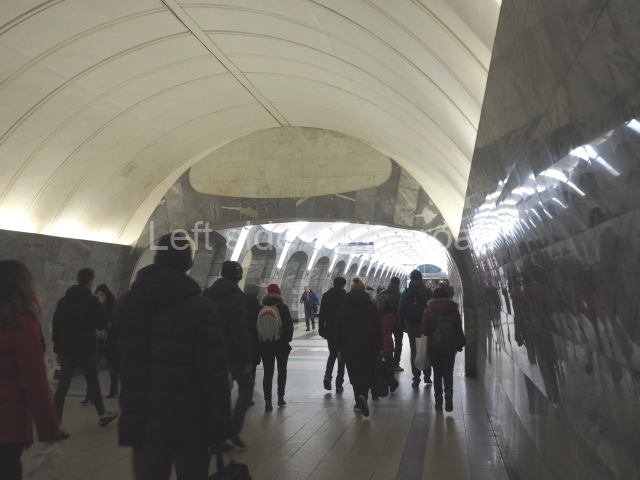
Biblioteka imeni Lenina is the first single-span ‘arched station of the Moscow Metro. Such construction creates not the illusion of open space and height but real open space and height. So, there is a huge unencumbered and undivided space appeared underground.

The platform of the station under such vault seems narrow, so it becomes slightly uncomfortable when crowded. The decoration is utterly concise. The walls are faced with light beige small ceramic tiles. The wide pilasters which decorate carrying belt (line where the vault arches support on the walls) are with dark fancy marble. Long rectangular panels of the same marble are on the walls. They carried the schemes of until there was enough room. There are lines of coffers with stepped edges on the vault of the station. The matted semi-spheres of chandeliers are built in the vault and placed by transverse lines while white spheres were suspended by two lines on the right and left sides from the central axis of the station.

The ceiling is decorated with pink-grey plates of large-crystalline granite from the Vyborg area of the Karelian Isthmus. The platform is rounded by narrow edging of dark grey diabase. The famous ‘library bridge’ is located approximately in the middle of the platform. It opens the exit to the city and transit to stations Arbatskaya and Aleksandrovsky sad, but its main function – a place of meeting. It is customary to make an appointment ‘under the bridge’. When the station is crowded, as soon as one goes under the bridge one appears as in a house. There is dark and quiet. You may read, have a seat on a container for bombs, replace purchases from one bag to another, or try on new dress [a strange comment to make for a public space!].

The northern and southern ends of the station have stairways. Going up by the northern stairway, one appears in a quite large cubic entrance hall with balconies above the track tunnels. The blind wall of the hall is adorned with a mosaic (Florentine mosaic of various facing stones) portrait of V. Lenin. Lenin looks at a broad passageway divided by columns and high forged grille along the axis, which separates people coming from the opposite directions. The passageway ends at the escalators of Arbatskaya. If going by the left part of the passageway, there is an exit from station Aleksandrovsky Sad and, then, the passageway from the library bridge.

The stairway at the southern end of the station goes up to a broad passageway whose wall is decorated with a small majolica portrait of V. Lenin.

Text from Moscow Metro 1935-2005, p63

Location:

GPS:

55.7512°N

37.6100°E

Depth:

12 metres (39 ft)

Opened:

15 May 1935

More on the USSR

Moscow Metro – a Socialist Realist Art Gallery

Moscow Metro – Chkalovskaya – Line 10

The Chkalovskaya Station - by Limitchik

The Chkalovskaya Station – by Limitchik

More on the USSR

Moscow Metro – a Socialist Realist Art Gallery

Moscow Metro – Chkalovskaya – Line 10

Chkalovskaya - 01

Chkalovskaya – 01

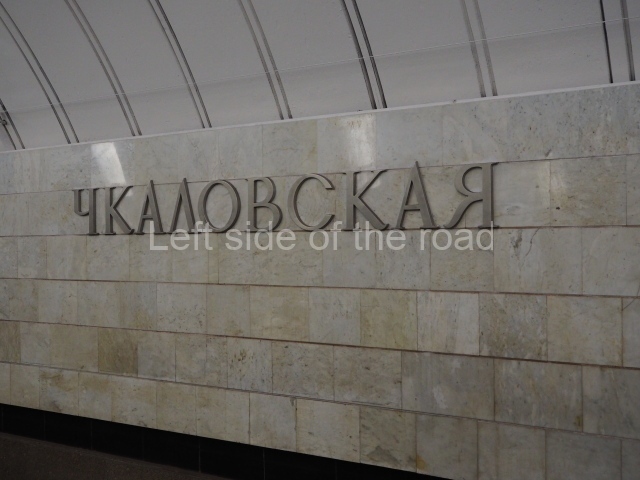
Chkalovskaya (Чка́ловская) is a Moscow Metro station in the Basmanny District, Central Administrative Okrug, Moscow. It is on the Lyublinsko-Dmitrovskaya Line, between Sretensky Bulvar and Rimskaya stations.

Chkalovskaya - 10

Chkalovskaya – 10

Chkalovskaya opened on 28 December 1995 as the first stage of the Lyublinskiy radius.

Chkalovskaya - 14

Chkalovskaya – 14

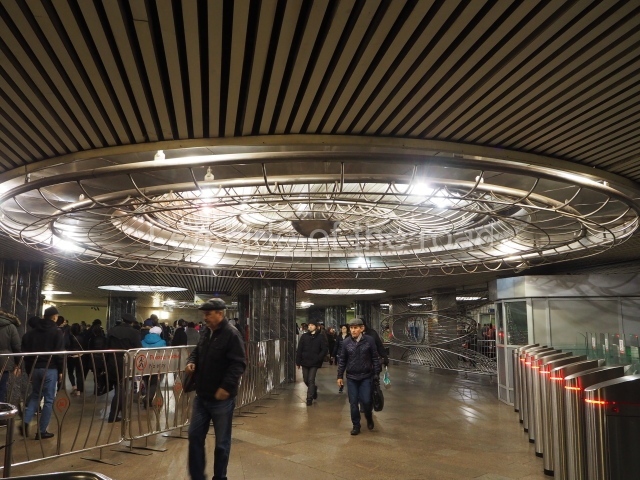
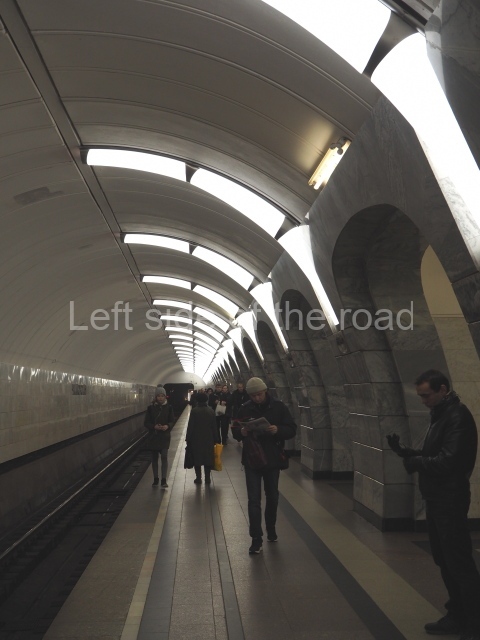
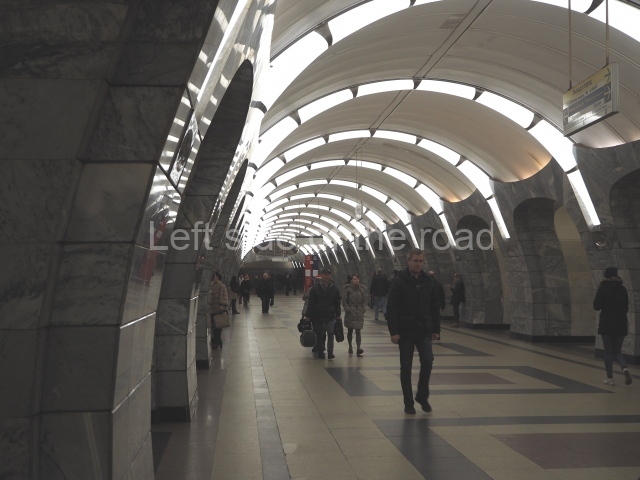
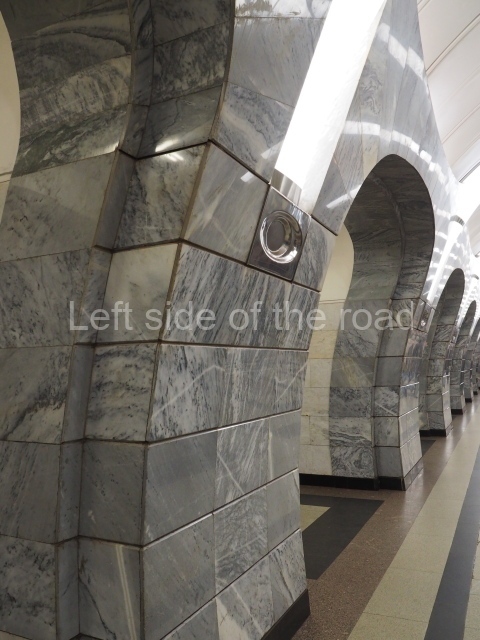
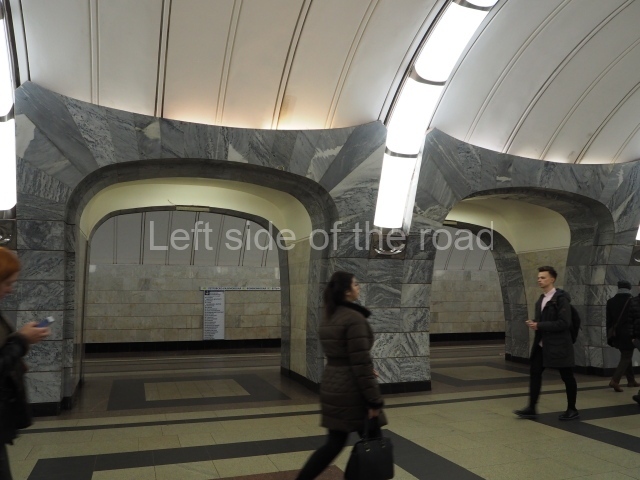
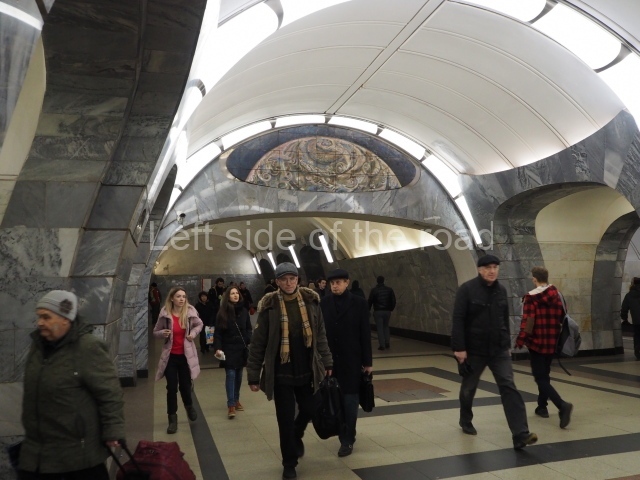
A team of architects designed the station: Nina Alexandrovna Aleshin, Leonid Borzenkov, and Aleksandr Vigdorov. Named after the famous Soviet aviator Valery Chkalov, the decorative theme is dedicated to aviation. The station is modified Pylon trivault at a depth of 51 metres. The pylons are reveted with grey and light blue wavy marble whilst the floor is covered with grey red and black granite. The hinged ceiling is covered in semi-circular lighting. The walls are done with combined marble tones.

Chkalovskaya - 16

Chkalovskaya – 16

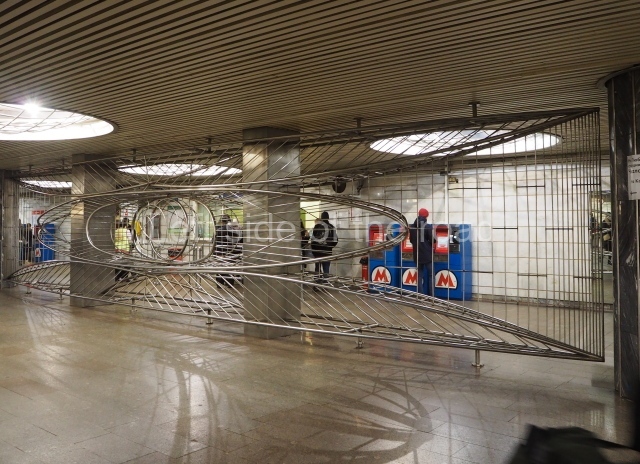
An escalator leads from one end of the station’s underground vestibule to Zemlyanoi Val street and Kurskiy Rail Terminal. The vestibule also acts as a transfer to Kurskaya-Koltsevaya. The other end of the hall is a direct transfer to Kurskaya-Radialnaya of the Arbatsko-Pokrovskaya Line, which opened on 28 March 1996.

Text above from Wikipedia.

Chkalovskaya

Date of opening;

28th December 1995

Construction of the station;

deep, pier, three-span

Architects of the underground part;

N. Aleshina, L. Borzenkov, A. Vigdorov, N. Samoylova and M. Chistyakova

Authors of decoration;

M. Alekseyev and L. Novikova

Transit to Stations Kurskaya of the Circle Line and Arbatsko-Pokrovskaya Line

The part of the Garden Ring was named Ulitsa Chkalovskaya in 1938-1990 (now Ulitza Zemlyanoy Val). The legendary pilot V. Chkalov dwelled in one of its buildings. Hence, it is natural that station Chkalovskaya is devoted to the trans-polar flights of the 1930’s. Its decoration clearly means ‘back to the future’. The pylons of elegant smooth lines slightly widen upward and gradually go into the vault. The vault of the central hall is obviously higher than those of the platforms. It has a semi-oval cross-section rather than usual semicircular.

The pylons are faced with marble of two kinds, elegantly matched by colour. There is bright bluish-grey and white streaky Ufaley marble on the side of the central hall and platforms, while inside the passes it sets off vertical inserts of cloud-white Koelga marble. The upper parts of the inter-pylon passes are decorated with smooth rectangular and wavy strips of Ufaley marble. The walls are faced with cloud-white marble, and the socle is with grey granite. The floor is covered with white granite. It is decorated with squares of red marble in the central hall, and white squares set off black and red granite.

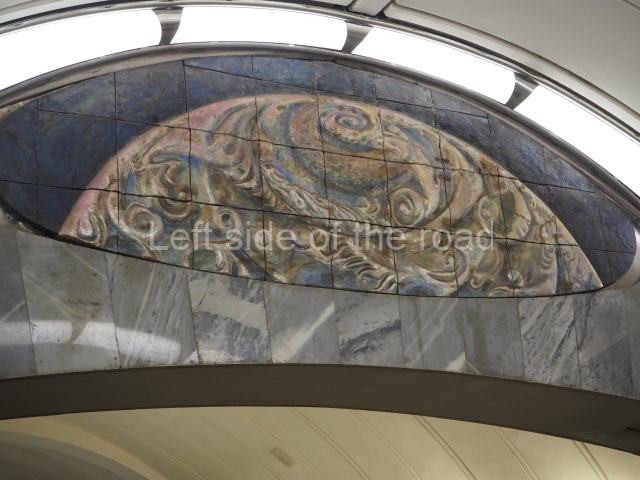
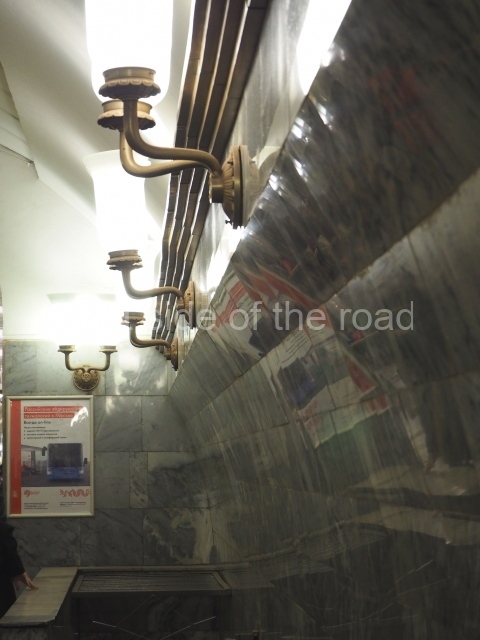
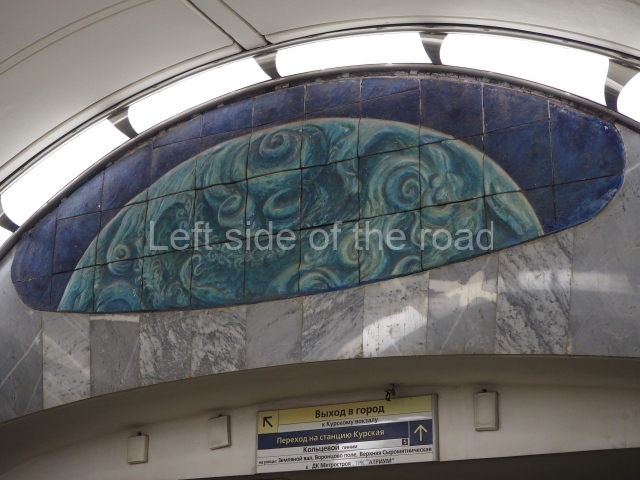
The station is illuminated with original lamps. The light belts stretch out from the middle of one pylon to the middle of the opposite one. They are covered with matted translucent milk-coloured gutters. On the platforms they rise to the axis of the vaults. There are mysterious metal inserts (two concentric pressed in ovals) at the bases of the belts, which answer the general cold strictness of the decoration. The unusual lamps and general style of the station make a passenger feel itself within a large underground airship. Two simple small raised panels are placed in the oval niches above the passageways in both ends of the central hall – the Earth’s polar cap by day (northern end) and at night (southern end).

Text from Moscow Metro 1935-2005, p93

Location:

GPS:

55.7565°N

37.6573°E

Depth:

51 metres (167ft)

Opened:

28 December 1995

More on the USSR

Moscow Metro – a Socialist Realist Art Gallery

The BBC helps to move the second hand closer to midnight

Earlier anti-Russian propaganda

Earlier anti-Russian propaganda

View of the world – up to end of 2022

View of the world – 2023

Ukraine – what you were’nt told – 2022

Ukraine – what you’re not told – 2023

The BBC helps to mover the second hand closer to midnight

We all know that the BBC (British Broadcasting Corporation) is impartial. Why is that? Because the BBC is always telling us that’s the case.

In Britain the BBC is constantly involved in a ‘debate’ with the two main political parties of whether it takes a ‘right-wing’ or a ‘left-wing’ stance – but that’s just smoke and mirrors. There’s little (or no) significant difference between the the British Labour and Conservative parties when it comes to domestic issues and they are totally indistinguishable when it comes to foreign matters – especially when British ‘interests’ worldwide are involved.

Unfortunately many within the British labour movement have yet to understand this. Domestic policies of the Tory (Conservative) Party which would have brought workers on to the streets in their tens of thousands in the 1970s are to the left of the policies of the present day Labour Party. And yet activists will continue to support the Labour Party in elections and expect others on the ‘left’ to do likewise.

But that’s going off the main point.

The BBC, when it comes to Britain’s imperialist ambitions/aspirations/pretensions is always fully on board and vomits out the racist, jingoistic and xenophobic rhetoric on the orders of its imperialist masters.

In recent years the BBC will ‘fact check’ certain claims – as if it is the world’s arbiter of truth. But if we go back into the past, to the likes of the Malvinas War of 1982 and the so-called ‘First Gulf War’ of 1991, we see that British Government reports are taken at face value and its only years later that the actual truth comes out.

Although the term ‘fact check’ wasn’t in vogue then the concept, when it comes to the BBC, supposedly was. However, when claims were made by US government officials at the UN that there there were ‘weapons of mass destruction’ in Iraq and when Tony Blair stated that Iraq could send those weapons over to Britain ‘within 45 minutes’ there was no ‘fact checking’ by the BBC then. No, they just trotted out whatever was written for them by the warmongers in the Ministry of Defence.

With that background it’s no surprise that the BBC, since 24th February 2022, has been publishing whatever spews out of the mouths of Ukrainian government representatives without any pretence of checking what is claimed is correct or not. Added to that the BBC is very adept at the use of words and/or English grammar. Take, for example, the different approach to the reporting of two similar incidents of Ukrainian and Russian claims on the numbers of deaths following missile strikes around 9th January this year.

There are other examples of supposed BBC ‘impartiality’ throughout 2022 and a few (of many more) examples can be seen here.

Bringing matters up to date; on 8th February 2023 the Ukrainian President Zelensky arrived in the UK begging for a greater escalation of the conflict in the Ukraine (by asking for NATO aircraft) and pushing the Doomsday Clock a few seconds closer to midnight.

Coincidently[?] there was a flurry of reports on the BBC website that day with even more negative comments on Russia. The BBC (as the rest of media in general in the UK), for just under a year, has been pushing Russophobia but on 8th February they went on overdrive.

Articles on the BBC website 8th February 2023

Notorious Russian nationalist Igor Mangushev shot dead in Ukraine.

This is quite a bizarre article in the way it reports what is, in effect, an assassination. But instead of coming to the conclusion that if someone was fighting against the Ukrainians the main ‘suspect’ of the killing would be a Ukrainian the BBC decides that it must be infighting amongst the Russians – without giving a shred of evidence.

Also, near the beginning it makes reference that Mangushev ’emerged from a neo-Nazi movement’ (again with no more details) but since 24th February 2022 any mention that groups (such as the Azov and Krakon Battalions) in the Ukraine are Nazis is never mentioned. Although the members of such groups wear Nazi inspired insignia, have Nazi -inspired Tattoos, follow a Banderista ideology and have been filmed in the past marching through the streets of Kiev with Nazi banners this is all forgotten now. They have some how ‘reformed’.

Borrowed time for Bakhmut as Russians close in.

For months the fighting in Bahkmut (and before that Soledar) where the British media have been claiming the Ukrainians are winning and the Russians are losing thousands of dead in wild frontal assaults when the Ukrainian President comes begging for more western weaponry the BBC, all of a sudden, sends a correspondent to the area (after months when very few, if no, western mainstream media reporters were anywhere near the front line) and reports that the Ukrainians are struggling.

Just what Zelensky wants. The impartial BBC to back up his arguments for modern jet fighters.

MH17: Putin probably supplied missile that downed plane – investigators

This plane was shot down in July 2014. Why does this report, or so-called investigation, appear on the 8th February 2023?

Here we have an example where the BBC’s use of words implies one thing although the rest of the article has no evidence to substantiate it. It depends on the reader making an assumption based on their own prejudices and the information (or mis-information) that has been fed to them by the ‘oh so holy than thou’ BBC.

A few paragraphs in it is stated that there is no evidence that Putin had any hand in ordering the plane be shot down but that is not the implication from the headline – and we must remember that most people these days will read the headline and then skim read the article, if that.

There is supposed to be ‘evidence’ that Putin had a hand in this event – but no reference to where such evidence can be read, no link to the report.

What we have is innuendo, quotes from ‘impartial’ Ukrainian Prosecutor and quotes from relatives of those who dies – who are obviously emotional and (I would suggest) being manipulated by all the anti-Russian elements in the EU who have now come out of the woodwork in the last eleven months. (we must remember that both Merkel and Hollande have admitted that they were not acting in good faith when it came to the Minsk Accord in 2015. They signed just to give more time for the west to provide Ukraine with armaments and time for the Ukraine to prepare its defences – hence the long drawn out battles in places such as Soledar and Bahkmut.)

SNP MP Stewart McDonald’s emails hacked by Russian group.

Another strange one, this.

I know nothing of hacking but if I were to get in such a practice I would make sure that I would hide my identity. If these hackers are so clever that they can get through sophisticated firewalls and the like why can’t they hide their location? Or are they clever when it comes to computers but stupid generally and always sign off with ‘da svidania’?

When there’s an an attack on computer system in the west then it is always either the Russian, the North Koreans or the Iranians – all depending who is the bogeyman at the time.

But obviously the ‘west’ doesn’t indulge in such techniques. So why does Government Communications Headquarters (GCHQ), which is the size of a small town, exist?

On the following day those ‘big’ stories dropped out of sight on the BBC website. But that’s OK. Once the BBC had done its job reporting on the conflict in Ukraine went back to normal, i.e., ignoring anything that might interfere in the western narrative.

(For a discussion with Noam Chomsky about propaganda in the Ukraine war go here.)

View of the world – up to end of 2022

View of the world – 2023

Ukraine – what you were’nt told – 2022

Ukraine – what you’re not told – 2023