
Mosaic in Cahul
More on Moldova – on the Post-Socialist Countries – Eastern Europe and Asia page
Soviet Mosaics – Bălți – Moldova
VI Lenin and Palace of Culture Mosaic – Ribniţa – Pridnestrovie
Soviet-era mosaics in Cahul – Gagauzia – Moldova
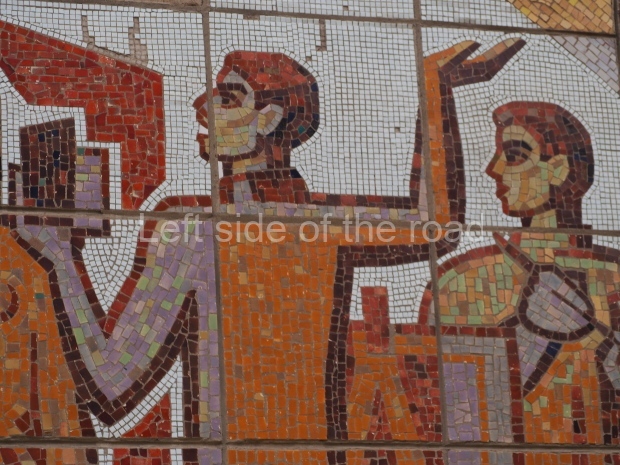
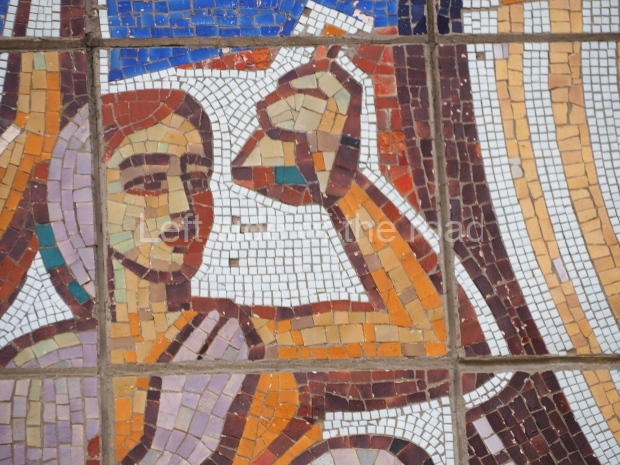
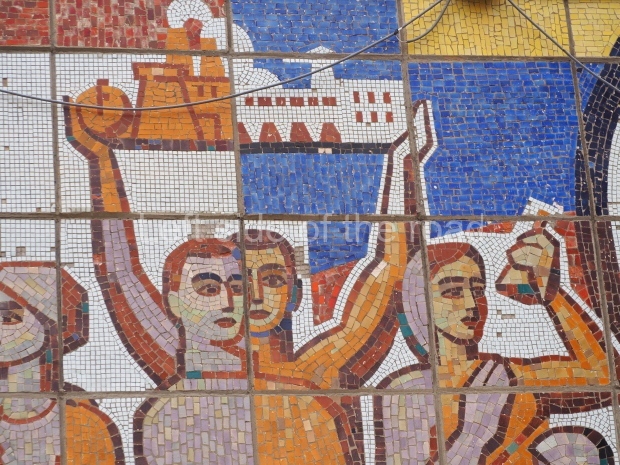
Cahul, in the south western corner of Moldova, close to the border with Rumania, isn’t a spectacular city by any means but it is the home of four large Soviet era mosaics plus a collection of smaller mosaics (some in a very sad state of repair) on the external walls of a kindergarten. Chișinău, the capital of Moldova, has a greater number but few of them are on the scale of those in Cahul.
The problem facing all Soviet era mosaics (and public art in general in post-Socialist countries) is due to a combination of factors; there’s little enthusiasm on the part of authorities (and the local population in general?) to properly maintain and care for these reminders of a previous era and there’s probably a lack of skilled artists (either with the skill or the inclination) to carry out such maintenance and repair. Being a central European country Moldova has a huge variation in temperature throughout the year and this plays havoc on the mosaics out in the open. Once cracks in the art work begin degeneration becomes exponential.
However, that degeneration on the four large has not developed to such a stage that a visitor cannot appreciate the skill of the (often un-named and unknown) artist/s.
Sports School

Sports School
‘On the wall of the School building in 1989, a mosaic was executed by the artist GA Hadjioglov (in some sources Hadjalov), originally from Ukraine, a member of the Union of Plastic Artists of Russia, who has held numerous exhibitions all over the world, a series of monumental works in the Republic of Moldova in the period 1979-89, including two mosaics in the city of Cahul. Among them is this mosaic – a panel consisting of five stylized compositions with a sports theme, brightly colored, made of enamel (fused glass with pigments of different colors).’
From; Visit Cahul
In the four panels on the left and right hand sides of the artwork it’s possible to see represented; running, wrestling, boxing, field athletics, football, basket ball, cycling, volley ball and women’s hockey. (Or that’s what it looks to me.)
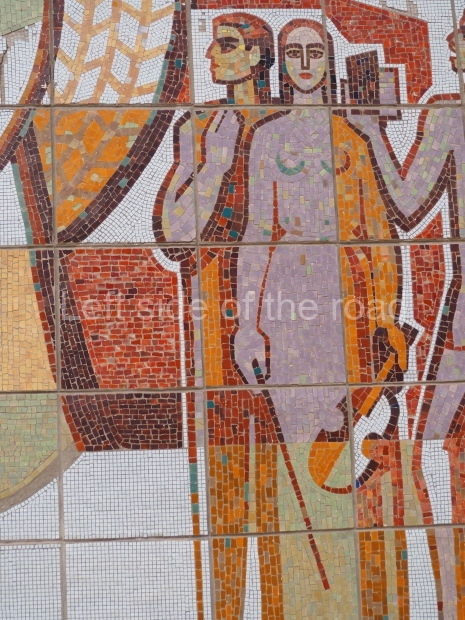
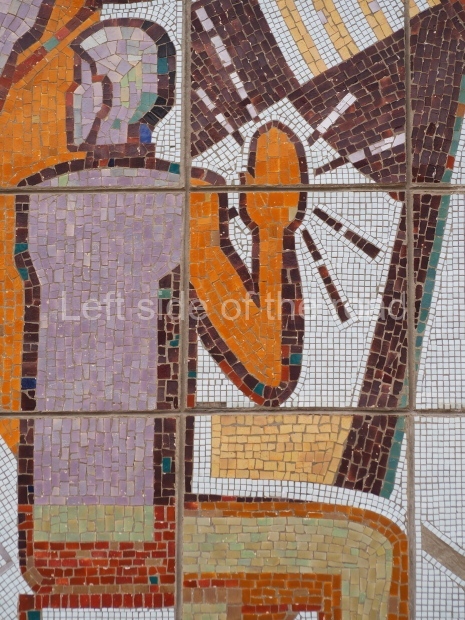
I’m not totally sure what is the story being told in the central panel. It depicts six female figures. At the top are four young women, the two on either side of the group playing a flute – or similar instrument. Of the two main characters the one on the right is holding what looks like an laurel branch (signifying victory?) and the one on the left has a living flame cupped in her hands. This traditionally signifies vitality, energy and passion that comes from competition. It could also symbolise the spirit of unity and teamwork – as in the Olympic flame.
There are a few signs of deterioration, but there is an obvious fault line running down the mosaic from top to bottom of the two panels on the right, especially through the image of the basketball player in red. Here some of the small tiles are missing. Other than that the mosaic looks in a good condition, indicating some level of regular maintenance.
Also on the bottom corner of the top left hand panel, the one with the runners, can be seen the name of the artist Gheorghii Hadjioglov (in Cyrillic) and the date of inauguration, 1989. Hadjioglov was also the artist for the mosaic on the front façade of the Palace of Culture in Cahul – see below.
Location;
The external wall of Sports School No. 1, Strada Bogdan Petriceicu-Hașdeu 4,
GPS;
45.90135 N
28.18862 E


Palace of Culture

Palace of Culture
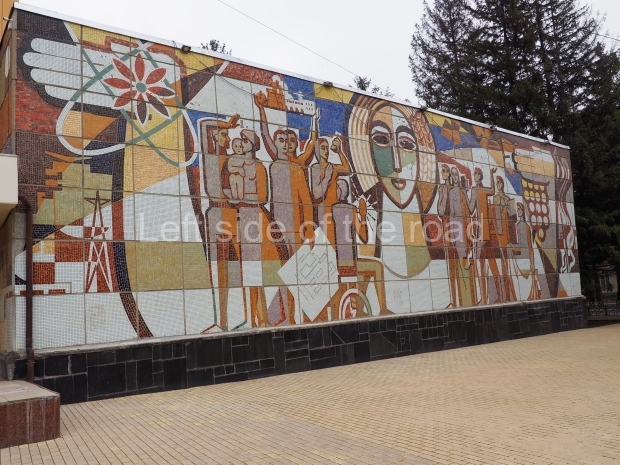
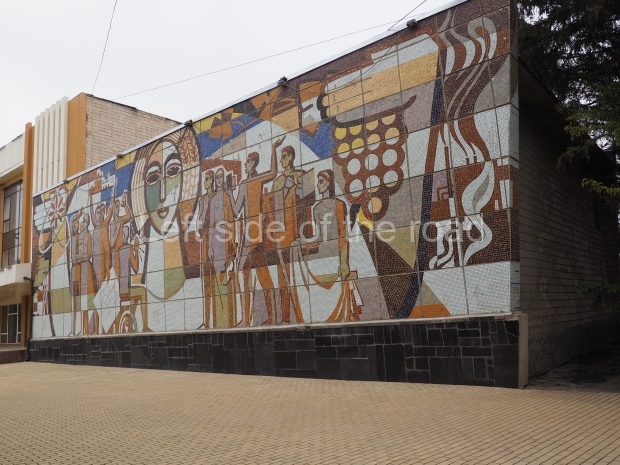
This large mosaic, on the side wall of the large Palace of Culture in Cahul is also the work of Gheorghii Hadjioglov – who created the mosaic at the Sports School (see above). However, this predates that mosaic by 3 years being created in 1986.
(Here it might be appropriate to mention that many of the mosaics in Moldova seem to date from the late 1980s – this was following the introduction of the policies of Perestroika and Glasnost which contributed to the demise of what still existed of Socialism in the Soviet Union. That means they tend more to ‘the pretty and colourful’, lacking any strong political content and, therefore, more difficult to interpret the story being told or the reason for their creation in the first place.)
One of the reasons that its difficult (without any information about the intentions of the artist) to interpret the five panels of the mosaic as that there are few, if any, clues from the clothing. Traditionally, the first panel would be a representation of the October Revolution. After all this was the birth of the Republics of the Soviet Union – before then all that existed was serfdom, Tsarism, feudalism, exploitation and oppression.
Often the wording on banners help in the interpretation but the words seen at the top right hand corner of the first panel on the left seem to be only a part of the slogan and for a non-Russian speaker like myself, depending upon machine translation, it doesn’t make sense. Here’s what I think is the Cyrillic;
ВСЯ ВЛАСТЪ СОЕ ДА ЭАРАВСТВЧЕТ ПРО
which makes reference to a government but which and when is still a mystery.
The first panel does have elements that point to the October Revolution with a combination of armed soldiers and civilians. However, although the civilians are dressed as they might have been in 1917 the soldiers uniforms, and especially their helmets, seem to point to an earlier period. Is this, perhaps, reference to an uprising of the Moldovan people pre-October Revolution, therefore the image already attempting to roll back Socialism in favour of the nationalism that was to take over the thinking and politics of many of the Soviet Republics after 1990?
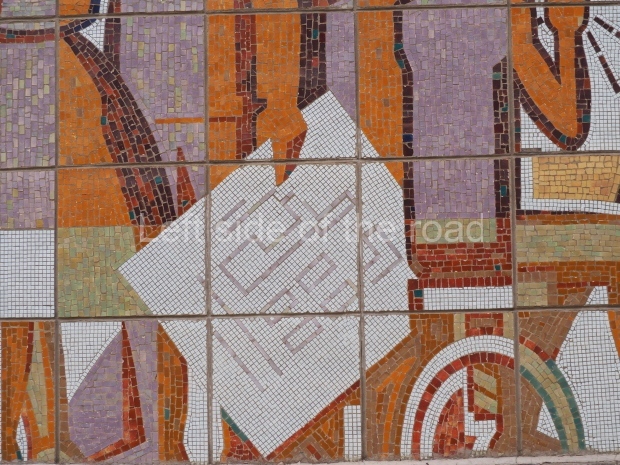
The second panel depicts three men and three women sitting at a table, all writing. Is this a reference to a literacy campaign? After all this is a Palace of Culture and universal literacy would have been one of the first goals of the Bolsheviks after the threat from the invading powers and local reactionaries had been defeated in the War of Intervention/Civil War.
The third panel depicts soldiers being welcomed by civilians. Are these soldiers returning home or are they liberators? And from which war are they returning? The uniform of the two soldiers has more in common with that of the armies that fought in the first imperialist war of the 20th century, with puttees on their legs and their bed rolls over their backs. And there is a total lack of any symbolism of Socialism in this image – no Red Stars and no red Flags.
The fourth panel depicts similarly dressed soldiers but here they seem to be going to war, the way they are moving and the soldier in the foreground kissing a woman in what seems to be a farewell kiss.
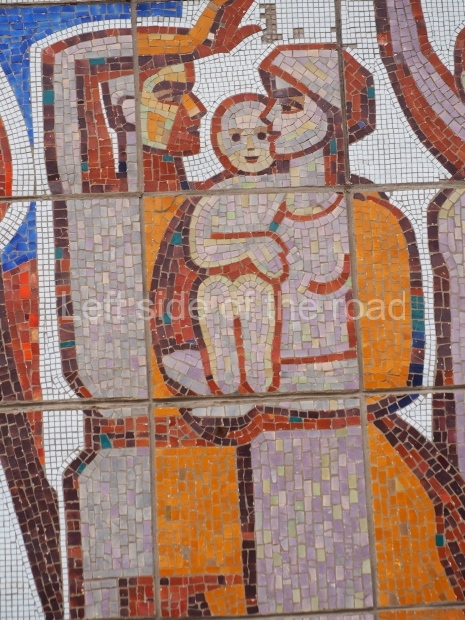
The final panel is a bit of a leap from the others. The central figures are a woman and a very young child. This is more reminiscent of a Virgin and Child scene than one celebrating the family under Socialism. However, here we have a woman holding a huge sheaf of wheat, an image that normally represents collectivisation and also there are images of grapes in the background, again indicating organised agriculture on a large scale – something that is evident for anyone who has travelled to any extent through the Moldovan countryside.
So that’s my ‘best guess’ interpretation of this mosaic. It might be well off mark but I can’t come up with anything better at the moment. There might have been some clues in Hadjioglov’s biography but I have been, so far, unable to find out anything at all about him.
In the bottom right hand corner of the final panel the mosaic is ‘signed’, this time just with the initials of the artist, in Cyrillic, together with the date of its creation, 1986.
Of the four large mosaics in Cahul this one shows the greatest signs of damage due to lack of maintenance. Throughout the whole length and breadth of the mosaic there are many places where the small, ceramic tiles have fallen away. So far this decay hasn’t developed to the stage where big sections of the image are missing but when a big enough space of missing tiles exists the weather damage can become exponential – this is demonstrated in some of the mosaics on the exterior of the kindergarten described below.
Location;
Bulevardul Victoriei 18
GPS;
45.90458 N
28.20079 E


Liceul Teoretic Serghei Rahmaninov/Theoretical High School Sergei Rahmaninov

Liceul Teoretic Serghei Rahmaninov
This mosaic, on the façade of an educational building, is some way from the centre of Cahul but still within a reasonable walking distance.
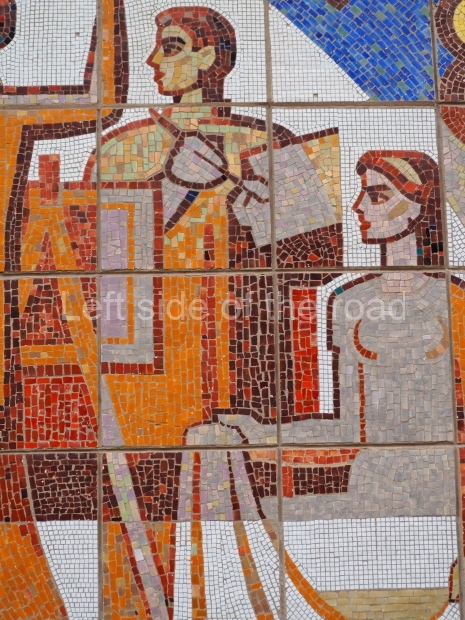
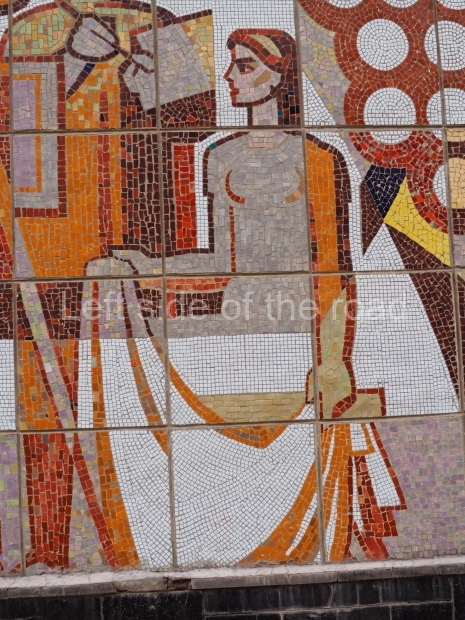
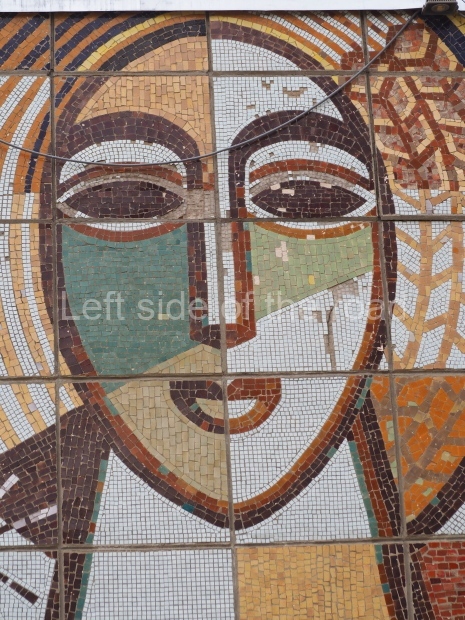
In the very centre there’s an image, slightly abstract, of a female figure. She’s obviously the most important image, both in size and the centrality of her position. She has her left arm, bent at the elbow, with her hand at near shoulder height and in her open hand rests a small object – but it’s not exactly clear what that is. Her right arm hangs down at her side, slightly away from her body. By her hand is something that resembles a painter’s palette. She is dressed in what would probably be described as ‘classical’ style. She is possibly an allegory for culture and art, or more likely ‘The Muse’. Her ‘classical’ dress makes a connection to timeless ideals, while the palette and other object perhaps symbolize creative and intellectual enlightenment.
Behind this main figure are two other females, one behind her on each side, just behind her shoulders. The one behind her left shoulder has the hand of her left arm, which is stretched down, resting on a swirl that looks similar to a symbol in musical notation. Are these the ‘handmaidens’ to ‘The Muse’?
Some ideas about the background which is a mixture of;
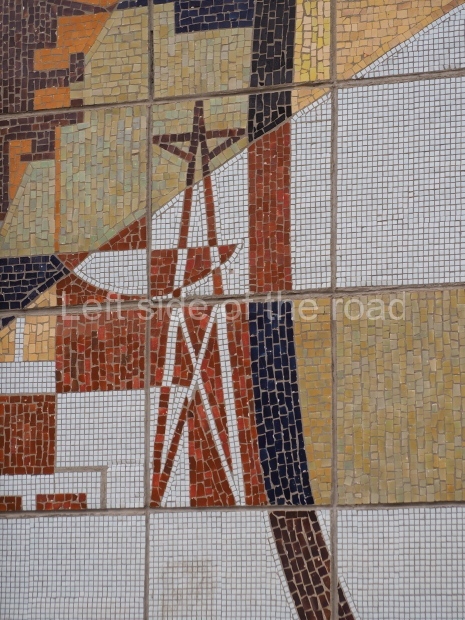
vertical and horizontal blocks and the triangular, almost machine like shapes – do these represent industry, construction and modern science? The arts are important in a modern developing society but they are dependent upon a healthy economy. Here we are presented with a faith in progress and technology;
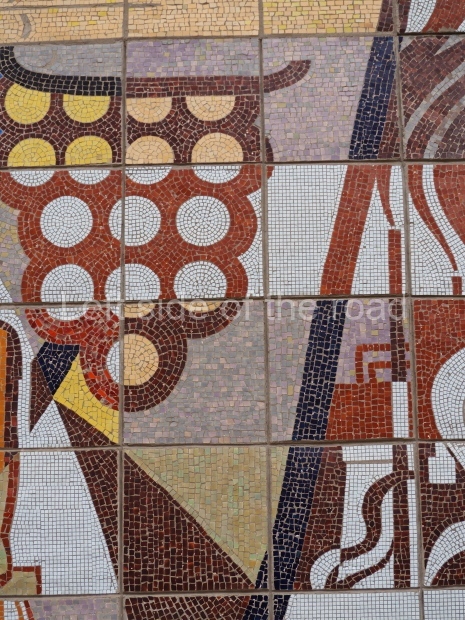
bunches of grapes, which are on the left side of the figures, representing Moldova and the importance of agriculture in the economy (which also pays for education) and celebrating the vineyards found throughout the country;
images reminiscent of musical notation honouring the school’s namesake, the Russian composer Sergei Rachmaninov – connecting the education institution’s cultural mission to a celebrated figure;
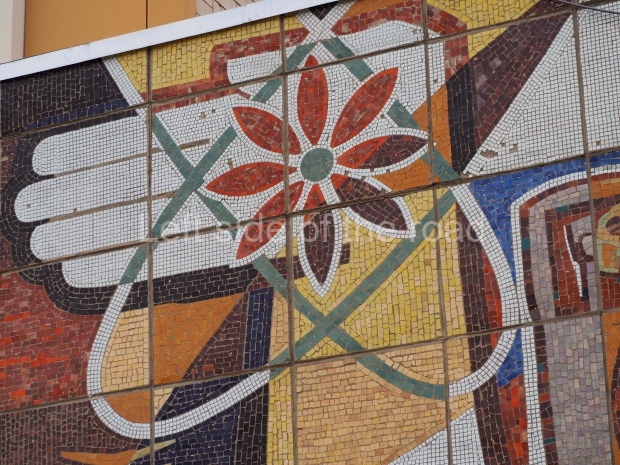
there are abstract representations of what could be flowers at the feet of the female figures – this being a nod to nature;
behind, to either side of the female figures, and going upwards to the edge of the mosaic, are two large arcs which contain within them what looks like a representation of clouds – this could possibly represent artistic inspiration and the flow of knowledge, forever aiming for greater heights.
Not definite, but a possible interpretation.
To date I have no information of the artist nor the date of its inauguration, but as two of the other major mosaics in the town were created in the late 1980s I would assume this one would be dated at, more or less, the same period.
Despite the area being somewhat exposed the mosaic is in a very good condition.
Location;
Strada Păcii 6,
GPS;
45.89457 N
28.18949 E


Woman with doves and flowers

Woman with doves and flowers
This, the fourth of the large mosaics in Cahul, is very different in style from many other mosaics in Moldova or any of the other post-Socialist societies in Eastern Europe. If we consider the three mosaics in Cahul described above they all had, if sometimes tenuous, a relationship to some of the aims of a Socialist society – the history of the country at the Palace of Culture; sport and recreation at the Sports School; and the idea of education and progress at the Rachmaninov school. Here there’s none of that and that would seem to indicate a very late creation of the Soviet era.
Here we have a simple, although spanning multi-storeys, image of a young, blond, blue-eyed woman. She’s dressed in a loose, flowing dress, with very wide sleeves and is barefoot as she walks through the countryside. Perhaps through a wood as the vertical lines behind her could well represent silver birch trees (as seen in some of the mosaics in Bălți). She is surrounded by flower heads and doves and with her arms in the air she might be playing with the birds. This is very reminiscent of ‘flower power’ images of young women of the 1960s. There is some sort of scroll going across her lower body which then swirls around above her head which might be representative of music.
Whilst the other large mosaics in Cahul are on public building this one is on the gable end of an apartment block, very close to the centre of the town. As in other parts of Moldova there isn’t a great deal of respect paid to the past culture as an air conditioning unit invades the edge at the lower right hand side and there is a one storey building, a small shop selling furniture, which cuts across the bottom of the work. It doesn’t look as if the more modern construction has obliterated anything important but it does make it impossible to see any possible signature and/or date – which would normally be placed at the bottom corner of such a mosaic.
Location:
Strada Mihai Eminescu near the junction with Strada Ștefan cel Mare
GPS;
45.90729 N
28.18979 E


Kindergarten

Kindergarten
The last example of this Soviet-era art in Cahul is a number of smaller mosaics which are interspersed around the outside of a large Kindergarten on the northern edge of the town centre.
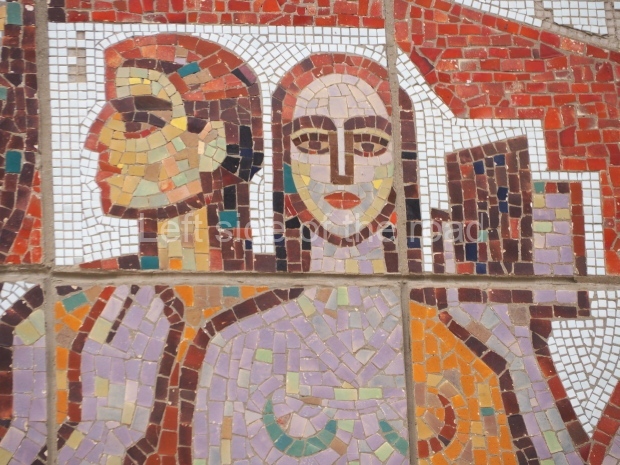
A number of them appear to be characters that you would see in a circus, dressed as clowns, some of them in very fancy gowns. There is one, which upon first glance is a Christ-like figure but on a closer look you see he is holding a bared sword in both his hands at waist level. Moldova, even in Soviet times, seemed to place Stefan cel Mare into public imagery so it’s possible that is who is represented here. As he was involved in battles against the Ottoman Turks I assume he represents Moldovan nationalism and independence.
When it comes to their physical condition they range from very well preserved to just hanging on by a thread. I didn’t come across any indication of the name/s of the artists or when they might have been placed there.
Unlike the others mosaics in Cahul these are not readily observed from the street. There’s only one that can be seen properly from the street. I was there when the school had closed for the day and was able to walk around the premises and able to see some of those in the best condition which are at the back of the building.
I don’t know if it became quite common to install mosaics on school premises but that’s a possibility – as can be seen by the large mosaic on the wall of the kindergarten in Bălți and also an interesting one on a school in Chișinău.
Location;
Strada Costache Negruzzi at the junction with Strada Mihai Eminescu (just a couple of blocks, along the same road, further north from the Woman with doves and flowers)
GPS;
45.91001 N
28.18882 E
More on Moldova – on the Post-Socialist Countries – Eastern Europe and Asia page


Soviet Mosaics – Bălți – Moldova
VI Lenin and Palace of Culture Mosaic – Ribniţa – Pridnestrovie