On the paths of war by Hektor Dule

On the paths of war

On the paths of war

More on Albania ….

On the paths of war by Hektor Dule

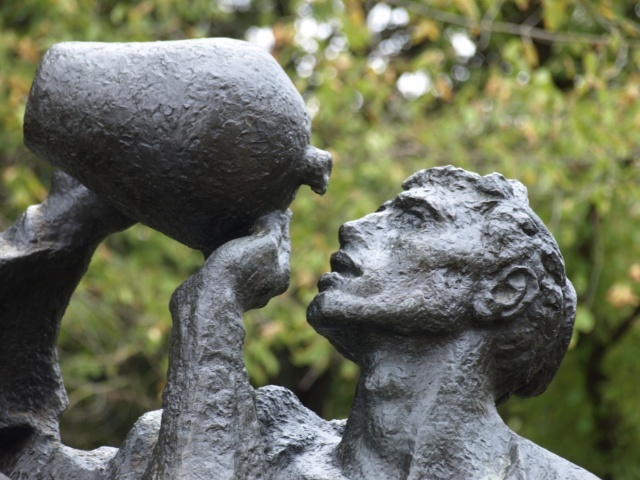
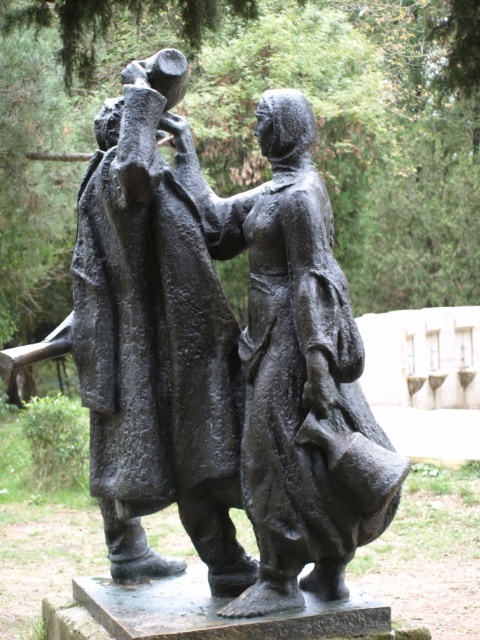
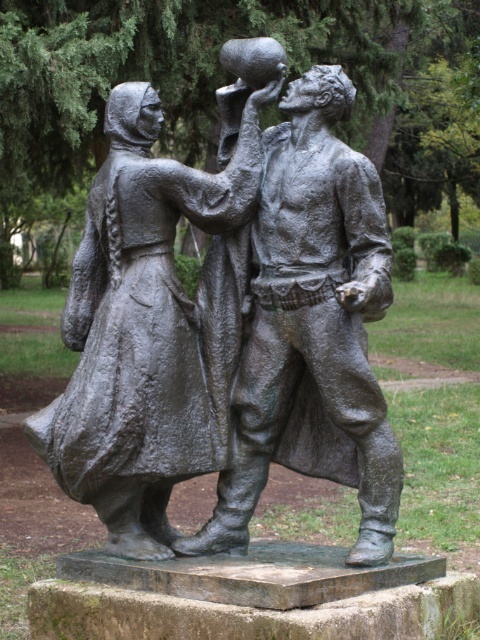
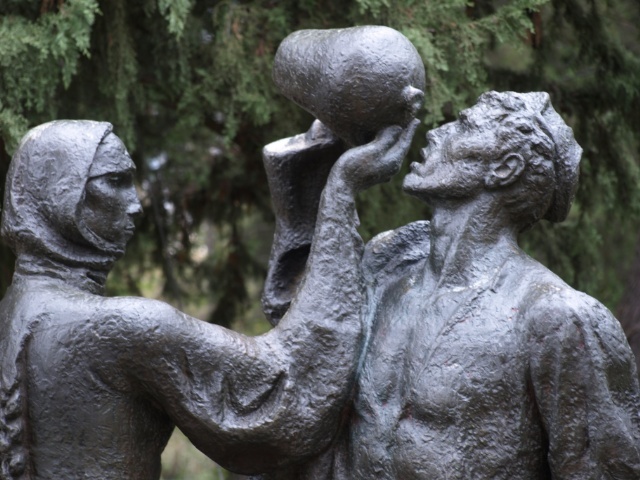
Rather than give my own interpretation of this statue I thought to reproduce the article below which includes a number of interpretations of the statue of the Partisan and the women offering him a refreshing drink. It originally appeared as Eros on the Roads of War: Some Brief Notes on Hektor Dule’s Në Udhët e Luftës For and Against the Decadences of the Fles by Raino Isto

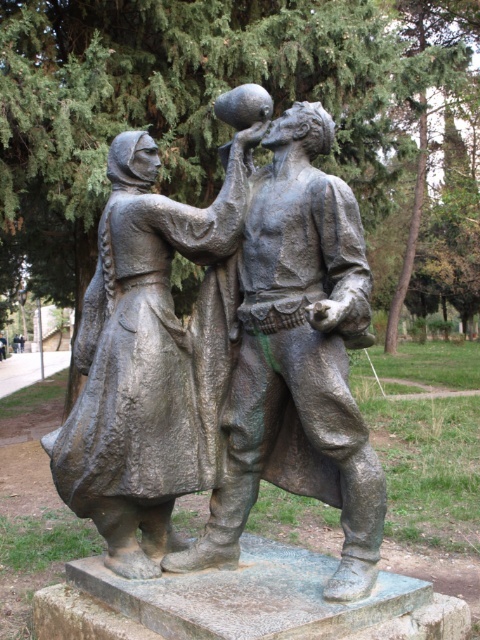
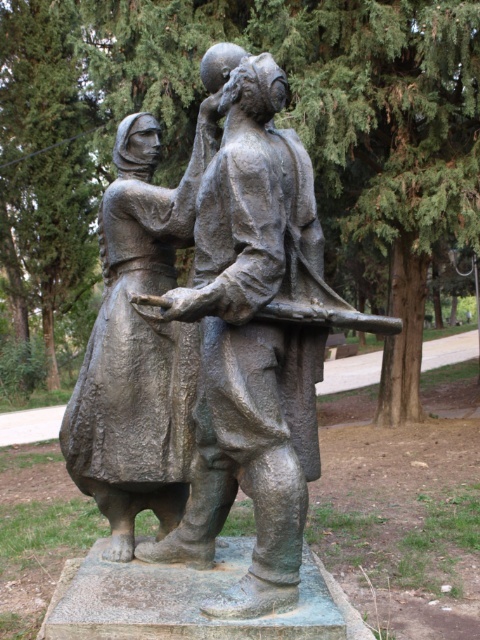
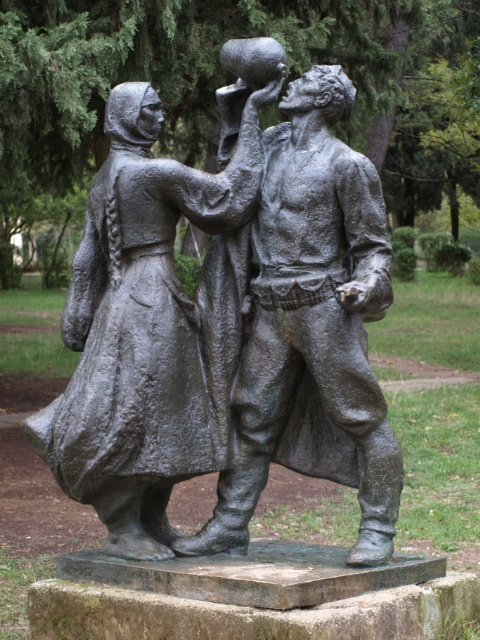
First exhibited in during the National Exhibition dedicated to the 30th Anniversary of National Liberation, Hektor Dule’s Në Udhët e Luftës [On the Paths of War] (also called Në Rrugën e Luftës) now stands in Tirana’s Great Park,[1] near to the fountains (and also to the new assortment of exercise equipment installed in the last few years). The bronze statue, depicting an Albanian woman holding up a jug of water and allowing a partisan soldier to drink deeply from it, seems appropriately placed in its pseudo-natural surroundings. It is, after all, about the nourishment of the body in the course of its struggles…what better location for it that the Great Park, where the body—in exercise, in sex, in relaxation and communion with an artificial nature—is fundamental to the creation and experience of space?

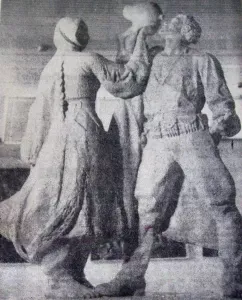
In 1975, writing of the work’s appearance in the exhibition (in its earlier version done in plaster), Fatmir Haxhiu wrote that ‘precisely in this moment both ordinary and life-affirming, in this fundamentally simple act—one that may people have encountered during the war years (a mother giving a jug of water to a partisan)—the artist struggles to show the love and intimacy that our people felt for the partisans, and the support that ordinary people gave to the partisans during the National Liberation War. And the artist achieves his goal. The two figures are connected to each other in a conceptual unity and by the complete harmonization of their forms.’[2] Later, Haxhiu writes, ‘It is an intimate work’ [my emphasis].[3] The remainder of his article praises Dule (who at this point was one of the important figures in a new generation of Albanian sculptors, best known for the Mushqeta monument and his work with the famous ‘monumental trio’ of K. Rama, Sh. Hadëri, and M. Dhrami), offers the typically supportive assessment of his treatment of themes from the National Liberation War, and makes some minor aesthetic criticisms aimed at his future improvement as a sculptor.

Without dismissing the relevance of the ever-present theme of the partisan struggle, and certainly without wishing to poke fun at either Haxhiu’s analysis or Dule’s work, I would like to suggest a slightly different interpretation of Në Udhët e Luftës. Perhaps it is more accurate to say: I wish to expand upon our understanding of the themes of the partisan struggle precisely by pausing as we read the words love and intimacy, and considering what sculptural traditions Dule’s work is truly in dialogue with. In short, I would like to introduce (or perhaps, since so much popular discourse seems so committed to separating the two, to reintroduce) the question of the body, sensuality, and sex into the discussion of Albanian socialist realist sculpture.

For it seems undeniable to me that Dule’s sculptural group carries an immense sexual charge (and not just because of some vague associations with what goes on elsewhere in the Great Park). If Haxhiu’s analysis of the work seems to avoid this aspect, I think the fact that he uses the words ‘love and intimacy’ to characterize the work indicates his awareness of the issues potentially broached by the work and an active attempt to undercut them. In much the same way, I think that Dule is trying to use the tropes of a certain sculptural tradition in the context of socialist realism in order partially to undermine them and partially to harness them.

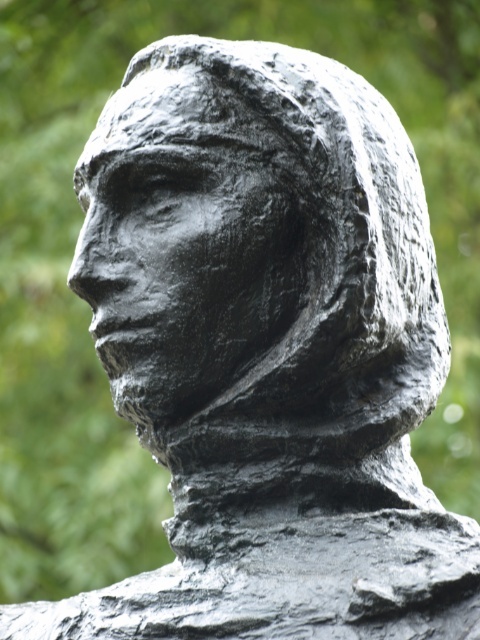
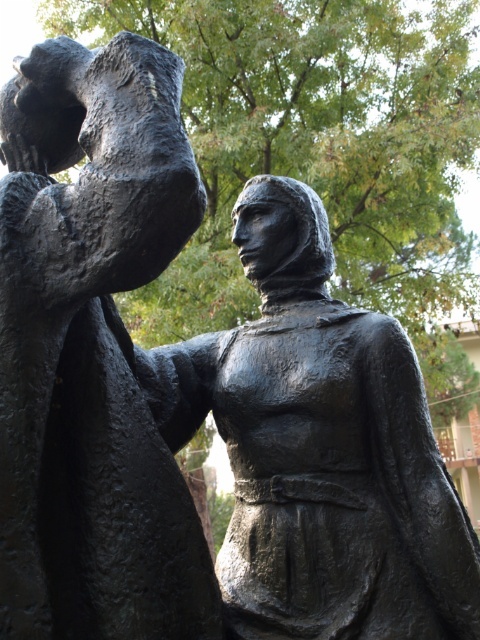
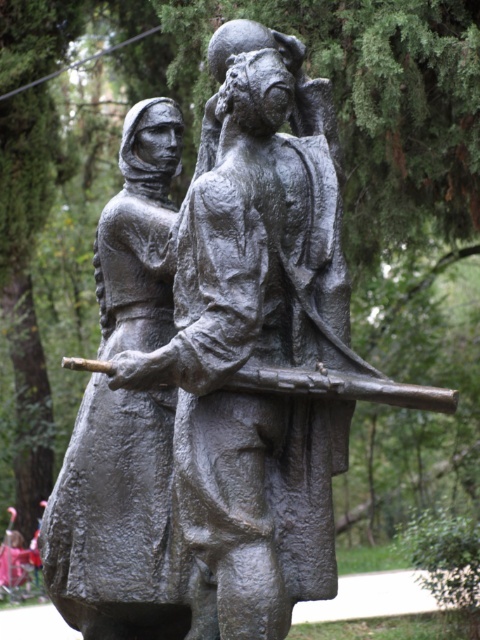
To see the eroticism of Dule’s sculpture, we need only compare it to a work that I dare say it was actually intended to be in dialogue with: Clodion’s Nymph and Satyr Carousing (also known as The Intoxication of Wine), 18th century (ca. 1780–90), terracotta, in the Metropolitan Museum of Art. Clodion’s work, which straddles (as the sculptor himself did) the turn towards the Neoclassical in sculpture with the more playful sensuality of the Rococo, is a kind of decadent mirror of Dule’s work. In Clodion: a satyr, the preeminent mythical being of male lust, leans back, allowing himself to rest upon a stone as he lifts one animal leg off the ground and pulls a naked nymph to him, his fingers digging into the flesh of her back. She leans into him, straddling his left leg, wrapping her right arm around his neck, and holds a goblet of wine above his mouth, pouring. In Dule: an Albanian woman, barefoot and dressed in garb that suggests she must be a villager) stands before a male partisan. Her feet are slightly apart, and one of his booted feet steps forward, placed firmly between hers. Her left arm and shoulder are drawn back, her clothing flowing out a bit behind her, and her right hand reaches out to steady a full, rounded jug as the partisan holds it in his right hand, by its handle, above his head. His head is thrown back, the jug held a few inches from his open mouth to allow the water to flow down his throat. His left shoulder is likewise thrown back, exposing his chest, and he braces his weight on his left leg. His left hand steadies his rifle at waist height, as its barrel juts out phallically, but directed away from the woman. The only contact between the two bodies takes place between her sleeve and his chest as she steadies the jug, but she stares directly at his face as he drinks in a fixed gaze that connects the two emotionally, physically, and compositionally. Like Clodion’s pair, Në Udhët e Luftës rewards viewing in the round, shifting perspectives that give us different views of the two bodies and their intimate connections.

I do not think that Dule’s sculpture intends to posit for its viewer a narrative of sexual engagement between the village woman and the partisan he shows, although that is certainly possible.[4] Rather, I think that Dule takes the tradition of which Clodion is emblematic (a Neoclassical sensibility, but with one foot still in the aristocratic tastes of the Rococo,[5] celebrating not only the sobriety of antiquity but also its Bacchic excesses) and attempts to overcome it in the context of socialist realism. Socialist realism was, after all, as much a ‘logic of cultural supplementarity, a logic that established itself by qualifying previous aesthetic traditions that were already…known’ (as Devin Fore asserts), as it was a style in itself.[6] At the same time, however, he brings sensuality into socialist realism, offering a view of the National Liberation War—in its most ‘ordinary’ and ‘life-affirming’ moments—as a struggle that includes the sensual gratification of the body and its desires, of the partisan reinvigorated physically by his encounter with the village mother. There is no need to digress into Freud, and love, and the death drive (though indeed one could) to consider the equation of war, sexuality, and physical release that Në Udhët e Luftës presents. As much as Haxhiu seems careful to ensure that ‘love and intimacy’ have strictly Platonic meanings in the context of Dule’s sculptural pair, the suggestion of sexual fullness present in the jug, the rifle held stiffly at waist-level, the partisan’s head thrown back, and the assertive offering of the village woman trace the contours of a very different set of connotations.

One could certainly go further, and perhaps one should. All I mean to suggest here is the necessity of reasserting the body and its pleasures—sexual and sensual—at the heart of socialist realist sculpture (and art in general) in Albania (and elsewhere, of course). Works like Në Udhët e Luftës reveal the tension of inheriting the sculptural tradition of bodily desire made materially manifest, and the rich possibilities of bringing that ‘decadent’ tradition into the context of the National Liberation War narrative—of denying the pleasures of the flesh, but also of reaffirming them in the context of sacrifice and struggle. It should also remind us that the war years were not simply a clash of battalions and strategies, of ideas and ideologies, but also of bodies and their desires.

[1] I would welcome anyone with information about the precise year in which the bronze version of the statue was placed in the park—I confess I have no information regarding this placement.
[2] Fatmir Haxhiu, ‘Në Udhët e Luftës: Shënime rreth grupit skulptural të H. Dules,’ Drita, 28 September 1975.
[3] Ibid.
[4] And the narrative itself seems plausible, though I have read of no accounts that discuss the occurrence and/or frequency of sexual dalliances between partisans and the ‘ordinary people’ that gave them support and shelter during the war.
[5] Indeed, what style or period could more fully epitomize the ‘decadence’ of bourgeois culture—that perennial enemy of socialist society—than the Rococo?
[6] Devin Fore, Realism After Modernism: The Rehumanization of Art and Literature (Cambridge: MIT Press, 2012), 244

Location

In the centre of Tirana Park.

GPS

41.31374401
19.81815702

DMS

41° 18′ 49.4784” N
19° 49′ 5.3653” E

Altitude

137.7 m
Arms industry sees Ukraine conflict as an opportunity, not a crisis

Ukranian tanks - January 2022

Ukranian tanks – January 2022

View of the world

Ukraine – what you’re not told

Arms industry sees Ukraine conflict as an opportunity, not a crisis

[The article below first appeared on the Truthout website on 2nd March 2022.]

Arms industry sees Ukraine conflict as an opportunity, not a crisis

by Jonathan Ng

In February, a photograph of Russian President Vladimir Putin sitting hunched over a 13-foot table with French President Emmanuel Macron circulated the globe. News about their sprawling table and sumptuous seven-course dinner was reminiscent of a Lewis Carroll story. But their meeting was deadly serious. Macron arrived to discuss the escalating crisis in Ukraine and threat of war. Ultimately, their talk foundered over expansion of the North Atlantic Treaty Organization (NATO), yielding little more than the bizarre photograph.

Yet the meeting was surreal for another reason. Over the past year, Macron, the leading European Union (EU) peace negotiator, has led an ambitious arms sales campaign, exploiting tensions to strengthen French commerce. The trade press even reported that he hoped to sell Rafale fighter jets to Ukraine, breaking into the “former bastion of Russian industry.”

Macron is not alone. NATO contractors openly embrace the crisis in Ukraine as sound business. In January, Raytheon CEO Greg Hayes cited “tensions in Europe” as an opportunity, saying, “I fully expect we’re going to see some benefit.” Likewise, CEO Jim Taiclet of Lockheed Martin highlighted the benefits of “great power competition” in Europe to shareholders.

On February 24, Russia invaded Ukraine, pounding cities with ordnance and dispatching troops across the border. The sonic boom of fighter jets filled the air, as civilians flooded the highways in Kyiv, attempting to flee the capital. And the stock value of arms makers soared.

The spiraling conflict over Ukraine dramatizes the power of militarism and the influence of defense contractors. A ruthless drive for markets — intertwined with imperialism — has propelled NATO expansion, while inflaming wars from Eastern Europe to Yemen.

Selling NATO

The current conflict with Russia began in the wake of the Cold War. Declining military spending throttled the arms industry in the United States and other NATO countries. In 1993, Deputy Secretary of Defense William Perry convened a solemn meeting with executives. Insiders called it the “Last Supper.” In an atmosphere heavy with misapprehension, Perry informed his guests that impending blows to the U.S. military budget called for industry consolidation. A frantic wave of mergers and takeovers followed, as Lockheed, Northrop, Boeing and Raytheon acquired new muscle and smaller firms expired amid postwar scarcity.

While domestic demand shrunk, defense contractors rushed to secure new foreign markets. In particular, they set their sights on the former Soviet bloc, regarding Eastern Europe as a new frontier for accumulation. “Lockheed began looking at Poland right after the wall came down,” veteran salesman Dick Pawlowski recalled. “There were contractors flooding through all those countries.” Arms makers became the most aggressive lobbyists for NATO expansion. The security umbrella was not simply a formidable alliance but also a tantalizing market.

However, lobbyists faced a major obstacle. In 1990, Secretary of State James Baker had promised Soviet leader Mikhail Gorbachev that if he allowed a reunited Germany to join NATO, the organization would move “not one inch eastward.” Yet lobbyists remained hopeful. The Soviet Union had since disintegrated, Cold War triumphalism prevailed, and vested interests now pushed for expansion. “Arms Makers See Bonanza In Selling NATO Expansion,” The New York Times reported in 1997. The newspaper later noted that, “Expansion of the North Atlantic Treaty Organization — first to Poland, Hungary and the Czech Republic and then possibly to more than a dozen other countries — would offer arms makers a new and hugely lucrative market.”

New alliance members meant new clients. And NATO would literally require them to buy Western military equipment.

Lobbyists poured into Washington, D.C. fêting legislators in royal style. Vice President Bruce Jackson of Lockheed became the president of the advocacy organization U.S. Committee to Expand NATO. Jackson recounted the extravagant meals that he hosted at the mansion of the Republican luminary Julie Finley, which boasted “an endless wine cellar.”

“Educating the Senate about NATO was our chief mission,” he informed journalist Andrew Cockburn. “We’d have four or five senators over every night, and we’d drink Julie’s wine.”

Lobby pressure was relentless. “The most interested corporations are the defense corporations, because they have a direct interest in the issue,” Romanian Ambassador Mircea Geoană observed. Bell Helicopter, Lockheed Martin, and other firms even funded Romania’s lobbying machine during its bid for NATO membership.

Ultimately, policy makers reneged on their promise to Gorbachev, admitting Poland, Hungary and the Czech Republic into NATO in 1999. During the ceremony, Secretary of State Madeleine Albright — who directly cooperated with the Jackson campaign — welcomed them with a hearty “Hallelujah.” Ominously, the intellectual architect of the Cold War, George Kennan, predicted disaster. “Such a decision may be expected to inflame the nationalistic, anti-Western and militaristic tendencies in Russian opinion,” Kennan cautioned.

Few listened. Former Assistant Secretary of Defense Chas Freeman described the mentality of policy makers: “The Russians are down, let’s give them another kick.” Relishing victory, Jackson was equally truculent: “‘Fuck Russia’ is a proud and long tradition in US foreign policy.” Later, he became chairman of the Committee for the Liberation of Iraq, which paved the way for the 2003 invasion, the biggest industry handout in recent history.

Within two decades, 14 Central and Eastern European countries joined NATO. The organization originally existed to contain the Soviet Union, and Russian officials monitored its advance with alarm. In retrospect, postwar expansion benefited arms makers both by increasing their market and stimulating conflict with Russia.

Targeting Ukraine

Tensions reached a new phase in 2014 when the United States backed the removal of President Viktor Yanukovych in Ukraine. Yanukovych had opposed NATO membership, and Russian officials feared his ouster would bring the country under its strategic umbrella. Rather than assuage their concerns, the Obama administration maneuvered to slip Ukraine into its sphere of influence. Assistant Secretary of State Victoria Nuland coordinated regime change with brash confidence. Nuland openly distributed cookies to protesters, and later, capped a diplomatic exchange with “fuck the EU.” At the height of the uprising, Sen. John McCain also joined demonstrators. Flanked by leaders of the fascist Svoboda Party, McCain advocated regime change, declaring that “America is with you.”

By then, newly minted NATO members had bought nearly $17 billion in American weapons. Military installations, including six NATO command posts, ballooned across Eastern Europe. Fearing further expansion, Russia annexed the Crimean Peninsula and intervened in the Donbas region, fueling a ferocious and interminable war.

NATO spokespeople argued that the crisis justified expansion. In reality, NATO expansion was a key inciter of the crisis. And the conflagration was a gift to the arms industry. In five years, major weapons exports from the United States increased 23 percent, while French exports alone registered a 72-percent leap, reaching their highest levels since the Cold War. Meanwhile, European military spending hit record heights.

As tensions escalated, Supreme Commander Philip Breedlove of NATO wildly inflated threats, calling Russia “a long-term existential threat to the United States.” Breedlove even falsified information about Russian troop movements over the first two years of the conflict, while brainstorming tactics with colleagues to “leverage, cajole, convince or coerce the U.S. to react.” A senior fellow at the Brookings Institution concluded that he aimed to “goad Europeans into jacking up defense spending.”

And he succeeded. The Stockholm International Peace Research Institute registered a significant leap in European military spending — even though Russian spending in 2016 equaled only one quarter of the European NATO budget. That year, Breedlove resigned from his post before joining the Center for a New American Security, a hawkish think tank awash in industry funds.

The arms race continues. After European negotiations gridlocked, Russia recognized two separatist republics in the Donbas region before invading Ukraine this February. Justifying the bloody operation, Putin wrongly accused Ukrainian authorities of genocide. Yet his focus was geopolitical. “It is a fact that over the past 30 years we have been patiently trying to come to an agreement with the leading NATO countries,” he said. “In response to our proposals, we invariably faced either cynical deception and lies or attempts at pressure and blackmail, while the North Atlantic alliance continued to expand despite our protests and concerns. Its military machine is moving and, as I said, is approaching our very border.”

In retrospect, three decades of industry lobbying has proved deadly effective. NATO engulfed most of Eastern Europe and provoked a war in Ukraine — yet another opportunity for accumulation. Alliance members have activated Article 4, mobilizing troops, contemplating retaliation and moving further toward the brink of Armageddon.

Yet even as military budgets rise, European arms makers — like their American counterparts — have required foreign markets to overcome fiscal restraints and production costs. They need clients to finance their own military buildup: foreign wars to fund domestic defense.

Yemen Burning

Arms makers found the perfect sales opportunity in Yemen. In 2011, a popular revolution toppled Ali Abdullah Saleh, who had monopolized power for two decades. His crony, Abdu Rabbu Mansour Hadi, became president the next year after easily winning the election: He was the only candidate. Thwarted by elite intrigue, another uprising ejected Mansour Hadi in 2015.

That year, Prince Salman became king of Saudi Arabia, but power concentrated into the hands of his son, Mohammed bin Salman, who feared that the uprising threatened to snatch Yemen from Saudi Arabia’s sphere of influence.

Months later, a Saudi-led coalition invaded, leaving a massive trail of carnage. “There was no plan,” a U.S. intelligence official emphasized. “They just bombed anything and everything that looked like it might be a target.”

The war immediately attracted NATO contractors, which backed the aggressors. They exploit the conflict to sustain industrial capacity, fund weapons development and achieve economies of scale. In essence, the Saudi-led coalition subsidizes the NATO military buildup, while the West inflames the war in Yemen.

Western statesmen pursue sales with perverse enthusiasm. In May 2017, Donald Trump visited Saudi Arabia for his first trip abroad as president, in order to flesh out the details of a $110 billion arms bundle. His son-in-law, Jared Kushner, arrived beforehand to discuss the package. When Saudi officials complained about the price of a radar system, Kushner immediately called the CEO of Lockheed Martin to ask for a discount. The following year, Mohammed bin Salman visited company headquarters during a whirlwind tour of the United States. Defense contractors, Hollywood moguls and even Oprah Winfrey welcomed the young prince.

Yet the Americans were not alone. The Saudi-led coalition is also the largest arms market for France and other NATO members. And as the French Ministry of the Armed Forces explains, exports are “necessary for the preservation and development of the French defense technological and industrial base.” In other words, NATO members such as France export war in order to retain their capacity to wage it.

President Macron denies that the coalition — an imposing alliance that includes Saudi Arabia, Egypt, Jordan, the United Arab Emirates, Kuwait, Bahrain, Qatar, Sudan and Senegal — uses French weapons. But the statistics are suggestive. Between 2015 and 2019, France awarded €14 billion in arms export licenses to Saudi Arabia and €20 billion in licenses to the United Arab Emirates. CEO Stéphane Mayer of Nexter Systems praised the performance of Leclerc tanks in Yemen, boasting that they “have highly impressed the military leaders of the region.” In short, while Macron denies that the coalition wields French hardware in Yemen, local industrialists cite their use as a selling point. Indeed, Amnesty International reports that his administration has systematically lied about its export policy. Privately, officials have compiled a “very precise list of French materiél deployed in the context of the conflict, including ammunition.”

Recently, Macron became one of the first heads of state to meet Mohammed bin Salman following the assassination of journalist Jamal Khashoggi. Like Trump’s trip, Macron’s diplomatic junket was a sales mission. Eventually, Macron clinched a deal with the United Arab Emirates for 80 Rafale fighters. The CEO of Dassault Aviation called the contract “the most important ever obtained by French military aerospace,” guaranteeing six years of work for a pillar of its industrial base.

French policy is typical of NATO involvement in Yemen. While denouncing the war, every Western producer has outfitted those carrying it out. Spanish authorities massage official documents to conceal the export of lethal hardware. Great Britain has repeatedly violated its own arms embargo. And the United States has not respected export freezes with any consistency.

Even NATO countries in Eastern Europe exploit the war. While these alliance members absorb Western arms, they dump some of their old Soviet hardware into the Middle East. Between 2012 and July 2016 Eastern Europe awarded at least €1.2 billion in military equipment to the region.

Ironically, a leading Eastern European arms exporter is Ukraine. While the West rushes to arm Kyiv, its ruling class has sold weapons on the black market. A parliamentary inquiry concluded that between 1992 and 1998 alone, Ukraine lost a staggering $32 billion in military assets, as oligarchs pillaged their own army. Over the past three decades, they have outfitted Iraq, the Taliban and extremist groups across the Middle East. Even former President Leonid Kuchma, who has led peace talks in the Donbas region, illegally sold weapons while in office. More recently, French authorities investigated Dmytro Peregudov, the former director of the state defense conglomerate, for pocketing $24 million in sales commissions. Peregudov resided in a château with rolling wine fields, while managing the extensive properties that he acquired after his years in public service.

The Warlords

Kuchma and Peregudov are hardly exceptional. Corruption is endemic in an industry that relies on the proverbial revolving door. The revolving door is not simply a metaphor but an institution, converting private profit into public policy. Its perpetual motion signifies the social reproduction of an elite that resides at the commanding heights of a global military-industrial complex. Leading power brokers ranging from the Mitterrands and Chiracs in France, to the Thatchers and Blairs in Britain, and the Gonzálezes and Bourbons in Spain have personally profited from the arms trade.

In the United States, the industry employs around 700 lobbyists. Nearly three-fourths previously worked for the federal government — the highest percentage for any industry. The lobby spent $108 million in 2020 alone, and its ranks continue to swell. Over the past 30 years, about 530 congressional staffers on military-related committees left office for defense contractors. Industry veterans dominate the Biden administration, including Secretary of Defense Lloyd Austin from Raytheon.

The revolving door reinforces the class composition of the state, while undermining its moral legitimacy. As an elite rotates office, members insulate policymaking from democratic input, taint the government with corruption and mistake corporate profit with national interest. By 2005, 80 percent of army generals with three stars or more retired to arms makers despite existing regulations. (The National Defense Authorization Act prohibits top officers from lobbying the government for two years after leaving office or leveraging personal contacts to secure contracts. But compliance is notoriously poor.) More recently, the U.S. Navy initiated investigations against dozens of officers for corrupt ties to the defense contractor Leonard Francis, who clinched contracts with massive bribes, lavish meals and sex parties.

Steeped in this corrosive culture, NATO intellectuals now openly talk about the prospect of “infinite war.” Gen. Mike Holmes insists that it is “not losing. It’s staying in the game and getting a new plan and keeping pursuing your objectives.” Yet those immersed in its brutal reality surely disagree. The United Nations reports that at least 14,000 people have died in the Russo-Ukrainian War since 2014, and over 377,000 have perished in Yemen.

In truth, the doctrine of infinite war is not so much a strategy as it is a confession — acknowledging the violent metabolism of a system that requires conflict. As a self-selecting elite propounds NATO expansion, military buildup and imperialism, we must embrace what the warlords most fear: the threat of peace.

View of the world

Ukraine – what you’re not told