
Electrification
More on Moldova – on the Post-Socialist Countries – Eastern Europe and Asia page
Soviet-era mosaics in Cahul – Gagauzia
Soviet Mosaics – Bălți – Moldova
VI Lenin and Palace of Culture Mosaic – Ribniţa – Pridnestrovie
Electrification mosaic – Chișinău – Moldova
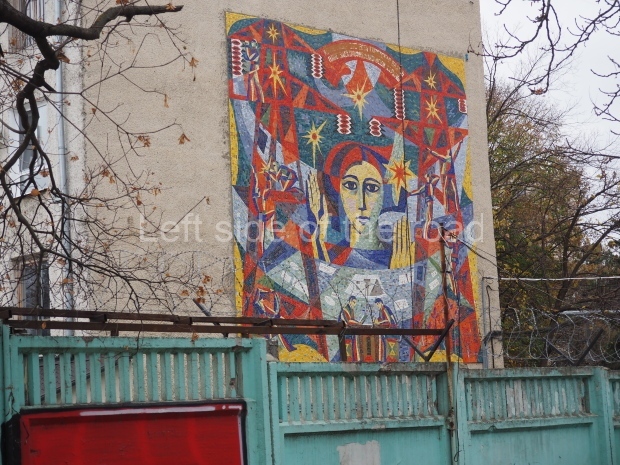
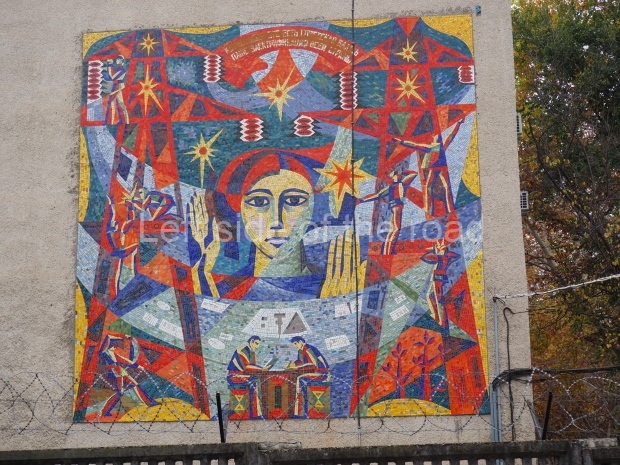
Known as ‘Electrification’ this mosaic covers the whole of the western end of the building. As far as I can tell the reason the mosaic was installed in this location was due to the fact this was originally a factory making electrical components. The building has since been re-purposed.
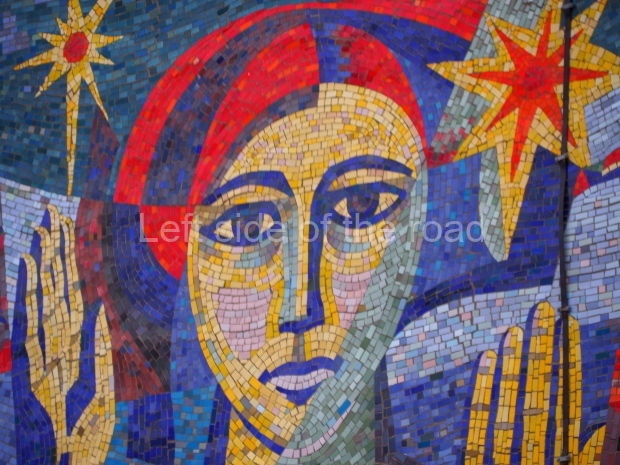
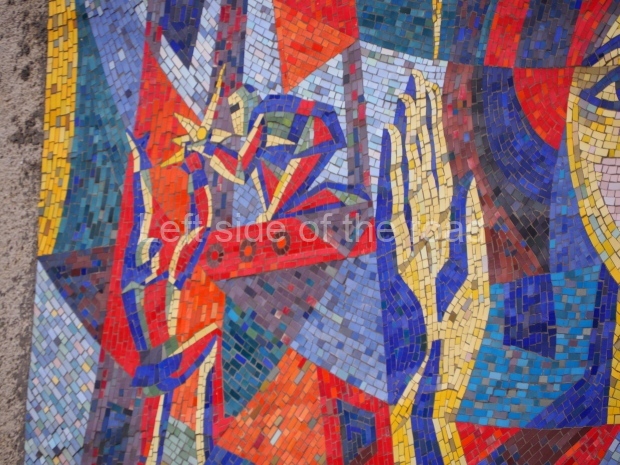
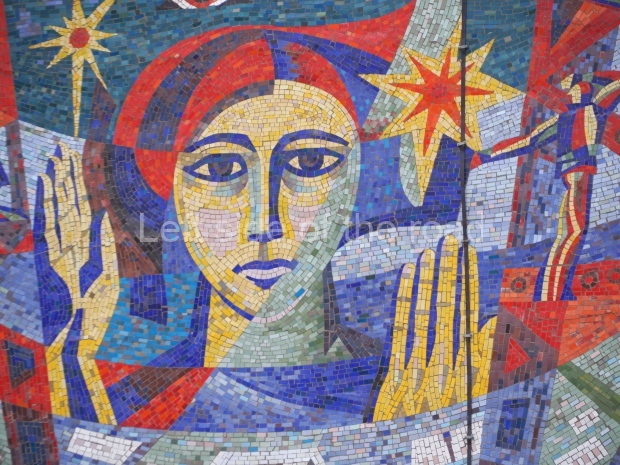
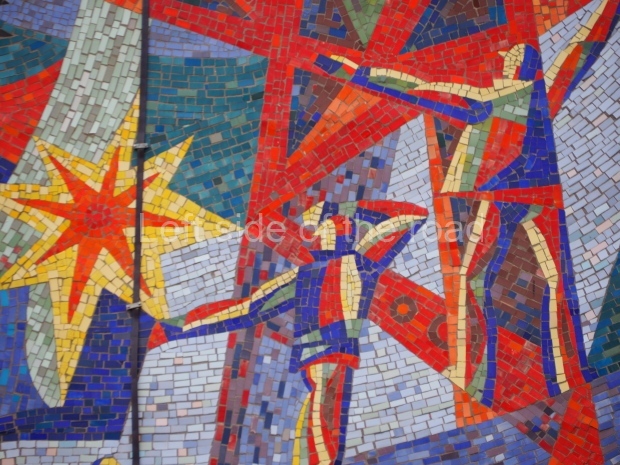
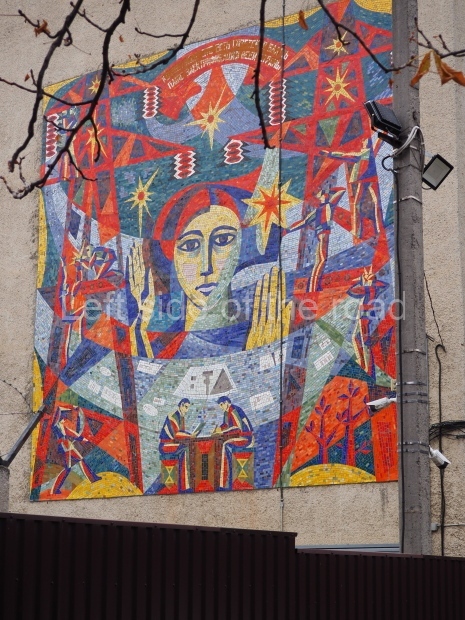
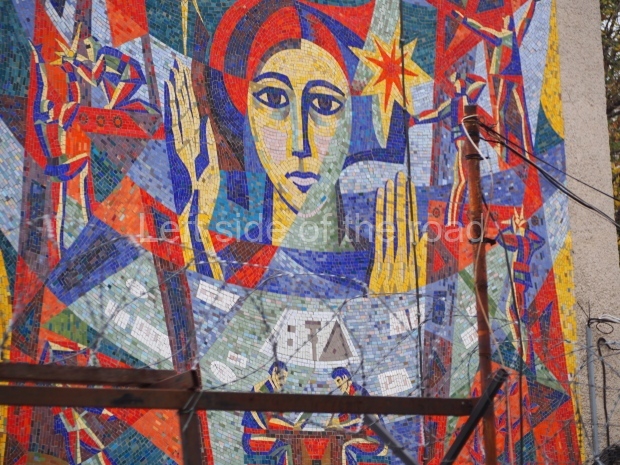
This is a very symmetrical mosaic with the principal focal point being the large image of a female face right in the centre. In Socialist Realist art the female face represented progress and the collective effort towards industrialisation. Central to this struggle to bring the backward country of Russia, inherited by the Russian Revolution, was the electrification of the country – as set out by VI Lenin in his speech to the Congress of Soviets in 1920 (see below). This was just an extension of the artist depiction of women. In the Soviet society they were active participants in the construction of Socialism (in both town and country) and their depiction in artist works integrated femininity with themes of modernity and technological advance. Here both her hands are raised to shoulder level and it appears that the power, the energy, the electricity is emanating from her finger tips.
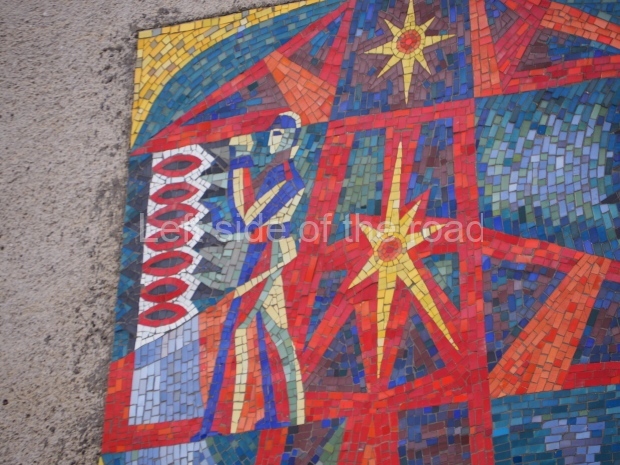
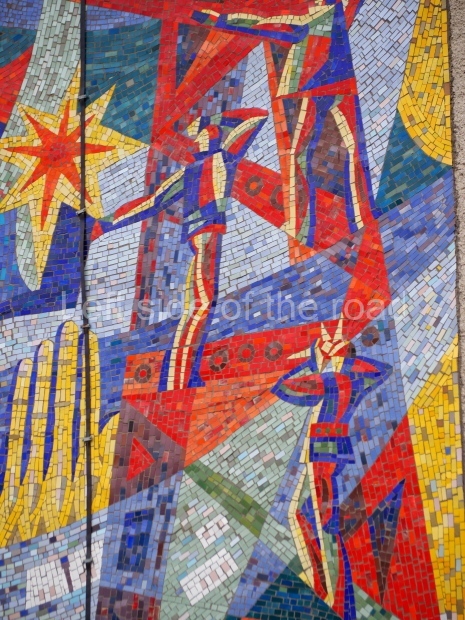
On both sides of the mosaic, and taking up the whole height and a third each of the width, are two large, red pylons. The pylon represented both the promise of electricity to all the country but also the enormity of the task of bringing electricity to all the people in a country that covered a sixth of the world’s land mass. This achievement was a visible difference from the old, Tsarist and feudal society in which the working masses were the last to see, if ever, the benefits of science and technology. When the pylon came to town life for all was about to change.
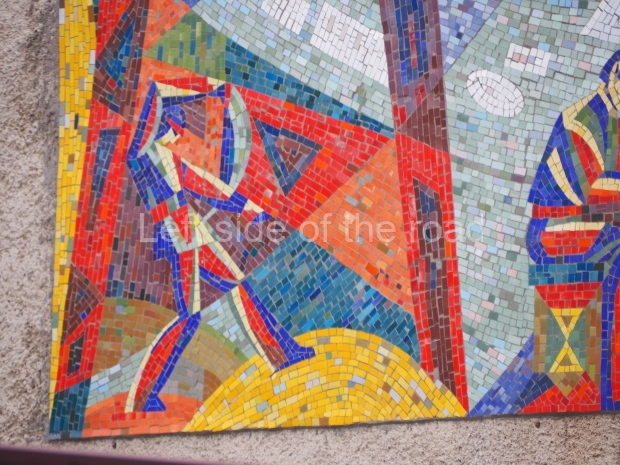
There are workers all over these two pylons and there are two tasks which can be clearly made out. One is the worker at the very top of the left hand pylon who is connecting cables to the glass insulators and lower down, on the same pylon, another worker is welding. Other workers on both sides are presenting a scene of activity, movement and a desire to complete the task of electrification as quickly as possible.
Underneath the pylon on the right there are a couple of trees and this indicates the task of providing electricity to the Soviet people was not just for those who lived in the cities – where the task was much ‘easier’ – but was something for which those who worked and lived in the countryside also had to see the benefits. It has to be remembered that immediately following the October Revolution the vast majority of the Russian people lived in the countryside and the sheer size of the country made the task that much greater.
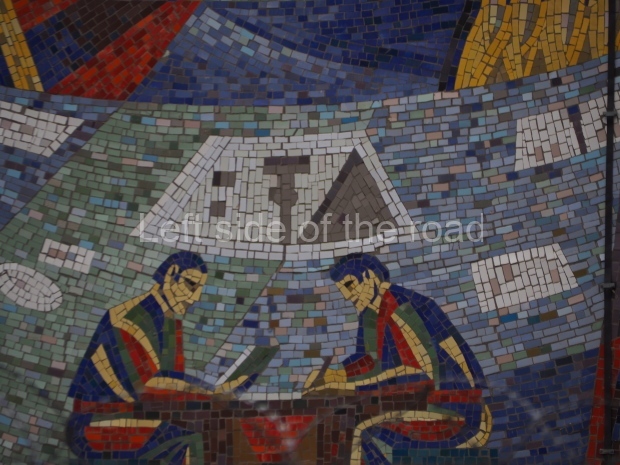
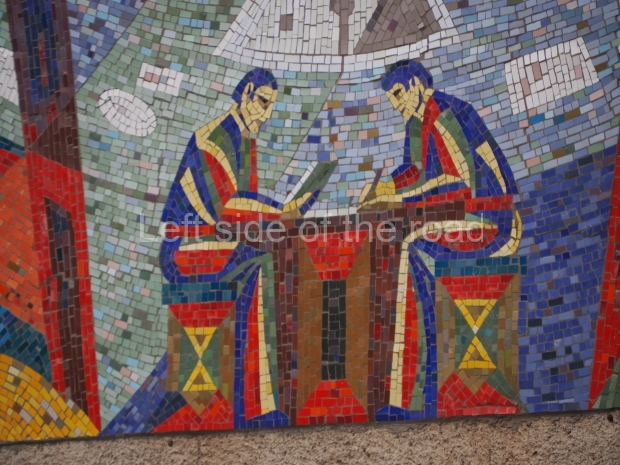
At the bottom of the mosaic, directly beneath the female face, two males sit at a desk. Presumably these are operators in the control room of a power plant, making sure all is correct for the distribution of the power through the pylons being constructed throughout the country. Above their heads, in a sweeping upwards arc, is what looks like the dials that you would normally see on a power plant control panel.
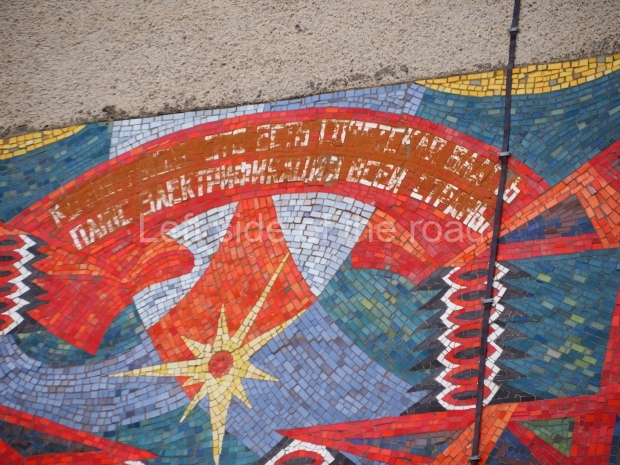
Perhaps the most interesting aspect of this mosaic, at least from the political perspective, is the quote from VI Lenin that are placed at the very top, in the centre.
In Russian;
Коммунизм — это есть советская власть плюс электрификация всей страны
which translates as;
Communism is Soviet power plus the electrification of the whole country
The quote can be found in context in VI Lenin, Collected Works, Volume 31, p516.
More than a 105 years since Comrade Lenin uttered these words at the Eighth All-Russian Congress of Soviets in December 1920 they are considered so incendiary, at least amongst the capitalist/European Union leaning authorities in Moldova, that there has been an attempt to mask that part of the image. They don’t have the courage to directly attack the mosaic so just resort to petty vandalism.
It’s not possible (or at least I couldn’t find an easy way) to get really close to the mosaic but it is still possible to get an overall view of the art work from various viewpoints at street level at the junction. However, from a distance the mosaic looks in a reasonable condition – apart from the crass vandalism of VI Lenin’s words.
Artist;
Aurel David
Created;
1969
Location;
On the side of a building at the corner of Vaslie Lupu Street 18 and Vassarion Belinski Street.
GPS;
47.02220 N
28.80424 E
How to get there;
Trolleybuses 3, 4, 33 35 go along Vaslie Lupu Street. Get off at the Vassarion Belinski Street stop.
From here you are only a short walk from the north edge of Valae Morilor Lake for the VI Lenin monument and on the way to the Colonnades mosaics of activities in the park.
Soviet-era mosaics in Cahul – Gagauzia
Soviet Mosaics – Bălți – Moldova
VI Lenin and Palace of Culture Mosaic – Ribniţa – Pridnestrovie


